
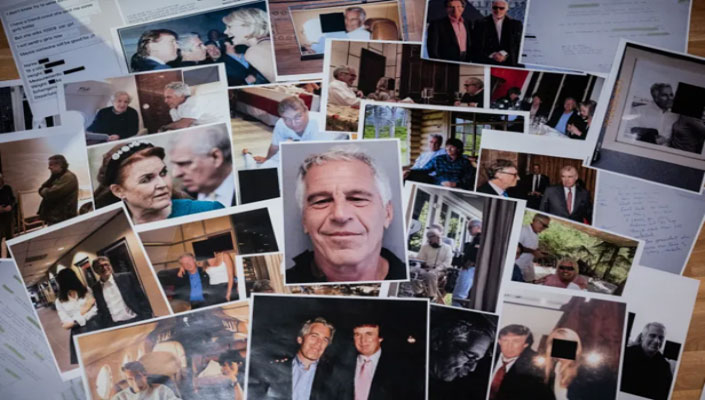
Afrasianet - Noureddine Iskandar - Let's look at how the media covers, how the courts accelerate or slow down, and how accountability works. So we know that Epstein's model is alive and bigger than we expect, and that there are also workers and employees who are doing their jobs to the fullest, but with acceptance and silence.
The world opened its eyes wide as the horrific facts of the Epstein Island affair unfolded, and with each truth that came to light, questions grew as to the horror of the crimes committed. But the media and the public focus was mainly on the identity of the figures involved in these dirty acts, and the appetite of the traditional and new media to use these facts in the context of the political conflict associated with each of these figures was opened. Hundreds of politicians, businessmen, artists, and celebrities in various fields fell in the light of the major scandal, and their news became widely followed and with unprecedented fervor.
Behind this big picture, as each of the characters involved sought to treat the case as an urgent and dangerous case, a dark corner remained at the heart of this scene, and it concerned those who enabled Jeffrey Epstein to carry out his crimes, and who represented the bureaucratic infrastructure necessary to complete each crime in itself.
The "club" of those involved turned into something like a closed cult whose door Epstein opens the door to selected names, or names to be implicated, since the leads that were revealed pointed to Epstein's intelligence connections to a device Israeli intelligence, the Mossad, and that his work over many years was not only driven by moral deviance and a desire to enjoy through crime.
The whole issue is a large, coordinated work, whose people are carefully selected to serve as a result of their implication in the interest of a network of interests, one of the most important of which will be Tel Aviv. Who are these? And why do they lose focus? To what extent does this absence facilitate the idea of helping deviant criminals commit their crimes, without accountability?
Complete evil structure
The moment the entire network was exposed was a rare moment in which a full intent of evil was revealed to the public that had become a permanent working machine, where humanity groaned under screams and in closed rooms, and only a small part of what Epstein himself documented, or of which the victims later spoke about, emerged.
There was calm, organization, and division of roles, which made the whole process seem like a normal routine, or a high-level job, in relation to the level of the characters involved, their lifestyle, and the services they were provided to them.
Beneath the veneer on display, the crux of the case emerged as a human, administrative, and economic network that made abuse a repeatable process, in which bodies were used as a source of pleasure, and in which collaborators were transformed into an organized crime bureaucracy.
Their identities range from the receptionists with their broad smiles, the lures who contact the victims and drag them into the stinking swamp, flight attendants and crews, lawyers who work hard to protect the criminal system from any exposure or prosecution, assistants who organize appointments and facilitate roles, drivers who see children and young women being transported like herds to the altar of crime and bring others back, cooks who prepare the tables of the island's wealthy, and middlemen who trade in the holiest thing on earth.
Alongside these are the visiting personalities who see the crime, commit it, and remain silent about it, waiting for the next journey. All of these are the heart of the issue and not a margin in the story, and they are its necessary infrastructure.
In political sociology, the concept of "bureaucratic evil" is used to describe that type of crime that is not committed out of hatred or individual sadism, but through disciplined professional performance within institutions or networks. These are precisely the concepts that the evil looks like a monster as we imagine it in movies and stories, but rather in the utmost elegance and elegance. Cold employees who perform their roles "professionally and professionally," even to make you think that they are practicing a sacred or high-level mission.
Cruelty is not required. What is really needed is to complete the procedure as if it were a meticulous protocol in an honest business, in which criminal acts are broken down into small tasks, so that no one feels responsible for the whole picture. If one of them is asked about his contribution to the crime, he will say that he is applying the law and the rules of the profession.
This is what a lawyer will do, for example, while an assistant will say that he is following the instructions of his superiors, and the pilot will say that he is doing his usual job and that it has nothing to do with what the passengers are doing, or what the victims are transporting to be exposed to it later, or what they were already exposed to before receiving them on the return flight.
This is about those who have returned, and they are not everyone in any case, after the data revealed murders and ritual practices in which children are sacrificed on the massacres of the secret doctrines of the "elite" of civilization.
The employee here can claim to be doing his job, but the scale of the crime reveals that the perpetrator is the sum of them, from Epstein to his chief assistant Gillian Maxwell, to every doorkeeper who stood up and locked a door, or opened a hallway through which the crime could pass.
In fact, in the execution of this level of crime, there is a clear evil bureaucratic mastery, since breaking down the crime into small parts does not make each part sufficient for conviction, and it does not enable any person involved to possess the full secrets of the great crime. However, it was enough for Nasser to emerge from among them, revealing the tip of a thread, which would have spared a large number of victims the horrors of what they experienced on the cursed island.
Ordinary people can practice satanic evil by simply remaining silent about a single scene that passes in front of them, so how can one remain silent in the suspicion of raping a child, without mere suspicion stirring the human conscience and exposing the whole story?
Thus, every silence about one of the features of the crime is a complete participation in all the crimes, because the commission of one of these types of violations is enough to confirm that the whole chain is moving in the same direction, and that the ambiguity of the place, the guests and the victims dragged there indicate a crime scene full of dirty practices, especially since the matter has been going on for many years, and it was not an interrupted event or a passing sight in which the memory of the details may be absent.
Crime does not need savages, but ordinary people who do their jobs well. But why do these networks work so smoothly? And why are so many participants silent?
Here we enter a more ambiguous private path, which can be called the "moral economy of the elites." The commodity here is the human body, from the most tender to the most eloquent. In the market itself, values are traded, silence is bought by influence, money, threats, repression, but also by temptation.
A network of powerful relationships that leads to the prevention of accountability. The victim is the only party who does not have negotiating capital. His position in this process is a loser in any case, and he is cut off from the world, he does not have sovereignty over his body, in front of those who have control over presidential offices, governments, parliaments, intelligence services, armies, and transcontinental companies. And what can a weak person do in the face of such a system? But our central point here points to a striking paradox.
With the enormity and tyranny of the figures involved and their perverse project, a junior employee standing at one of the doors closed on crime can demolish the entire structure with a word, a picture, or just a leak. This possibility is precisely the door of condemnation for every pawn in the game of major crime.
But these pillars of the crime infrastructure have been distributed across their tasks in the opposite direction. Lawyers are able to turn assault into civil disputes, silence agreements that turn pain into a financial item, and use political connections to obscure any investigation. The media plays its role in deciding when to shut up, when to speak, who to disclose and who to cover.
In Epstein's model, sex was a tool and a document of pressure and blackmail, its secrets stored as a valuable asset for the future. Through this balance, the destinies of countries and peoples are changed, decisions are adopted, and the guarantee of compliance is the crime held by the decision-maker, or those next to him.
The result is to build loyalty networks within the elite world, through shared secrets, rather than shared ideas. The person involved is easy to obey, whether it is to know the information or to participate in the crime. In this way, the crimes are an alternative, informal, transient technique for state institutions to govern globally, and to pick the interest (of the operator with the interest) without going through any bureaucracy within a specific country.
Only from Jeffrey to the implicated, who will come out to support the genocide or to advocate "for the right to self-defense" of another child killer in a remote part of the world. This clearly explains Epstein's association with Israel, for example.
Outside of the power of constitutions, Epstein's power is governed by the wishes of decision-makers, and therefore by their decisions. But back to the filth workers themselves, how did they keep quiet? How did they manage to swallow so much filth?
Crime Normalization Workers
The most dangerous thing about this system is not its top, but its human base, who move, arrange, sign and open doors. It is not normal for all of them to be sadistic. Many of them are ordinary people, they have families, bills, fears... But they learned one basic skill, which turned them into evil souls, which is the separation between function (interest) and conscience, and this is the essence of evil in the administrative field, that is, to perform your role accurately and leave the results to others.
The pilot who did not touch the victim, the lawyer who did not smell the abused bodies, and the muffled assistant who would not speak the truth, are all fundamental pillars of the system, and they have participated in it because they are trusted by the Great Satan who runs the machine. This particular trust is enough to condemn Epstein's group, his people, and his incubating environment.
Over time, abnormal practices become routine, trips are repeated and faces change, but the pattern is constant, and the pattern is enough to uncover any crime. Ordinary detectives in a series of minor thefts of motorcycles or even clothes from the laundry shop look at the pattern. As long as the Epstein people have witnessed the pattern and haven't acted, they're no doubt accomplices in crime.
The first shock that should move the conscience disappears with repetition, and kills the conscience of the weak souls. Then everything becomes normal, and this is what sociologists call "normalization of violation." Choosing not to speak gives the system its legitimacy and normalcy, and silence in turn becomes an investment for violators to expand their crimes, as long as it is safe. But why children in particular?
Why children?
Children are the weakest link in the whole shameful scene. They have no voices, no lawyers, no platforms, no assistants. Their voices are too weak to break through the gates of the place, so how can you get out of an island?
Far from psychoanalyzing the sick phenomenon, which may open the door to new discoveries in the field of diseases, deviations and evils, the children's choice of this role, as a fragile victim, is due to the pleasure of the predatory instinct enhanced by an unlimited level of evil. You may shake yourself if a boy is slapped in a school or on a street, or even by his mother in the lobby of a shopping mall. But you will not find the reaction worthy of kidnapping, rape, murder, torture. These are too horrible to find a suitable punishment.
This leads to an important conclusion, which is that childhood is without real protection in our whole world. You wouldn't be surprised if you say that among the criminals in this case are those who teach/work in the field of humanitarian work! Children don't have networks of relationships and forms of interests.
They are innocent of that, and this innocence is their killing in an environment of meanness. Fragility here is an opportunity that must be exploited, and the right to enjoy and enjoy crime is guaranteed to those who have acquired power, money, influence or fame.
In this case, the crime becomes an institutional act, the head is Epstein or those behind him, but the institution is large and there are many, maybe more filthy workers in it, than we expect. If we want to point them out, let's look at how the media covers, how the courts accelerate or slow down, and how accountability goes. If the facts are obliterated, it means that the filthy people are a majority that are spread around the world.
Epstein is dead, but the model is alive and frightening.!
