
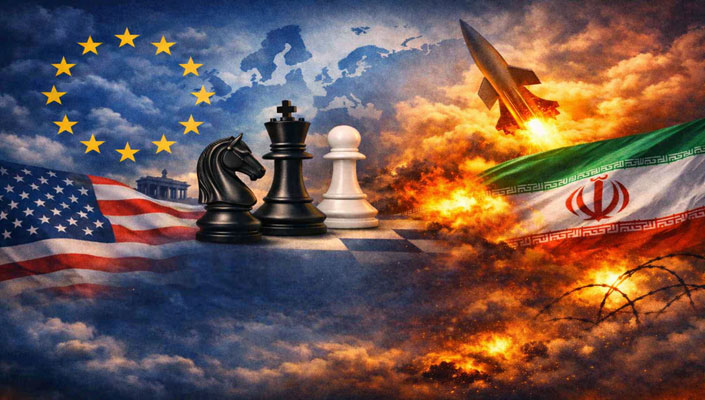
Afrasianet - Mahmoud Al Asaad - Confused Europeans are using media rhetoric to avoid getting involved in the war, to hide the division between them, and to try to cover it up with verbal stances to avoid moving from de facto neutrality to commitment on the ground.
At a pivotal moment in world history imposed by the US-Israeli war on Iran, which began on February 28, many countries of the world and regional political, economic, and military powers and blocs found themselves on the critical threshold of human history and global transformation.
Everyone seemed hesitant or in a state of strategic confusion between sitting on the hill waiting for the outcome of the war, standing by the Zionist-American alliance, or voicing its opposition to it. This confusion seems logical for many reasons, foremost of which is that this war of aggression is led by the United States, which represents the first superpower in the world, and sits on the throne of the economy, finance, technology, and lethal weapons, in addition to its instrument "Israel", which has the most famous criminal record in carrying out dirty missions outside the framework of international and humanitarian laws, in the face of Iran, the rising power in technology and militarily, which mediates the global geopolitics and economy, and intersects through and around it the old old and new trade corridors, and stands On the verge of being crowned one of the most influential countries in the New World.
Despite its decades-long strategic alliance since World War II with the United States of America, whether under the umbrella of NATO or outside it, and under the influence of this hesitation and confusion, the declared positions issued by European countries varied, which cast a shadow on the depth of the division within the old continent, a division that was not born of the moment, as we have already witnessed its manifestations in the wars on Afghanistan, Iraq and Libya. More recently, Yemen, but today it has remained under the collective hesitation of European countries, albeit more expressive of the fragility of the unified resolution.
Declared European positions
It can be pointed out that the British position that was rejecting the war on Iran before it happened, then changed in terms of allowing Washington to use the Diego Garcia military base in the Pacific, before Britain announced the dispatch of two aircraft carriers to the region a week after the start of the war, which Trump met with reproach and blame that is closer to dispensation, while the German position was more enthusiastic in supporting the war on Iran in the words of Chancellor Friedrich Mertz, but this support did not come out of the enthusiastic verbal framework.
On the other hand, Italian Prime Minister Giorgia Meloni declared her country's rejection of her country's involvement in the war, citing its illegality, and Spain's position was the most tough in attacking the aggression against Iran, in the words of Prime Minister Pedro Sanchez, before he was forced to agree to send a warship to Cyprus, after Trump's threats to cut trade relations with his country, while France, its President Macron sent an aircraft carrier to the region under the title of defense to intercept attacks on regional allies in the Gulf and secure trade corridors away from Offensive operations .
Causes of European hesitation and confusion
It seems clear that the confused Europeans are using media discourses in order to avoid getting involved in the war and to hide the state of division among themselves, and they are trying to cover this up with verbal positions to avoid getting out of the state of actual neutrality, to the commitment on the ground with the American ally.
First, the tacit desire of European countries to involve Trump after he adopted the slogan "America First", endorsed the "Trump Principle", which closed Latin America to Europe, and demanded that Europe adopt an independent strategy to protect itself instead of the United States protecting it under the umbrella of NATO, as Europe found itself confronting Russia on the Ukrainian scene while Trump effectively excluded it from the negotiations.
Second, Europe fears that its economic crisis will deepen, both as a result of the costs and financial burdens that will result from its participation in the war, and as a result of the potential targeting of European investments in the Middle East, in the event of its involvement in the war against Iran.
Third, Europe seeks to mediate in order to stop the war and not prolong it, because it has caused a rise in energy prices (oil and gas), as the increase has so far reached about 16-20%, which will constitute an additional burden on the European economy and on the costs of production, services and living.
Fourth, Europe has already announced a plan to abandon Russian oil and gas until the beginning of 2027, and fears that Russia will take advantage of the interruption of energy supplies from the Middle East due to the war, and put pressure on Europe before that date and exploit its need for energy sources to change its position on the conflict in Ukraine and other Eastern European files.
Fifth, Europe is aware that Iranian missiles and drones that have reached the island of Cyprus can target energy facilities, including production or transportation in the Eastern Mediterranean, which means depriving Europe of additional energy supply chains, and Iran has already threatened that Europe's involvement in the war against it will be met with a violent response.
Sixth, Europe is acting opportunistically, and it is aware that the current war will, at a minimum, weaken Washington and Tel Aviv politically in the Middle East, which will allow it to fill the resulting political and diplomatic vacuum, which will strengthen its position in the framework of the transformation that the Middle East is witnessing on a new geopolitical basis .
Seventh, in light of Trump's tariff policy in dealing with countries around the world, including Europe, European countries that seek trade networking with China fear that the current war will accelerate a US-China trade agreement at their expense as one of the results of this war, or at the very least, increase production costs, which will put them in a weak position vis-à-vis the Chinese partner in any previous or future trade agreements.
Eighth, Europe fears that the current war on Iran will take a long path leading to a global economic collapse, in which it will be the biggest losers, after decades of growth and prosperity in services and living.
Ninth, Europe views the war with Iran as a front of attrition and preoccupation with the main arena of conflict for it, namely Ukraine, which has been inventing provocations to hinder the US withdrawal from the Ukrainian arena, and therefore the war on Iran may be a decisive factor in resolving the conflict in Ukraine in favor of Russia.
Tenth, the internal factors cannot be overlooked, as the phenomenon of Islamophobia has been one of the factors of concern within European societies due to the biased positions taken by Europe over the decades on the issues of the Western and Muslim worlds, and in light of the rise of the European right, European societies will be exposed to more internal divisions that contradict the declared European values.
In conclusion, it can be concluded that Europe, in the face of this new global entitlement, is proving once again that it needs to advance itself without the need to be dependent on the United States, and that its path to achieving this is still long, and it cannot be certain that it will succeed in achieving this, especially since it currently lacks the factors of military and economic independence, and the safest option for it today is to seek to stop the American-Israeli war on Iran as soon as possible.
