
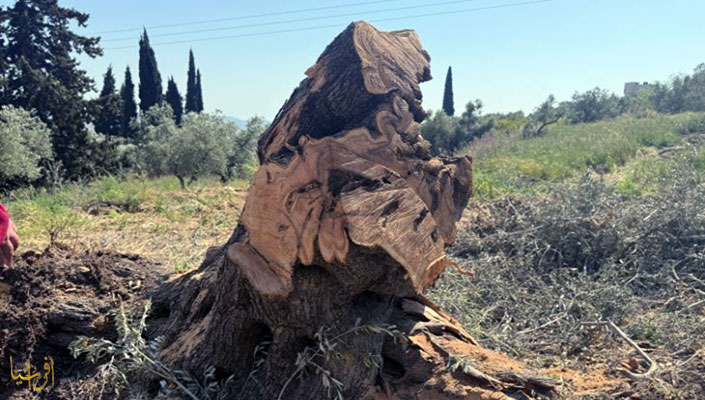
Afrasianet - Ola Mohammed - On the main road between the cities of Nablus andJenin in the northern West Bank, and at the entrance to the town of Cyrenaica, which is in the middle of the two cities, the Israeli occupation uprooted dozens of cypress, fig, almond and citrus trees, in the vicinity of Fadi Massoud's house.
According to locals, the bulldozing hit perennial Roman olive trees, which were not just a source of oil, but "family members" bearing the names of their ancestors and details of their lives, before they suddenly turned into rubble under bulldozer tracks.
When the bulldozer finished its work, and there was not a single olive tree left to shade the ground, an Israeli officer approached Fadi Massoud and his seven neighbors standing in front of the remains of their trees, and told them in one sentence that summed it all up: "We hit you with your dearest possessions, something very dear to you, we hit you with the olive tree."
In that sentence, which was made after the tracks of the massive D-10 military bulldozer ran over hundreds of years of roots in minutes, lies the essence of what happened in the village of Cyrenaica, northwest of Nablus, on April 27.
Every tree has a story
According to the testimonies of three villagers, the "security argument" that was used as a pretext for uprooting was not the real motive, but rather the blow that was "very dear" to them and to the memory of a Palestinian association.
In that operation alone, the occupation uprooted about 500 trees, dozens of them Roman olives that are more than hundreds of years old. But the numbers don't tell the story, which is that each of these trees had its own biography, a name, a face, a memory, and 4 generations that passed under its shade.
In the West Bank, the razing of the olive tree is not only described as an agricultural loss, but as part of a systematic process of "erasing memory" and uprooting silent witnesses to the history of the land.
The story of the Massoud family with the land began in 1955, when the grandfather laid the first brick of the house and planted various types of trees around it in the area, originally known as "El Geneina". Fadi Massoud says that the "olive trees" predate the construction of the house centuries, and they stood as a witness to the change of times.
Massoud continues his speech while standing among the remains of the shattered trunks: "The olive trees existed before the house, my grandfather built the house between 1955 and 1959, and the olive was here before, it is hundreds of years old, so it was called the garden, from the word paradise."
Generations of hope and work have been inherited
On this land, 4 generations of the family had known each other through trees, the grandfather planted a cypress that rose 8 meters above the roof of the three-story house. The father, who died two years ago, planted figs with his own hands, and when he did so, people would say to him, according to Fadi, "Your life will not bear fruit," and he replies, "I do not plant them for myself, but for you and your children to eat from them."
These fig trees grew so large that in his last years, the father began to pick their fruit from the second-floor balcony, reaching out and picking up the figs he had planted himself decades ago. This photo was recently erased by the occupation, as "about 12 fig trees" were among those uprooted.
In this land, farming was a family ritual, Fadi says: "On holidays, we would all go down to the perimeter of the house where the garden was, plant trees, put compost, and prune diseased branches. The tree is like a little child we take care of, and the older we get, the more we fear it."
Today's visual comparison between the Massoud family's former "paradise" and the current scene is a comparison between life and nothingness. While cypress trees swayed tall and olive trees covered the ground, the occupation bulldozers left behind nothing but dust from the ruined stone fences and broken branches that had been deliberately trampled to prevent their replanting.
Blur 300 years
Meters away from Fadi's house, on the opposite side of the main street, stands another land owned by Salama Shabib, an expert and agronomist who knows the history of every tree on his plot as well as the dates of his children's births.
Salameh stands under a tree that survived the uprooting, shaded by it, while the trunks of the uprooted neighbors pile around him, "Most of the trees that were uprooted are the heritage of our fathers and grandfathers," Salameh says. "By looking at the trunk of these trees, it turns out that it is almost 300 years old, and the rest of the trees were planted successively according to the rule of popular wisdom: plant and we eat, and we plant and they eat," he adds, referring to a cut trunk.
As an agronomist, he puts the safety of loss in the right context. "The olive tree has a great economic impact on us, but it is worth nothing compared to the ages of these trees, and the obliteration of our identity, history and memory in this place," he said.
For Salameh, like all Palestinians, the tree acquires a third dimension, in addition to the family and religious dimensions: after the historical testimony, the tree is a witness in his vision, and he says: "The existence of this tree proves us in this place, and proves to the whole world that it is hundreds of years older than the age of the occupation."
This particular land, Salameh says, was planted with pear and pomegranate trees before the people settled on olives, "because they do not need care compared to other crops".
And all those layers of agriculture – pears, pomegranates, olives, were a memory accumulation and a living archive open under the sky, and then the bulldozer came along and wiped it all out in a few minutes.
Away from security pretexts
What happened in Cyrenaica is not an isolated act, but a link in a systematic plan that can be read on a map as soon as you see it, as this area has been systematically targeted since the 1970s .
In this context, Diab Massoud, an anti-settlement activist from Cyrenaica, describes what happened as an "environmental disaster" and says: "All the land on the right side of the entrance to the town was subjected to continuous bulldozing, but the latest attack was the largest and most cruel, as a group of lands containing hundreds of perennial trees such as Roman olives were bulldozed."
The vandalism did not stop only at the fields, but also on the trees inside the walls of the houses and on their fences, where part of them were bulldozed and the residents were forced to cut down the other part at gunpoint.
Diab pointed out that invoking "security arguments" is nothing but a cover to justify the restrictions on the residents and the destruction of their lives to force them to leave and forcibly displace them from their lands, in the complete absence of any role for the Israeli courts, which have refused to take any action to protect the rights of Palestinians.
A broader plan for water and land
Regarding the broader framework of these attacks, Diab pointed out that what happened is closely linked to the settlement expansion plans in the area, especially after the return of the settlers to the settlement of "Homesh", which was evacuated in 2005 by a unilateral decision implemented by the government of Ariel Sharon , which included the evacuation of the settlements in the Gaza Strip and five settlements in the northern West Bank.
He added that the settlement activity is witnessing an accelerated expansion over vast areas estimated at thousands of dunams, exceeding the previous borders of the settlement, to include lands located between the towns of Bzaria and Cyrenaica, within a total area of about 6,000 dunums (the dunam is equal to one thousand square meters).
Not only on the land, but settlers also took control of Ain al-Dalba, a historic water source that has been feeding Cyrenaica since the 1960s, and provides about 30% of its water needs, according to Diab.
He warned of the extension of the "settlement incursion" from Area C, which is under full Israeli control according to the Oslo Accords, to Area A, which is supposed to be under Palestinian administrative and security control, as well as Area B, which is administratively under the Palestinian Authority's administrative control.
He pointed to the establishment of a new outpost on the "Badas" hill, which is in the middle of Cyrenaica and the surrounding villages such as Ramin and Bazaria, within areas classified "A", in a move aimed at controlling an additional 5,000 dunums.
The hill includes lands belonging to farmers, in addition to a number of projects belonging to a national company, and a treated water tank belonging to the Nablus municipality, which puts the lives of farmers in constant danger, Diab stressed, adding that "the settlement plan aims to confine Palestinians only to the vicinity of their homes."
Deep wound
Diab said that the deliberate targeting of the olive tree in particular leaves a deep wound in the Palestinian psyche that cannot be healed, as this tree "is the heritage of the ancestors and fathers, and the relationship between the Palestinian farmer and his oils reflects an inseparable spiritual and emotional connection."
The scene describes the moment Israeli bulldozers stormed the ground: "Everyone cried silently. The elderly, women, and even children, because they feel that there is a direct attack on their soul, heritage and Islamic and Arab history."
He added: "This act is not just the removal of vegetation, but it is a systematic crime aimed at destroying the steadfastness of man by striking at the holiest thing he owns in his land, which is the blessed tree that has provided him with shade, food and safety since the dawn of history."
Diab described the scene as a summary of the essence of what is going on, stressing that this targeting is a "war of the novel", as the occupation is trying to obliterate the Palestinian memory represented by the Roman olive trees that extend for thousands of years, and their existence is the conclusive and living proof of the authentic roots in this land, and the witness that denies the narrative of the occupation, which is only seventy years old.
Therefore, the settlers see this tree as a "spear" to counter their claims, because it proves to the world that the Palestinian has been here for 4,000 years and still holds on to his land.
Diab concluded by explaining that the attempt to uproot the olives in Cyrenaica, Beita, Al-Mughayyir, Al-Laban al-Sharqiyah and other villages in the West Bank is nothing but a desperate attempt to remove "the historical witness from its place, in an effort to falsify reality and formulate a new narrative that is devoid of the real owners of the land."
Uprooting in numbers
In April alone, the Israeli army and settlers targeted 4,414 olive trees by poisoning, uprooting and vandalizing (2,169) in Hebron governorate, followed by Ramallah and Al-Bireh with 1,170, and Nablus with 740. Settler attacks since the beginning of 2016 have reached an attack.
Behind these figures are the stories of farmers who lost their livelihood and memory in moments, after these trees accompanied the details of their daily lives and annual seasons.
With the repetition of the scene in more than one area, from Nablus to Ramallah and Hebron, one pattern of targeting is perpetuated: in each location there is a land such as "El Geneina", a family like Al Massoud, and a perennial tree that uproots the story of 4 generations.
According to cumulative figures in the reports of the Palestinian government's Anti-Wall and Settlement Commission, the occupation uprooted, destroyed, and poisoned at least 120,000 trees in the West Bank from 2020 until the end of April.
The data reveals that the targeting of olive trees takes an upward curve, as in 2020, 16,507 trees were uprooted and destroyed, the number increased to 22,108 in 2021, and a relative decline in 2022 to 10,291 trees, and 21,731 trees in 2023.
With the escalation of attacks in October 2023, the numbers rose again in 2024 to reach 14,212 trees, including 10,459 olive trees, before peaking in 2025 with 35,273 trees uprooted and damaged, including 26,988 olive trees, more than double the previous year's total.
During the first four months of 2026, the occupation uprooted more than 9,000 trees, including 6,700 olive trees, including 4,414 trees during April alone.
