
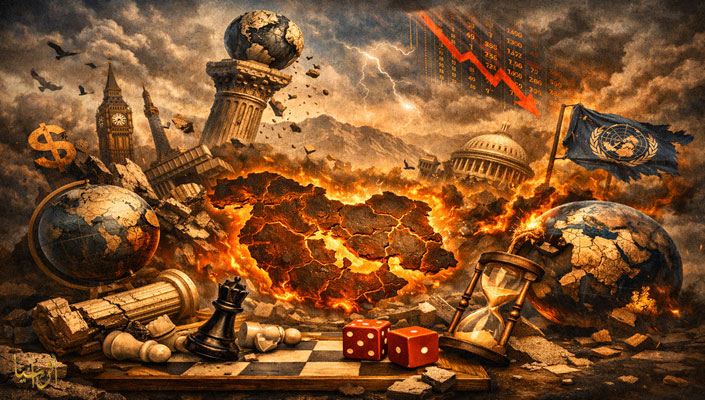
Afrasianet - Zuhair Al Sharman - There is no solution for the region, especially the Arab countries, except to consolidate collective security, as it is no longer acceptable for the Arab countries, especially the Gulf countries, to rely on the United States to ensure their security, as proven by the war on Tiran.
The same applies to the economic situation.
In this regard, Mr. Zuhair Al-Sharman writes: "The Middle East no longer lives within a well-defined international order as was thought after the end of the Cold War, but has become part of a world moving towards turbulent multipolarity, in which major powers compete economically, technologically, and militarily, and in which trade, energy, finance, and supply chains are used as tools of influence no less important than armies, and in such a world, geography becomes not only a destiny, but also a permanent risk, especially for a region located at the heart of the roads Trade, energy, sea lanes, and conflicts are all at the same time.
What we are witnessing today is not just a change in the balance of power, but a gradual decline in the rules of the existing international system and perhaps the beginning of the end of this system as the world has known since the end of the Cold War.
In this world, the major countries can withstand shocks, exert pressure, and reshape the system to serve their interests, because they have huge markets, military capability, technology, influential currencies, and alliance networks, while the countries of the Middle East, especially the medium and small countries, do not have the luxury of clash or the luxury of isolation at the same time, and therefore find themselves forced to manage the balances very carefully, not only within the region, but also between the competing global powers.
Over the past decades, most Middle Eastern countries have relied on an unwritten equation based on security versus political stability, oil or geographic location versus international protection or support, and economic openness versus integration into the global system.
The world is now moving towards what can be called a world of risk reduction rather than a world of full globalization, the major countries are no longer looking only for economic efficiency, but for strategic security, they are no longer looking for the cheapest resource, but for a supplier that cannot be turned into a pressure tool, and they are no longer looking for the fastest supply chain, but for a supply chain that can be controlled in times of crisis, this transformation will directly affect the Middle East in the coming decades.
For the Gulf countries, the biggest challenge will not only be in oil prices, but also in the position of oil itself in the global economy, as the world will try to diversify energy sources and reduce dependence on one region, and this means that the Gulf countries are moving in the right direction when they invest in industry, tourism, logistics, technology and renewable energy, because power in the coming world will not be measured only by what is underground, but also by what is produced above it in terms of knowledge, industry, technology and services.
Countries like Jordan are not oil countries or major military powers, but they are located in very important geographical locations between the Gulf, Iraq, Syria, Palestine, and Egypt, that is, at the heart of the network of crises and trade routes at the same time, in the new world, countries that are located on trade, energy, and communication routes can turn into logistical, financial, and technological transit countries if they exploit their location well, but this requires a productive economy, effective institutions, good education, and an investment environment. stable.
The main problem in many Middle Eastern countries is not only the lack of resources, but also the weakness of economic productivity, countries that do not produce technology, industry or knowledge will always remain in a subordinate position in the world system regardless of their political alliances.
In the past, sovereignty meant control of borders, but today sovereignty means economic resilience, a state that can be pressured by cutting off energy, finance, markets, or technology, is not a fully sovereign state, no matter how strong its political rhetoric, sovereignty in the 21st century has become more tied to energy, food, technology, supply chains, and finance than it is to borders alone.
The Middle East today faces a historic choice, either to remain an arena of competition for the major powers, or to turn into an interconnected economic, logistical and industrial cooperation zone, as international experiences indicate that regions that trade with each other, invest with each other, and link their infrastructure to each other become less prone to wars and more able to negotiate with the major powers.
The future of the region will not only belong to those who own oil, nor only to those who own weapons, but also to those who have a productive economy, good education, stable institutions, balanced relations, and the ability to adapt to a rapidly changing world, the new world does not ask countries whether they are big or small, but only one question, can they rely on themselves when the rules change, the countries that can answer yes will remain stable and influential, while the countries that cannot will always remain afraid of any change in the world.
