
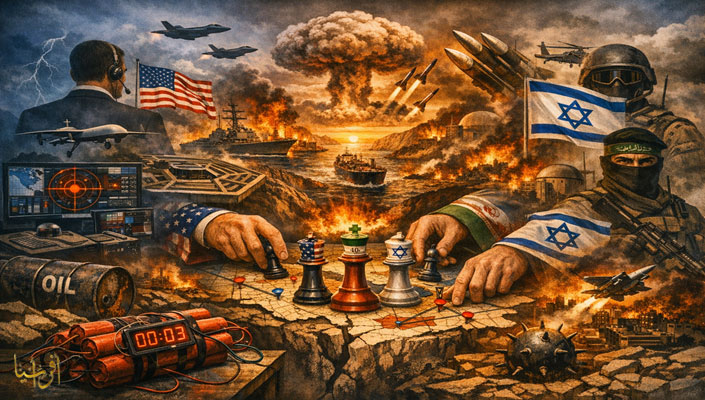
Afrasianet - Hassan Lafi - The bottom line of the American position is that it is not conducting a normal war, nor traditional negotiations, but negotiations under fire, and in the area of the critical point that may move the war to the stage of no return, in order to increase the pressure on the Iranians.
After more than three weeks of war on Iran, the scene is turning into a sensitive stage between the possibility of military escalation and entering more dangerous and broader phases, and the attempt to impose a political settlement that stops the war within a general framework for renegotiation.
In this context, all sides are moving in a complex pressure game rather than separate tracks, and hence reading the positions of the parties becomes an urgent necessity to know the future course of the war.
The American Position
President Donald Trump's position is still murky, playing his favorite game, through contradictory statements, and playing on the gap between intentions and reality on the ground.
At a time when the start of a negotiation process with Iran is being announced and a plan to end the 15-point war is being presented, the reality on the ground is witnessing more military buildups, and the transfer of ground forces to the region under the threat of occupying the island of Kharaj, the main artery for Iran's oil exports, with the possibility of land control over some of Iran's coastal areas overlooking the Strait of Hormuz.
At the same time, President Trump's two previous experiences in 2025 and the current war with Iran open the door to the possibility that the entire negotiation track that Trump is talking about is just a tactical cover to buy time and complete preparations for a broader military operation, while avoiding a sharp rise in oil prices, and creating an internal political and media environment that justifies any subsequent escalation, by blaming Iran for the failure of the diplomatic track.
What reinforces the skepticism of Trump's intentions to negotiate is that ending the war under the current balance of power is an important victory for the Iranian regime.
First, the overthrow of the regime by force did not materialize as Trump and Netanyahu had planned.
Second, the U.S. deterrence image toward Iran will decline significantly, proving to be a difficult figure in the region that cannot be subdued by military force.
Third, Israel and the idea of a "Greater Israel," its expansion in the region, and the imposition of rules of engagement by coercion on the region, especially Lebanon, will be significantly reduced.
Fourth, the Gulf, after this experience, and with it the Arabs in its entirety, will come to the conclusion that their national security cannot depend on the American capability and its bases in their regions, but that Arab national security must be in the hands of the Arabs themselves and not others, as experience has proven that there is no ally for America in the region except Israel.
Fifth, Iranian oil will be restricted in order to compensate for the oil reserves lost by major countries during the war, including American reserves, in addition to the fact that some countries will work to find solutions with Iran, away from American pressure on the release of Iranian funds frozen in their possession.
Sixth, America's position in the world vis-à-vis China and Russia will decline significantly, especially in the Middle East, for which the United States considers its exclusive sphere of influence.
On the other hand, the war has turned into a war of attrition, the consequences of which cannot be predicted and the loss of the ability to control it, similar to the Vietnamese experience, is more dangerous for the American than going to negotiated solutions in the absence of the ability to make a military decision.
Therefore, the bottom line of the American position is that it is not conducting a normal war, nor traditional negotiations, but negotiations under fire, and in the area of the critical point that may move the war to the stage of no return, in order to increase pressure on the Iranians.
Israeli Position
Although Trump's 15-point document is good for it, Israel's concern that it will turn into a negotiating ceiling is diminished by negotiating into a "bad deal", and thus Israel's concern is not just a political rhetoric, but an expression of existential concerns related to Iran's ability to possess nuclear weapons, warnings that the agreement may leave Iran with enough enriched uranium to produce 11 nuclear bombs, and ballistic missiles that threaten Israel's entire geography, will once again put Israel in the face of the problem In the sense that it did not achieve a strategic achievement with regard to the map of threats surrounding it after two wars with Iran, but rather the agreement came as an American and international declaration of Iran as a regional power that cannot be overcome even by military solutions.
Despite this dilemma, Israeli officials' statements that "Israel has no choice but to go along with Trump," despite a preference for continuing attacks, reveal a strategic dilemma. Israel finds itself forced to adapt to U.S. policy, even if it contradicts its immediate security vision, in order to maintain vital U.S. support.
This situation may prompt Israel to look for alternatives or strengthen its own capabilities to deal with the Iranian threat if it feels that the agreement does not meet its security requirements. This is in contradiction to its basic strategy of turning Iran into a global and regional threat that requires the United States to form an international-Arab coalition to fight it.
Iran's position
Iran is sending through the field that it is not in a hurry to end the war unless it meets its basic conditions, the most important of which is to ensure that the war against it will not be repeated in the future, as there is Iranian skepticism of the American intentions to negotiate, so its cautious treatment and its public rejection reflect an awareness of the possibility of using negotiation as a tool of pressure and not as a real path.
Iran is aware that there is another aspect of this war, which is the ability of the internal front of the parties to be resilient, and here Iran, with its area, geography and the nature of its people, is more resilient and resilient, on the other hand, the Israeli internal front with its narrow space and luxurious Western lifestyle.
Not to mention that the Iranian equation is trying to impose a price and cost on the American economy, and the whole world by playing on closing the Strait of Hormuz and disrupting the energy supply, so that the whole world becomes a pressure factor on Trump to stop the war.
But this equation also carries with it a risk, as this step forces the world to ally against it and form an international coalition under the banner of opening shipping lanes and protecting oil supplies.
Here, international and regional positions emerge, which are very cautious not to slip into the mud of this war, which many consider to be not an inevitable war, and therefore there is a relentless effort to find a political way out of it, through mediation efforts between the United States and Iran.
In general, the war stands at a decisive turning point, but its course is not decided by the decision of only one party; although Donald Trump holds the key to the greater escalation, the direction of the war will be determined by the interaction of the decisions of Washington, Tehran, and Tel Aviv together. The negotiating track remains a formality, as it has not yet been tested, but it may hide the preparation for a broader phase of escalation.
But, in summary, we are facing a scene governed by four main facts:
1. The swift military decisiveness failed.
2. The diplomatic track has become a necessity rather than an option.
3. The shape of the next agreement, if it occurs, will be less than the ambition of Israel and the United States.
4. Iran's ability depends on absorbing blows, no matter how painful and costly, and continuing to pay a price for its enemies and increase pressure on them in all possible ways and at all levels.
