
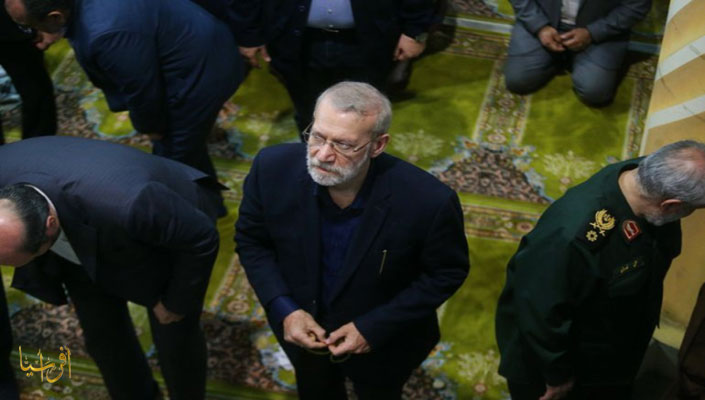
Afrasianet - In closed and complex regimes, getting rid of the strongmen in the heart of power does not necessarily weaken it in the direction the opponent wants, but may rearrange it more rigidly.
From this angle, the targeting of Ali Larijani does not appear to be just a security development related to the fate of a senior official, but rather a revealing moment for a further question: Does this war really weaken Iran , or does it push it to hand over its decision to the more hardline current?
At first glance, the answer seems simple: whenever Tehran loses prominent figures within its regime, it comes close to being exposed, but Iranian policy does not work so simply: Hardlining within the Islamic Republic is measured not only by the intensity of the rhetoric or the degree of hostility toward the United States and Israel, but also by the way the conflict itself is managed:
Is it governed by the logic of the state that negotiates when the need arises, or by the logic of the doctrine that sees negotiation as an unforgivable structural concession?
It is precisely here that Larijani's significance comes to light, as he was not a moderate in the Western sense, but he was one of the most prominent pragmatic conservatives within the regime. He held sensitive sovereign positions, led the nuclear dossier at a very complex stage, and later returned to the secretariat of the Supreme National Security Council in August 2025 after the Twelve-Day War.
In this way, he was not just a name in the state bureaucracy, but one of the minds who know how to mix the rigidity of the regime with the calculations of the state, with the necessities of deterrence and the requirements of negotiation.
For years, Larijani has represented a "disciplined" mind within the Islamic Republic. Although he is sometimes classified as a "moderate conservative," he has remained transitory, able to maintain ties with distant centers of influence within the regime.
Even at the height of the estrangement between former Supreme Leader Ali Khamenei and former President Akbar Hashemi Rafsanjani, Larijani maintained a strong relationship with the two men.
With the exception of his sharp feud with former President Mahmoud Ahmadinejad, he tended to manage internal disputes with political tolerance and flexibility, rather than to break balances or go to the brink of clash.
When the Guardian Council rejected his candidacy for the elections twice, he did not act as an outsider to the Islamic Republic, but as its son who objected from within it, responding with a lengthy political legal letter, in which he refuted the justifications for the exclusion and called for correcting the course without breaking with the regime or questioning its legitimacy.
Even his objection carried the language of those who want to renovate, not demolish the house. In addition to his political position, his presence has also strengthened his family position, as he is the husband of Farida Motahari, the daughter of Ayatollah Morteza Motahari, one of the most prominent founding fathers and ideologues of the revolution. He is also the brother of Sadegh Amoli Larijani, the current head of the Expediency Council and former head of the judiciary.
Therefore, the absence of a figure like Ali Larijani does not necessarily mean that Israel has removed an adversary that could be succeeded by a face closer to the West, but it may mean quite the opposite: reducing the space in which the pragmatic current has been moving within the regime, and opening the way for those who see any settlement with Washington as nothing but a prelude to greater concessions.
It is in this vacuum that Saeed Jalili, Iran's Supreme Leader's representative on the Supreme National Security Council since 2008, stands out: he is not just a traditional conservative, but one of the most hard-line faces of the hardliners. His name has been associated with a more anti-Western vision, and less inclined to any political or negotiating openness.
In the eyes of this movement, dialogue with Americans is not seen as a tool for managing balance or reducing costs, but rather as a gradual path to loss. Therefore, the rise of Jalili or those who think like him does not mean just a change of names within the ruling elite, but rather a shift of weight within the regime from conservative pragmatism to ideological rigidity.
Herein lies the grand paradox. A war that is supposed to drain Iran could give this current everything it needs to move forward: fear, ideological mobilization, security legitimacy, and the justification for excluding the most cautious voices within the state.
Wars usually do not reward those who are good at turning corners, but rather those who maximize the cost of retreat, presenting clash as a fate rather than an option.
In the case of Iran, this rule is clearer. The more the logic of confrontation expands, the greater the presence of the security and military establishment in decision-making, and the narrower the space available to men of balances and compromises. In such a climate, pragmatists do not rise up, but those who believe that maximum toughness is the only way to survive, and that any flexibility can only be read as weakness.
The bet that the assassinations will produce an Iran "less dangerous to Israel" seems misguided. Weakening the moderates does not necessarily lead to a more flexible or closer system to diplomatic calculations, but may lead to a more closed-minded, less willing to negotiate, and more inclined to manage crises with military and security tools alone. The war has not reduced the "Iranian problem" as Washington describes it, but has reproduced it in a more difficult form.
This is precisely what gives Larijani's targeting significance beyond the elimination of a senior official, as with his negotiating experience and ability to move between institutions, he was part of the balances that prevent the most rigid school from being isolated from the entire scene.
When this type of personality is removed from the equation, the message that takes root within the regime will not be that pragmatism has saved its owners, but that wartime leaves room only for the most radical and the most prepared to confront to the end.
Therefore, the most important question is not whether Israel succeeded in assassinating Ali Larijani, but who will inherit his political place if he is absent.
If the answer is the expansion of the influence of the current represented by Saeed Jalili, the world will not be facing a weaker Iran, but rather a more rigid, less compromise-oriented, and more convinced that force is not a last option, but a first option.
This is the paradox that Israel may discover belatedly: assassinations that appear to be tactical successes may become, strategically, a recipe for the rise of the most radical within Iran.
When the pragmatic conservative disappears from the scene, it is not necessarily someone who is closer to America, but rather someone who sees that America itself is only confronted with the language of force, and that negotiating with it is just another name for losing.
The war would not have "opened a door to a solution," as Washington and Tel Aviv say, but would have closed one of its last doors.
