
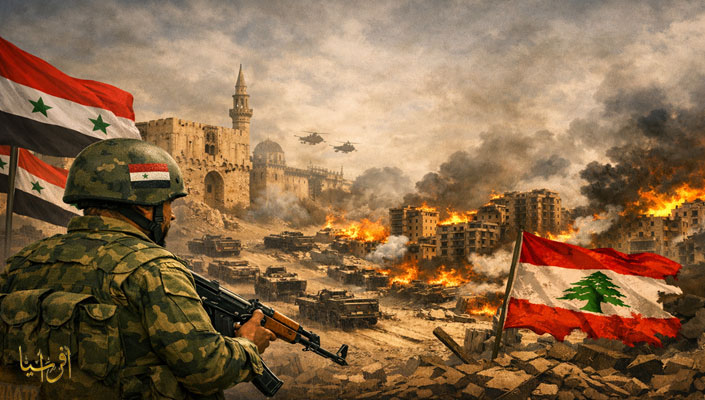
Afrasianet - Oraib Al Rantawi - Interest in Syria's position and role has recently revived in the wake of political developments, which began with President Al-Shara's departure from the "text" he has been accustomed to since he took power in Damascus, and his involvement for the first time in the corridors of the internal Lebanese file.
The debate over Syria's position and position under its new leadership of the US-Israeli bilateral aggression against Iran, and its extensions and repercussions, occupies a high place on the agenda of the political and media elites in the region in general, and Lebanon in particular. Most of this debate takes the language of mutual accusations and resorts to the vocabulary of propaganda and media wars, the most important of which takes place behind doors and behind closed doors.
Talk of a possible "Syrian role" in Lebanon has not yet begun, but has jumped to the surface since Trump's envoy and personal friend, Tom Barak, launched his naïve "Orientalist" statements about the "Sykes-Picot mistake" and the "curse of the modern Oriental nation-state," to the point of discovering the need to redraw the maps of the region, according to the lines of sects, sects, races, and ethnicities, horizontally rather than vertically, and to propose, in a moment of clarity, to re-"commit" the failed Lebanon to a successful Syria, under its young, "courageous" and "resolute" leadership.
Barak, in statements that he continues to repeat, even after he has raised his hand about Lebanon (some in Lebanon still nostalgia for him and summons him from time to time), tried to "deepen" the positions of his master in the White House, who the more he shows his disdain for Lebanon and its leadership, the more he praises the new Syria. The envoy recalled the history of the Levant as he read it flat in the hastily prepared brief intelligence reports, looking to the future, from the perspective of the "art of the deal" of his president, who was never known about him, his attachment With thought, knowledge, or history.
However, interest in Syria's position and role has recently revived in the wake of political and field developments, which began with the departure of the interim President Ahmed al-Sharaa from the "text" that he has been accustomed to since he took power in Damascus, and his involvement, for the first time, in the inner circles and corridors of the Lebanese file, from the gate of supporting the state in its project of "disarming Hezbollah" and eliminating the militias, and through direct contacts with Lebanese components, including (Gemayel and Jumblatt) in restoring some chapters of the Assad regime's experience in dealing with Lebanon with a "piece", which is He has previously expressed his "disapproval" of such practices, and his preference for the formulation of a "wholesale" relationship with Lebanon, "from one state to another."
These statements and communications coincided with information about military build-ups carried out by Salafist militias, mostly Asian, supported by units of the regular Syrian army, some of whose units have not yet dislodged the militias they were a year or a little more ago, which raised great concern.
Crowds that were said to be precautionary at times, in response to harassment carried out by Hezbollah in border areas at times, and in anticipation of the possibility that the party would open a new front on Lebanon's eastern border, as if the party was not enough to be exposed to the lava of fire that it is exposed to from every deep crack.
Is history repeating itself?
Al-Shara, which has only been in power for a year or more, is trying to burn the stages and distances that the Assad-father regime requires years to cross, in order to enter the folds and corridors of the thorny Lebanese file, and although it has major problems inside Syria, which has not yet recovered from the tails and repercussions of the decade of fire and destruction that befell Syria, it does not seem mind "jumping forward", or rather, "jumping out", in search of exits and solutions to internal crises, thinking that it has a role to play In Lebanon, governed by the ceiling of the U.S.-Israeli project, it can strengthen its regional position, provide it with legitimacy that it has not yet enshrined at home, and qualify it to ensure the permanence and stability of its "throne."
He was not provoked by Israeli helicopters loaded with elite Israeli soldiers who crossed Syrian airspace and unloaded their cargo in the "Nabi Sheet" and the Eastern Chain, and did not see it as a breach of the walls of Syrian sovereignty, but rather provoked in an interesting way, indiscriminate shells, which may have fallen here and there, in the battle of confrontation with Israeli ground "landings"... The walls of sovereignty are worthless when they are demolished by Israeli planes and patrols on an almost daily basis, and they were spread throughout Syria, all the way to the General Staff Command in the heart of Damascus, and the walls of the "People's Palace" that he inherited from the ousted president, but a few shells in the opposite direction are enough to declare the enemy and mobilize forces and militias, in defense of a wasted sovereignty.
We are aware that between the Sharia and its "body" on the one hand, and Hezbollah and Iran on the other, there is a sea of blood, hatred and a "sectarian seismic fault", and we are also aware that there are accounts under liquidation with every trace or presence of the party on Syrian soil, even if it is an ammunition depot or a tunnel that houses weapons. But for the Syrian army and its "auxiliary forces" to mobilize in the east, while six Israeli military divisions are mobilized and hundreds of thousands of reservists are called up in the south, is reprehensible and alien to any "Islamic", "nationalist" or "nationalist" reference.
We do not understand President Al-Shara's call to both Sami Gemayel and Walid Jumblatt, except as a message of reassurance to Lebanese components whose counterparts in Syria have not yet been reassured by the new rule, neither in Suwayda, the coast nor east of the Euphrates, nor in the Christian neighborhoods spread in most Syrian cities. We see it as an attempt to prelude and pave the way for roles that may come in the coming days and circumstances, and in an effort to "neutralize" some of the Lebanese, after securing the loyalty of some of them from the same sectarian fabric and "others without them."
This approach is difficult to understand politically and on the ground, in isolation from the calculations and arrangements of the "post-war on Lebanon" phase, which is characterized by a growing international conviction of the state's inability to enforce the "exclusivity" decision, and the fears of some about Israel's inability to accomplish the mission by brute force, despite the enormous disparity in the balance of power, and the heavy tax paid by the party, its environment, and Lebanon as a result of the genocidal war that has been extending for the third week in a row, which is likely to expand and prolong in space and time.
The "strong president", and the description of President Trump, seems to be qualified from the point of view of some Western circles (especially the United States) to respond to the projects of obligation to Lebanon to Syria, especially if the ongoing consultations and contacts behind the scenes between Damascus and Tel Aviv end in an agreement between the "Ibrahimiyya" cloth, even if it is "inlayed" with additional bright colors.
Let us recall that Assad Sr. was not a friend of the Israelis, and he had just come out of the October 1973 war, when he got the green light, the American-Israeli invasion of Lebanon in 1976, and the deployment within red latitudes and latitudes, which do not affect Israel's security and do not threaten it. Will history repeat itself, this time in the form of a farce, and Israel swallows its reservations about Sharia and its regime, in favor of completing a mission similar to the task of striking the Palestinian resistance and the Lebanese national movement at that time?
Will Lebanese Christians tomorrow, as some of them were involved yesterday, in calling for Syrian intervention in Lebanon to get rid of Hezbollah this time, just as they got rid of the Palestinian resistance and the national movement at the time, or at least caused them a chronic disability, which paved the way for a wider invasion in 1982, and in collusion with local militias that did what they did in the siege and encirclement war, and later in the Sabra and Shatila camps?
Will the "Sunnah of Lebanon" find in Sharia a leader to fill the voids of their faltering and scattered leaders after the demise of the "political Haririyya"? How will the Druze of Lebanon, who were divided among themselves after the events in Sweida and before them the events of Jaramana, and became a plunder of the clash of two currents, one Arab and the other "Istler", behave?
It seems that Washington, as is evident from its responses to President Joseph Aoun's initiative, is tired of the "charter" and the "formula", and no longer has patience with the rules of the "consensual democracy" that governed and controlled Lebanon, and with the growing status of Sharia in its political and strategic calculations, and its attempt to "sacrifice" Syria's response to the altar of helping Damascus and enhancing the chances of the new president, it is not at all unlikely that Tom Barak echoed what is going on in the closed corridors of the deep state in Washington, and not "echoed" Trump's whims and shenanigans.
I do not rule out a scenario in which Israel starts a war against the party and the resistance, something that has already begun and is likely to continue and escalate, provided that Syria is asked to complete the mission after a certain limit, because Israel will not occupy all of Lebanon, and it has neither the ability nor the desire to do so, and the air strikes, despite their intensity and cost, will not succeed in resolving the conflict with the party and its incubator. It is more likely that this force is not Lebanese, but foreign, and if the "exclusivity of arms" is achieved, it will not be in the hands of the Lebanese state, but in the hands of the Syrian state, which can distribute whatever it wants, whenever it wants, to whomever it wants, always with the Israeli green light, and under the American gaze.
We also do not exclude that the "Commitment" project is a prerequisite for stopping the war and preventing the extensive Israeli ground invasion, or keeping it within specific geographical boundaries, and other things that are going on in the consultations and contacts that are being intensified these days, in the wake of the raids and heavy Israeli crowds, and on the basis of "enforcing the promise" of supporting the state and the army, which President Al-Sharia has made to himself, to help Lebanon get rid of the militias and disarm, and what this entails, in terms of an Arab-Islamic-international political umbrella, and heavy aid to Syria, not For Lebanon.
One might say that no one, even the most ardent admirer of Sharia and its new regime, will not allow the establishment of a strong, regionally expansive state, centered on Damascus, and that this project contradicts Israel's projects of fragmentation of Syria and the Levant, and this is true, but who said that this will be the end of the war, and who said that many mines will not be planted and moved after the mission is completed... In the American-Israeli "jurisprudence of priorities," "stretching the rope" for one or the other team has always been a preferred option, rather than ending up wrapped around its neck, and hanging it in regret or oblivion.
It is not an easy task, and without it, the war will take this form, it will launch new dynamics and alliances, and may lead to the dismemberment of Syria instead of unifying Lebanon and restoring its state. Whatever Arab, regional and international parties may support this scenario, there will still be parties – Arab, regional and international as well, who reject this process and wait for the opportunity to thwart their goals, and most importantly, the war on Lebanon (and most importantly Iran) has not yet ended, and Tehran and Dahiya have not issued a cry of pain, nor have a white flag been raised on their minarets, but precautioning against the coming days and the risks and challenges that lie ahead gives exceptional importance to winning the battle and preparing for the aftermath.
