
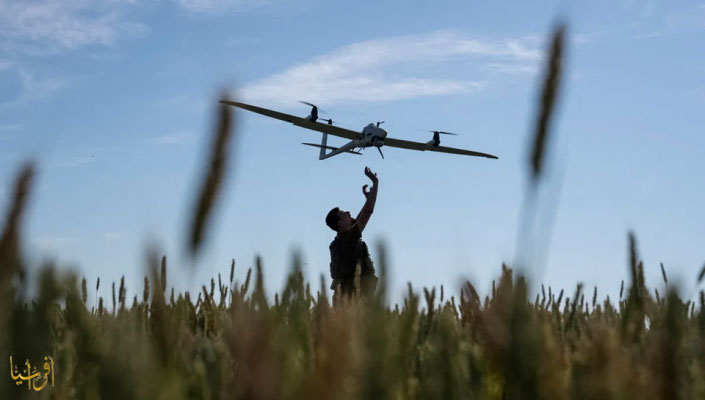
Afrasianet - Ukraine's largest drone attack on the heart of the Russian capital Moscow is putting Kyiv's strategy to hit deep into the balance of military viability, amid Ukrainian and Western bets on launching a "war of energy and economic attrition" that would break the "impregnable fortress" narrative and force the Kremlin to freeze fighting.
On the other hand, a Russian vision emerges that refutes the effectiveness of these strikes on the ground, and incorporates them entirely within the framework of a "political review" directed at Western allies with the aim of mobilizing support and funding.
The attack coincided with the Russia-ASEAN summit in Kazan, targeting a major oil refinery in Moscow and causing evacuations at major airports, marking the second time this month that Ukraine has struck deep into Russia during an international summit, after previously targeting St. Petersburg.
Kyiv Strategy
Former Ukrainian diplomat Volodymyr Shumakov says that Kyiv has a moral right to similarly destroy Russian oil refining facilities, as well as to achieve a decisive economic and psychological blow based on two axes:
• Refutation of defensive efficiency:
• Ukrainian claims suggest that Ukrainian drones powered by military artificial intelligence have successfully penetrated Russian air defense systems inside Moscow, downplaying Moscow's promotion of being an "impregnable fortress" and raising questions about the quality of these systems, which it described as "junk."
• Economic exhaustion:
• Ukraine claims that it has managed to destroy 50% of Russian oil export capacity in two months, and targeted 17 refineries within one month, amid a plan to destroy all facilities within a year, which will cause oil shortages and force Russia to import fuel in the future.
Teresa Fallon, director of the Russia-Europe Asia Center for Studies, supports this view, considering the targeting of energy infrastructure as a smart strategy to cut off funding from the Russian war machine and move the battle into Russia to pay the price, as well as being a response to a violent Russian attack that hit Kyiv with 600 drones and 70 missiles and destroyed a UNESCO site.
Fallon claims that Russia has sunk into a long "quagmire," and that clouds of black smoke in the sky over Moscow dispel the official narrative and arouse confusion and anxiety among civilians who are aware of the inefficiency of air defense.
Russian Novel
On the other hand, Russian writer and political analyst Yevgeny Sidorov refuses to consider the attack a security failure, and refutes the Ukrainian and Western narrative through several facts on the ground:
• Limited impact: Air defenses have not been completely breached, with only 5 to 6 out of 100 or 200 Ukrainian drones reaching. The fire covered an area of no more than one thousand of Moscow's area and was extinguished in minutes, and the refinery and gas stations returned to normal operation without any queues.
• Misleading figures: Sidorov denied Western human casualties figures (1.5 million), stressing that the body and death exchanges prove that the losses of Ukrainians are much greater than that of the Russians.
• Ukrainian President Volodymyr Zelenskyy , as the G7 summit in France ended, wanted to show off his ability to hit the depth to persuade the West to provide more weapons and money, despite European discomfort over corruption cases in which the Kiev leadership is mired.Prospects for Settlement
Under the official position announced by Foreign Minister Sergey Lavrov, Moscow will deal with this reality, according to Sidorov, by launching large-scale retaliatory strikes on vital targets in Ukraine, in parallel with strengthening defense systems to reduce breaches.
On the path of a political settlement, there are divergent readings of the prospects for a solution, with Theresa Fallon asserting that Russian President Vladimir Putin is not interested in any peace negotiations and insists that the war will continue until victory.
On the other hand, Sidorov denies Moscow's refusal to end the war, stressing its adherence to its basic condition for the start of negotiations, which is the withdrawal of Ukrainian forces from the remaining area under its control in the Donetsk region (about 15%), relying on mediation and serious pressure from US President Donald Trump to force Kyiv to accept Russian conditions and return to the negotiating track in a foreseeable future.
In recent months, the pace of drone attacks across the border between Russia and Ukraine has escalated, as the war between them has been going on for more than four years amid the stalled diplomatic efforts to end the war.
Coinciding with the continued exchange of accusations between Kyiv and Moscow over the course of the war , Zelensky confirmed, in an audio message to journalists:
"We don't want this war, we never wanted it, everybody knows it, and our partners know it. But if Ukraine burns, Moscow will burn."
Zelenskyy, who is scheduled to attend a meeting of Ukraine's military allies in Brussels , stressed the need to provide his country with air defense systems as part of a NATO program and the establishment of an anti-ballistic missile system.
He also called on Europe and the United States to intensify economic pressure and sanctions on Russia's defense and energy sectors, calling on Russians to "wake up and put pressure on their leader" Vladimir Putin to end the war.
Russia accuses of "disinformation"
Commenting on international political moves, Kremlin foreign affairs adviser Yuri Ushakov accused European leaders of trying to "charge" US President Donald Trump with "harmful ideas" and provide him with misinformation about the situation in Ukraine during this week 's G7 summit.
However, Ushakov noted in remarks to Russian state television that Trump is "a strong leader who sticks to his ideas," stressing that Moscow is still waiting for the visit of his envoys Steve Witkoff and Jared Kushner, although no date has been set yet .
Regarding the assurances of Zelensky and his European allies to Trump that Ukraine's chances on the battlefield have improved thanks to drone incursions into Russian territory, Ushakov described these claims as "completely untrue," stressing that Moscow is monitoring the developments of Western political positions in light of the cautious optimism expressed by the leaders of the G7 about the possibility of reaching a peace agreement.
These developments on the ground and politics come in light of the continuation of the Russia-Ukraine war that broke out in February 2022, which has entered its most complex phases as it has turned into a long-term war of attrition.
________________
