
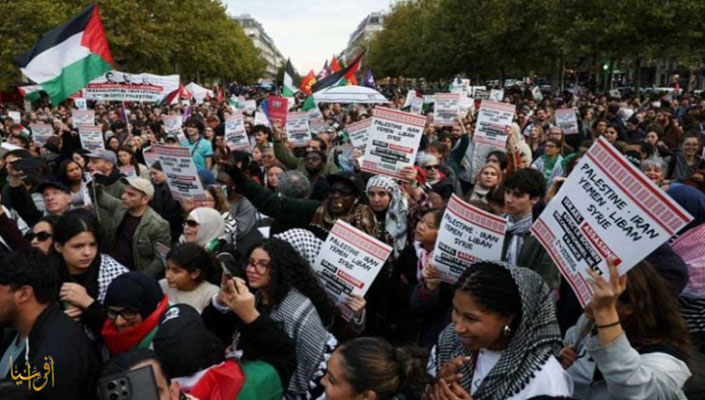
Afrasianet - Pro-Palestine movements within French universities are facing increasing pressure, including arrests, fines and disciplinary referrals, as protests against Israel's war of extermination in Gaza continue.
Participants in these movements confirmed that the measures taken against them have become more stringent over the past two years, while the French authorities continue to emphasize "the application of the law and the maintenance of public order".
Israel continues its aggression on Gaza, despite reaching a ceasefire agreement two years after the genocide that Israel began on October 8, 2023, with the support of the United States, and left about 73,000 martyrs and more than 173,000 wounded Palestinians, most of them children and women, and the destruction of 90 percent of civilian infrastructure.
Since the start of the war, France has witnessed continuous protests organized by students to denounce Israel's war of extermination, amid measures against a number of participants, including filing legal complaints for their positions in support of Palestine.
In May 2024, French police arrested 88 pro-Palestine activists, including students, during a demonstration at the Sorbonne University in support of the Gaza Strip.
In the latest move, Paris on April 14 witnessed protests at a number of universities rejecting the "Yadan" bill, which opponents say aims to punish anti-Zionist attitudes on campus.
The protests resulted in the arrest of four students, while fines of €400 were imposed on more than 70 students, before the controversial bill was withdrawn on April 16.
The bill, which was presented to the National Assembly by MP Carolyn Yadan in November 2024, stipulated that denial of the existence of the State of Israel or its likeness to the Nazi regime would be punished.
A number of French students recounted the details of what they described as the escalating pressure on solidarity movements with Palestine within universities.
'Unprecedented repression'
Rania, a French student and member of the Palestine Committee at Sorbonne University, said that violence is still practiced against students participating in pro-Palestine events, noting that any student may be arrested or detained by the police without any clear justification.
It added that the financial fines imposed on the participants have witnessed a significant increase, pointing out that the total fines imposed on the participants in the April 14 protests exceeded 35,000 euros.
She considered that the French authorities have recently started to move from the policy of arrests to direct financial pressure on students, saying that the state has become targeting economic activists instead of sufficing with arrest procedures as was the case in the past.
She explained that the main demand of the students is to boycott institutions and companies that they say are involved in supporting the Israeli war on Gaza, stressing their refusal to continue their universities' cooperation with Israeli companies or universities that they consider accomplices in the crimes committed against the Palestinians.
Rania also accused the Sorbonne of collaborating with French arms companies, as well as Israeli academic institutions that she said encouraged their students to join the Israeli military.
The French authorities called for an end to this cooperation, and called for facilitating the access of students coming from Gaza to France after their educational files were disrupted due to the war.
Rania said that the level of repression of pro-Palestinian movements is unprecedented, adding that the police entry into universities and the arrest of students is an exceptional event in the history of French university life.
She noted that students have previously participated in anti-colonial movements, but this time there are unprecedented levels of pressure against students who are advocating for a just humanitarian cause.
Prosecutions
Sofia, a member of the Federation of Student Unions, said the April 14 protests at the Sorbonne University were aimed at rejecting the "Yadan" bill, considering it an attack on public freedoms.
The sit-in lasted more than six hours before police entered the campus, it said, adding that security forces used violence to disperse students, and the operation was punctuated by "racist" attacks.
She confirmed that the police had photocopied the students' ID cards and threatened some of them with arrest when they refused to provide their phone numbers or personal addresses, considering these measures illegal.
She explained that the students are continuing their movements against the existing partnerships between French universities and weapons manufacturers, stressing that the current pressures will not prevent them from continuing to support the Palestinian people.
She also referred to the case of 18-year-old student Tiba, who teaches at Paris 1 Panthéon-Sorbonne University, and is facing prosecution from her university after she deleted people who follow the IDF account from the "Safia Group" on social media.
"The student faces accusations of anti-Semitism, even though her position is limited to rejecting Zionism," she said.
Violence against students
Ibrahim, a member of the Communist Youth Organisation, said that this year the students staged two protests at the Sorbonne.
He explained that the French police intervened very violently during the first movement organized by pro-Palestine students, adding that their treatment was characterized by a high degree of repression.
He pointed out that some students were referred to disciplinary boards for drawing the Palestinian flag on the stairs of the university or hanging pro-Palestine posters inside their educational institutions.
He added that what is happening reflects cooperation between university administrations, the French state and the police to "suppress voices opposed to the Israeli war and in support of the freedom of the Palestinians."
________________
