
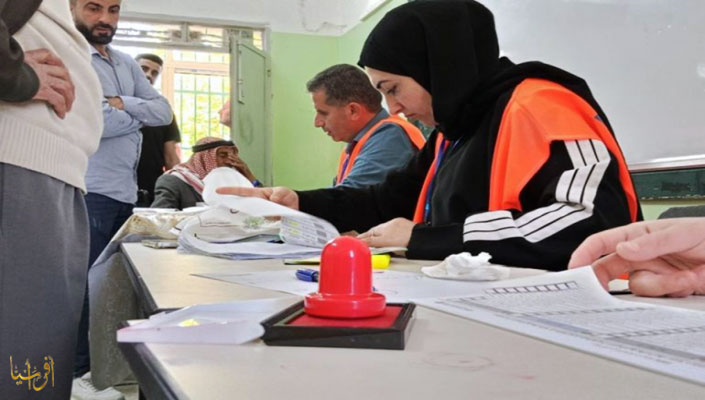
Afrasianet - Jenin - Fatima Mahmoud - Old age did not prevent Nader Shaaban, a 97-year-old Palestinian from the village of Jalameh, north of Jenin, from going to the polling station and casting his vote in the local council elections, despite his doubts about the possibility of change for the better.
Speaking to Al Jazeera.net, Hajj Nader said that his feeling that he should give his vote "to those who deserve it" is what motivated him to participate in the elections and vote. "I don't remember how many times I participated in the elections in my lifetime, but my duty was imposed on me to support those who deserve my vote," he added.
On Sunday, the Central Elections Committee announced the results of the local authority elections that took place on Saturday in the West Bank ,Jerusalem andDeir al-Balah in the Gaza Strip.
Search for "change"
The elderly Palestinian seems desperate about the possibility of change after the elections, but he hopes that the candidates will have plans that will improve the village and the future of its people. "Corruption began a long time ago in the core of this state, and it was reflected and spread to all its institutions, but we hope that the righteous will succeed in serving the village," he says.
He asserts that he was not elected on the basis of family, which governed the elections that were held according to a new law this year, adding that he did not give his vote to those with whom he has a relationship or interest, but rather elected those who he believes can bring about even a small change in the village.
At the polling station at the Aja Girls' School south of Jenin, Al Jazeera Net spoke to 38-year-old citizen Muhammad Ali, who says that the elections belong to service councils, and that they were never party elections, even if the candidates represent parties.
Medium participation
Across the West Bank, about 512,510 citizens out of more than one million eligible to vote cast their votes, with a participation rate of 53.44%, to elect members of 183 local authorities out of 5,131 candidates, according to the Central Elections Committee, while 197 local authorities won by acclamation.
In Jerusalem, the elections were held in 5 of the 29 local bodies: Qatna, Beidou, Qalandia Al-Balad, Hizma, andBeit Hanina Al-Balad, while other councils were formed by acclamation or political conditions did not allow them to be held.
According to the information officer in the Jerusalem governorate, Maarouf al-Rifai, the turnout in the governorate reached 43.9% until the polls closed at 8 p.m.
Al-Rifai explained to Al Jazeera Net that the non-participation of the rest of the local authorities is due to several reasons, including "the prevention of the occupation and military checkpoints, and the accumulation of financial debts on a number of these bodies."
Major cities out of competition
This year, it was notable that there were no elections in major and important cities in the West Bank, where the cities of Ramallah and Nablus went for acclamation, while the city of Qalqilya did not succeed in submitting any list to run for the presidency of its municipality, while the city of Hebron witnessed a modest turnout, as the percentage reached 30% despite the presence of 108,000 citizens who are eligible to vote.
According to journalist and political analyst Akram Al-Natsheh, the turnout for the elections in 2022 was greater, with the turnout reaching 45%, likely due to religious and political considerations behind the decline.
Al-Natsheh told Al-Jazeera Net that some factions boycotted the elections completely because of the fourth clause in the conditions of candidacy "recognition of the obligations of the PLO", where no one ran for them and called on their supporters not to vote, while other factions boycotted the candidacy and did not prevent their fans from voting. While a number of others boycotted the vote from a religious point of view, as the elections under their current conditions were considered contrary to religion.
Another reason for not participating in the elections, according to Al-Natsheh, is "the daily concern of the Palestinian citizen, which made the election event a secondary and non-essential thing, as economic concerns, the high rate of unemployment, the daily killing by the occupation army, and the theft of land have all overshadowed people's attention, and some considered that the timing of the elections is not appropriate in the presence of these daily conflicts."
Enforced disappearance
In Nablus, the announcement of Anan al-Atirah as the head of the municipal council by acclamation came as a surprise to a large number of residents, as about 89,000 people were deprived of their right to vote, in addition to registering objections from candidates who tried to form lists, which were suspended.
Mohammed Dweikat, a professor at the Faculty of Engineering at An-Najah National University, filed an appeal with the Central Elections Committee during the registration period, explaining that the Palestinian security services forced him not to submit the registration of an independent list that he had formed, but his appeal was rejected.
Dweikat told Al Jazeera Net that the security services, "specifically the Preventive Security and General Intelligence, summoned a number of candidates on his list and detained them for days, which led to their incompleteness and difficulty in submitting them on time."
"When at least two or three people are detained from the list, it is a compulsion not to run and a failure of the lists. The detention came without clear reasons, only to pass the days scheduled for submitting the lists, and that is exactly what happened with us."
Until the evening of polling day, Dweikat was demanding, through his social media pages, that the election process in Nablus be halted and reconsidered, in order to enable the people to form lists that represent them.
On the day of the polls, the Israeli occupation forces and settlers were not without attacks , as the occupation soldiers raided a polling station in Hebron, and lightly injured 6 citizens, and clashes broke out in Al-Arroub camp after the ballot boxes were closed, and settlers closed the road leading to the village of Mikhmas, northeast of Jerusalem.
Conditional Elections
Voters were distributed among 491 polling stations, 12 of which were in Deir al-Balah for the first time in 22 years. The election committee extended the voting period there by an additional hour, closing at 6 p.m., and the voter turnout was 22.7%.
Omar Assaf, a political activist and coordinator of the Palestinian People's Congress, believes that the condition of "recognizing the commitments of the PLO" excludes parties and factions that are not part of it, and empties the electoral process of its essence based on pluralism and competition.
Assaf added in his interview with Al Jazeera Net that this condition is "exclusionary and contradicts the constitution and international conventions," considering that it deprives the majority of the people of participation.
Political analyst Nihad Abu Ghosh said that the condition of adherence to the PLO's program is one of the most prominent reasons for citizens' reluctance to run in the elections, considering that the process has become "a formality to reproduce the existing reality, which will definitely happen in the legislative elections if they are held."
On the other hand, Ayman Youssef, a professor of political science at the Arab American University , said that the imposition of this condition came as a result of external pressures, especially after the events of October 7, 2023, noting that the goal is to send a message that the Palestinians are able to manage their political choices.
Yousef stressed that the outcome of these elections will be reflected on their legislative and presidential counterparts, as well as on the path of renewing the legitimacy of the PLO, in light of the faltering reconciliation between Fatah and the Islamic Resistance (Hamas) movements, which hinders the determination of the date of the legislative elections so far.
70% of those eligible to vote did not go to the polling stations in Hebron (Al Jazeera)
491 polling stations were distributed throughout the West Bank, including 12 in Deir al-Balah in Gaza (Al-Jazeera)
Source: Al Jazeera
