
When U.S. bases are a fuse for war: the dialectic of protection and sovereignty in the Gulf and the cost of political decision
Afrasianet - Emirati academic Abdulkhaleq Abdullah's tweet sparked a debate on social media, after he spoke about the lack of need for US military bases in the Gulf.
Abdullah's statement reopened an old and renewed file that raises the question of the need for the Gulf states to have a U.S. military presence to protect the region, or whether the Gulf states are closer to relying on their own capabilities.
In "The Shortest Words", political science professor Dr. Abdullah Al-Shayji, monitors the secrets of the Big Bang, so did the Gulf capitals fall into the trap of the "double deception" of Trump and Netanyahu after arduous negotiations that lasted until the last moment?
How did the U.S. bases turn from a "protective shield" to a "strategic burden" that calls for Iran's missiles and drones, which are raining down by the hundreds?
Why does Shayji believe that Washington is waging a "war without strategy" that is internationally illegitimate, and is the Kurds once again being led to be a "scapegoat" in a ground offensive that Trump sees as "wonderful" while reality sees it as a "fatal sin"?
What is the secret of the "nuclear deception" exposed by the contradiction of the Trump administration? And how did the Gulf states regain the memories of the "invasion" after Iran's missiles turned Gulf sovereignty into an arena for settling scores with the American "adversary"?
After the failure of the Gulf bet on external protection, is it time to "think outside the box" and be self-reliant away from the American retreat, which has lowered the region's position in its defense strategies?
For decades, the people of the region have been told that the US military bases in the Gulf are meant to protect countries and ensure their security and stability.
These bases were not established to protect the Gulf capitals as much as they were established to protect American interests and secure the Zionist occupation entity called "Israel", even if the price is to expose the entire region to grave dangers.
Since America established its military presence in the Gulf following the Second Gulf War, and with the establishment of massive bases such as Al Udeid in Qatar and the Navy Fleets in Bahrain, the U.S. military presence has become a constant element of the security equation.
But the fundamental question that arises today is: Do these rules really protect the Gulf states, or have they turned into tools to protect the U.S.-Israeli project in the region?
Recent events have proven that U.S. bases have not prevented a threat from the region, but, on the contrary, have made it an open arena for escalation.
When Washington is embroiled in direct or indirect conflicts, these rules become potential targets, putting host countries at risk without having a real decision in those confrontations.
The Gulf states have spent trillions of dollars for their alleged security and on U.S. arms deals under the pretext of boosting their national security.
However, this arsenal has never been used to protect Jerusalem or to support the Palestinian people, while we see the open military and political support provided by Washington to the occupying entity in all its aggression against Gaza, the West Bank and Lebanon.
The true security of the Gulf is not achieved by dependence on foreign bases, but by building an independent regional security system based on respect for the sovereignty of states and support for the nation's central causes, foremost of which is the Palestinian question.
Experiences have proven that the promised protection was nothing but a political illusion, while the truth is that these rules existed to ensure the supremacy of the Zionist occupation entity and to protect Washington's strategic interests in energy and sea lanes.
Today, it has become clear that the survival of these rules only serves the project of hegemony, and that betting on the outside has only brought more tension and division.
The peoples of the region must be aware that their security is not imported, that sovereignty is indivisible, and that those who protect foreign bases are risking the security of their homelands and the future of their generations.
Is it time to reconsider? Or will the Gulf remain an arena for the protection of others, while its major issues remain pending a free sovereign decision?
In the midst of the rapid geopolitical transformations that the world is witnessing, security in the Persian Gulf region remains one of the most complex and sensitive files. The central question that reality poses today is: Does protection come from outside, through bases and great powers, or is it built from within, through regional coordination based on common interests? For
decades, the US military presence in the Gulf has been part of the regional security equation, based on the idea of deterrence, protecting the flow of energy, and balancing the balance with regional powers. This model has long seemed stable, but it has begun to undergo real tests that have revealed the limits of this protection.
Recent events, especially the attacks in the Gulf states despite the presence of U.S. bases on their soil, have highlighted that this presence does not guarantee absolute protection, and that the military decision often remains hostage to U.S. interests, rather than its obligations to allies.
It becomes clear that the current relationship between the Gulf and the United States is not based on guaranteed protection, but rather on partial dependence imposed by American military superiority and the need for strategic coordination
US military bases, despite their size and deterrence capability, do not operate only according to the logic of protecting host countries, but also according to a strategy that achieves Washington's interests first. This explains their inaction in some direct incidents, such as in the recent cases of regional targeting, where US bases remained fortified, while the Gulf states themselves were exposed to events that were not prevented by American power.
From this point of view, it becomes clear that the current relationship between the Gulf and the United States is not based on guaranteed protection, but rather on partial dependence imposed by American military superiority and the need for strategic coordination.
In the context of these shifts, striking European positions emerged during the current war between the United States and Israel on the one hand, and Iran and its allies on the other. Countries such as France, Germany, and Italy have refused to use their military bases as a starting point to attack Iran or protect ships in the Strait of Hormuz, content with symbolic political rejection without engaging in direct military support.
This position reflects Europe's ability to redefine its commitments in accordance with its own interests, and offers an important lesson for the Gulf states: autonomy in security decision-making is possible, and a relationship with major powers can be a partnership based on common interests, not dependency or spontaneous engagement in conflicts that may not serve regional security.
In this context, the urgent need for the Gulf states to rethink the concept of protection itself, and to move from a model of total dependence on an external power to a more independent one.
The idea at hand, which is being seriously discussed in some political circles, is to build an alternative or parallel regional security system based on direct coordination between the states themselves, whether through partnerships with regional powers such as Turkey and Egypt, or through reshaping the relationship with Iran on the basis of mutual understanding and interests.
This approach does not mean abandoning relations with the United States, but rather redefining them so that they become a relationship of mutual interests, not dependency.
Iran, by virtue of geography and history, is not an entity that can be ignored or isolated from the Gulf equations, as it is part of the political and economic fabric of the region, and most of the major regional issues – in Iraq, Yemen, Syria, and Lebanon – are directly affected by its presence and influence. In
this sense, transforming Iran from a potential adversary into a partner, or at least a stable neighbor, could open the door to rebuilding the entire concept of security, based not only on external military deterrence, but also on regional understanding and coordination.
From a realistic perspective, this shift presents exciting strategic possibilities: Iran could enter into regional security calculations in a way that practically dissolves the effects of its past actions in Syria, Lebanon, Iraq, Yemen, and elsewhere, not by erasing what happened, but by establishing a political and security framework that allows for rebalancing relations and dealing with a history of tensions and crimes, in a way that leads to regional stability.
In other words, a realistic view does not ignore crimes or violations, but shifts the focus from retaliatory calculations to strategies of coexistence and balance, in order to achieve the interests of the Gulf states and reduce the chances of new conflicts. However, this vision faces significant challenges, as tensions in multiple arenas, accumulated mistrust, and divergent visions of influence and role are all factors that make achieving this transformation difficult, if not impossible.
Building trust between countries requires clear arrangements, mutual guarantees, and executive mechanisms to ensure commitment. This requires strategic patience and a long-term vision, away from momentary emotions and external pressures.
Replacing the U.S. presence with a regional alliance also poses other challenges, the most important of which are the difference in military and technological capabilities, the nature of commitments, and the extent to which they are willing to shoulder the burdens of mutual defense.
Therefore, the most realistic path at the moment seems to be to diversify strategic partnerships: strengthening their own capabilities, opening up to regional dialogue (Turkey and Egypt as a model for joint security sharing), and reshaping the relationship with major powers on the basis of mutual interests, without abandoning existing deterrence tools before building real alternatives.
Is security based on external protection alone, or on autonomy and the ability to control interests? Is it merely military deterrence, or is it a network of balances and mutual interests that makes war a costly option for all?
The crux of the issue is not to choose one party over another, but to redefine the concept of security itself. Is security based on external protection alone, or on autonomy and the ability to control interests?
The lesson of recent European positions, which have refused to engage in direct military conflict despite their alliance with Washington, illustrates the possibility of strategic independence even within traditional alliances . If Europe is able to reassess its positions in accordance with its own interests, the Gulf states, which are more vulnerable to any potential conflict, can adopt a similar approach: a partnership with major powers based on interests, not dependency or automatic commitment.
Ultimately, the path to a stable security system in the Gulf passes through three overlapping stages:
first, easing regional tensions through dialogue and confidence-building, especially with neighboring powers such as Iran; second, developing self-defense capabilities that reduce dependence on the outside; and third, reshaping relations with major powers on the basis of mutual interests, not absolute dependency.
There are no easy answers, no ready-made model, as each option carries opportunities and risks, but what is certain is that the region is facing a decisive moment that requires deep thinking and a flexible strategy that balances protecting its interests, building its independence, and adapting to rapidly changing global balance of power.
When U.S. bases are a fuse for war: the dialectic of protection and sovereignty in the Gulf and the cost of political decision
In moments of escalating conflict, when missiles intersect maps, the question of the fate of the Arab region becomes an existential test. The confrontation between Israel and the United States on the one hand, and Iran and its allies on the other, is not just an exchange of military power, but a test of the concept of protection, on which decades of security alliances have been built.
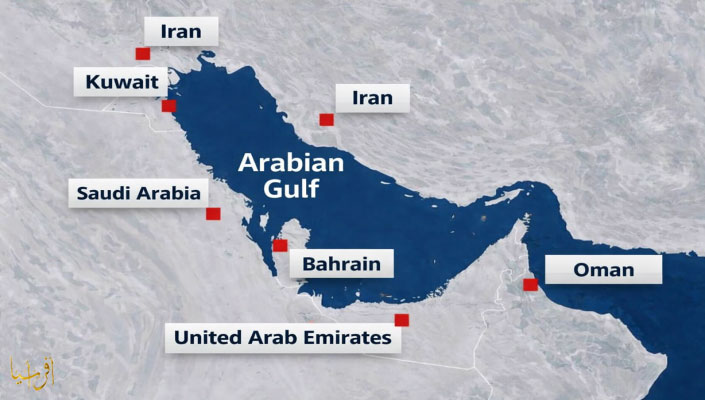
In a region that has suffered from deep structural flaws and since the 1991 Gulf War, the United States has established a military presence in the region through a network of bases spanning six Gulf states. The Al Udeid base in Qatar, which has about 8,000 troops, is the largest U.S. air facility outside the country. The Fifth Fleet is based in Bahrain in 1948. The Al Dhafra base in the United Arab Emirates hosts 3,500 military personnel, as well as facilities in Kuwait, Saudi Arabia, Oman, and Turkey.
But what was presented as a security umbrella to protect host countries has turned into a magnet for war in the current confrontation. Since the start of the US-Israeli strikes on Iran on February 28, 2026, US bases across the Gulf have been subjected to Iranian missile and drone attacks, resulting in damage to military installations and civilian targets, and deaths in Abu Dhabi, Dubai airport, and civilian sites that Iran says are being used as US and Israeli intelligence centers.
The region is reaching a critical crossroads: what is the cost of continuing this foreign military presence, and what is the cost of ending or reducing it?
Despite the declared neutrality of the Gulf states and their prohibition on the use of their territory to launch attacks on Iran, they have found themselves at the center of the battle. The
latest escalation reveals the underlying justification on which decades of hosting foreign bases have been exposed. The reality has revealed that these bases have not protected themselves from being targeted, let alone the host countries.
Iran's response strategy relied on turning its Gulf neighbor into a central theater of confrontation, targeting U.S. military installations, and expanding strikes to include civilian and economic infrastructure. Energy facilities and ports—vital to Gulf economies and global markets—have become pressure points in an Iranian strategy based on raising the cost of a military campaign against the Iranian regime.
The result is that the Gulf states found themselves in the position of defenders rather than attackers, even though they were not a party to the war, confirming that the presence of U.S. bases did not prevent a threat to the region, but rather made them more vulnerable.
Legally, the presence of U.S. military bases in the Gulf is not a violation of sovereignty, as it is done by formal agreements. But the problem arises when these bases become legitimate military targets in conflicts; the law of armed conflict recognizes that the military objective is what contributes to military action, and its destruction brings a clear military advantage. The element of security becomes an element of existential threat that goes beyond the noise of politicians when objecting to striking those targets.
But the complexity is compounded when these bases are intertwined with a civilian perimeter, when the targets extend to civilian infrastructure, or when residential areas are damaged by missile response.
This is where the region reaches a crucial crossroads: what is the cost of continuing this foreign military presence, and what is the cost of ending or reducing it?
The cost of survival is clear:
the transformation of host countries into an open arena for conflict, economic and human losses, the restriction of national sovereignty, and dependence on external decisions that do not take into account the interests of host countries. At critical
moments, it became clear that U.S. priorities could differ radically from those of their Gulf allies. The attempted assassination of Hamas leaders in Doha in September 2025, with U.S. approval, came as a profound shock to Gulf leaders and exposed the limits of the security umbrella. But
the cost of dismantling is no less complicated, as these rules represent decades of strategic investments and institutional relationships, and their dismantling may be read as a major strategic shift in the regional balance of power, and may create a security vacuum that the Gulf states alone cannot fill, especially as various threats continue.
Major geopolitical shifts require a radical reconsideration, as the U.S. military doctrine is witnessing a shift toward redistributing resources, with the rise of the Chinese challenge and increasing burdens in Europe, which means that Washington is leaning toward a more flexible and less expensive deterrence model, based on the ability to intervene when needed rather than permanent deployment.
This shift has been reflected in the calculations of the region's countries, which are beginning to realize that full reliance on external protection may not be a guaranteed option, so some countries have tended to develop their self-defense capabilities and diversify their military partnerships, in an effort to build a more independent balance. The
Saudi-Iranian rapprochement, and the ongoing mediation between Qatar and Oman, reflect a growing awareness of the limits of external safeguards and an effort to build direct channels with Tehran. But the road to an independent Arab security project remains long, and the region is paying the price for this delay.
The harshest lesson is that security is not imported, sovereignty is indivisible, and foreign bases can turn in an instant from protective shields to open targets
The current events bring us back to the existential question: Who protects whom?
The harshest lesson is that security is not imported, sovereignty is indivisible, and foreign bases can turn in an instant from protective shields to open targets. Every foreign base is a latent threat, every foreign soldier is a provocative message, and every bet on the outside world is a losing gamble.
Today, with the mask falling, the Gulf states are facing an unavoidable reality: to remain dependent on America means to remain in constant danger. This is what some politicians in the Gulf states have said, but getting out of this impasse requires a courageous decision to overhaul security policies, starting with gradual military disengagement and ending with building real security based on sovereignty, not on rules, and on regional understanding, not on foreign fleets.
If the new partition plan is clear and openly deliberated with the various threats to erase some countries from geopolitical maps, it is imperative for everyone to take proactive steps without waiting for other protection alternatives, even if they are within walking distance.
The most dangerous stages in geopolitical transformations do not begin when wars are declared, but when everyone thinks that the deterrence equation is still working, when its conditions have already changed.
