
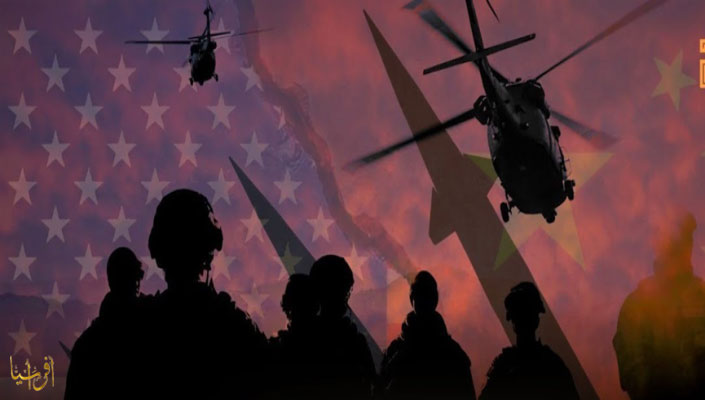
Afrasianet - Mazen Al Najjar - The U.S. War Department has a budget of $1 trillion a year, and its ammunition is running low. How did the military-industrial complex build a war machine to make a profit, not victory? !
The United States spends more on its military than the next 10 countries combined, is currently unable to make up for lost ammunition in just six weeks, and is forced to drain its defensive shield over South Korea to close the gap.
Reuters recently reported that the United States had informed allied countries of its inability to deliver contracted munitions on time due to the war consuming large stockpiles, becoming a priority to compensate for consumables.
In a report by the Center for Strategic and International Studies (CSIS) in Washington, the U.S. military consumed about half of its stockpile of Patriot missiles, more than half of its THAAD missile system stockpile, and more than 45 percent of its precision-strike missiles in the recent air and missile campaign.
It will take between one and four years to restore missile stockpiles, including Tomahawks and guided cruisers, to pre-war levels. They are critical munitions in the event of a potential conflict in the Western Pacific.
On March 31, Responsible Statescraft reported that military industry companies contracted with the War Department would deliver the new radar-free and combat-friendly F-35s.
While the military needs adequate equipment for its war on Iran, and presumably gets what it needs to achieve "victory," the reality looks different: Breaking Defense reported that the delivery of the F-35 without radars will begin in late 2026.
Exacerbating the readiness problem
The problem is that Northrop Grumman is delayed in producing advanced radars for the F-35 as part of the software update. These radars are supposed to help the fighter jet detect, track and target enemy threats.
These new F-35s are not designed to accommodate existing radars, so they can still fly, but they are only used for training unless they are upgraded with the new radars, which means they are excluded from the battlefield.
MP Rob Whitman confirmed to Breaking Defense: "Currently, the F-35s will be produced with metal blocks for balance [instead of the new radars]. They will not be ready for combat soon," and the readiness problem caused by this delay will be exacerbated. Experts say the new radars will not be available anytime soon, and updating the aircraft's radars could be expensive and lengthy beyond 2027.
The current failure of the radar system threatens to lose vital military equipment in the midst of America's war on Iran, and severe and devastating damage to key military assets, including the F-35, during the confrontations. Experts see the delivery of the F-35 without radars as further evidence of the failure of its program.
Still, the companies have reaped hundreds of millions of dollars in incentives that should encourage them to deliver weapons systems on time throughout the years of the F-35 program, which will cost about $2 trillion.
Author and former Vietnam War officer Dick Dowdell doesn't see this as a procurement failure, it's a system that works exactly as designed. President Dwight D. Eisenhower explained to the American people how this system works in a farewell speech before he left office. But there are those who refuse to listen.
What Eisenhower realized and constantly forgets
This system has brought the U.S. military into a truly fragile strategic position, not by the enemy, but by the logic of its accumulated motives, a war of choice waged in blatant defiance of the law and the advice of allies, and the dismantling of the professional senior officer body, which will last longer than any other recent damage to the military.
On January 17, 1961, at the end of his second presidency, Dwight D. Eisenhower, the 5-star general, Supreme Allied commander, and planner of the invasion of Normandy, delivered his farewell address, warning of an institution in which he had spent most of his life: "In the circles of government, care must be taken not to gain undue influence, with or without the military-industrial complex."
He was describing a regime that was self-reinforcing and politically unrestrained and whose internal motives were not necessarily in line with the national interest. Sixty-four years later, the bill arrived.
Eisenhower's warning is routinely invoked, and almost routinely misunderstood. He did not predict that these companies would resort to bribery to bad results, even though it did, but rather to something more structural and permanent: a large, permanent defense industry, embedded in the economy of nearly every state's congressional districts, creates institutional pressures that operate outside of military logic.
This complex is not concerned with the needs of the country, but with what it can sell, and then shaping the environment, through political pressure, mutual relations between the Pentagon and industry, and lobbying members of Congress to ensure that it sells what it can.
The result has been seen for decades: a buying culture that always favors expensive and complex products, with a high profit margin over useful, sustainable, and cheap products. The F-35 attack fighter jets are a prime example of this.
At a cost of nearly $103 million per aircraft — $82.5 million for the fuselage, along with $20.4 million for the separately contracted engine — the F-35 program spent about $428 billion in acquisition costs alone, an 84 percent increase from the original estimate, for its total lifecycle costs to exceed $2 trillion through 2088.
In 2024, the Government Accountability Office reported an average of 238 days delayed aircraft deliveries, however, Lockheed Martin received hundreds of millions in incentives. None of these models met their goals of average uptime for five consecutive years.
Lessons of the Vietnam War
I arrived in Vietnam as a U.S. Army officer and served as an adviser to the U.S. Military Assistance Command in the Mekong Delta. I came home with a deep understanding of the limits of technical superiority, and no brevity can match.
The U.S. firepower in Vietnam was enormous by any measure. It dropped more munitions on Vietnam than the entire World War II ordnance, and with the ability to destroy almost anything. The dilemma is that destruction and decisiveness are not the same thing.
An adversary who fights on his own soil, for his existence, and realizes that survival in itself is a victory, does not need to keep pace with the technology of his enemy. Rather, he needs to excel in enduring sacrifices.
The wars in Iraq and Afghanistan have confirmed this lesson in detail. An army prepared for decisive conventional confrontations — with heavy armor, air superiority, and linearly advancing logistics — wreaks havoc against irregular adversaries, but it doesn't decide the outcome. The adversary adapts, disperses, and waits. Eventually, the aircraft carrier owner returns home.
The Iran war is the current chapter, and it is necessary to clarify exactly what happened: The war was waged without congressional authorization or allies' support, and on grounds that the CIA director called a "farce."
Trump threatened to wipe out Iranian civilization, and Hegseth explicitly declared a policy of "relentless, no mercy," a phrase with specific legal significance under the laws of armed conflict that America helped draft in Geneva. Neither of them seemed to notice or care that they were publicly committing the country to conduct that would constitute a war crime under treaties signed by the United States.
The result was quite predictable. Iran absorbed the strikes, activated its strategy in the Strait of Hormuz, and ended the round in a stronger strategic position than it had begun. The ceasefire was no longer the status quo ante, but rather cemented Iran's new influence.
All of America's other adversaries, including China, stationed across the Taiwan Strait, watched and adjusted their calculations. The lesson is unreassuring.
The problem of consumables.. a system that works as designed
The U.S. military currently suffers from a severe shortage of equipment for combat consumption: Tomahawk cruise missiles, Patriot interceptors, artillery shells, machine gun ammunition and small arms. These consumables are pulled from stock when firing begins, and must be replaced by an industrial base capable of producing them quickly in large quantities.
This has allowed this industrial base to atrophy. This is not a passing neglect, but a logical consequence of a culture of "buying" governed by profit margins. For example, Tomahawk missiles are expensive, but they are a relatively mature technology.
By contrast, the F-35 is a permanent source of income, with its development and upgrade costs exceeding original estimates in the billions, and its maintenance contracts extending until 2088.
If the regime chooses between funding stockpile and funding the next generation of fighters, it understands the preferred option. Members of Congress from districts where these aircraft are manufactured are aware of their preferred option.
The result is an army that has consumed most of its high-tech precision munitions in just six weeks against Iran — which spends 3.33 percent of U.S. defense spending — while weakening missile defenses over South Korea to fill the gap.
North Korea's ability to launch ballistic missiles is real, effective, and in a specific direction. Weakening this shield to compensate for recklessness on another front is not a logistical margin, but rather an acknowledgment through the equipment that the United States can no longer meet all of its existing commitments together.
The calculation is not complicated, because when your obligations exceed your resources, you cannot meet them all at once. Specifically, this is a situation that the great powers cannot afford, and one that has pushed the military-industrial complex to focus a generation on profitability rather than readiness.
Hegseth variant: a wound that does not heal itself
Dowdell sees the possibility of making up for the lack of equipment, as it requires money, time, industrial will, and leadership with a clear understanding of the true nature of the army.
Nothing is simple between these things, but they are all available in principle. What Pete Hegseth does to army officers is a very different kind of malfunction.
Militaries adopt a professional culture. The officer corps is where this culture is formulated, transmitted, and imposed—the accumulated institutional experience on how to make decisions under pressure, maintain unity cohesion, and balance the mission and well-being of individuals under your command. This culture takes decades to build, and it can be dismantled within a single presidential term by imposing ideological and religious norms rather than professionalism.
The selection of the officers' body based on its loyalty to a political patron and its alignment with a particular ideology, rather than its professional competence and independent judgment, makes it less effective on the ground and even structurally incapable of providing impartial assessments of the political leadership to prevent catastrophic mistakes. It tells it what it wants to hear. The result becomes clear as the first clashes fail, and the consequences come quickly and irreversibly.
Three Expressions of One Problem
The culture of buying based on maximizing profit margins, not learning the lessons of asymmetrical warfare, and ideologically reconfiguring the army officer corps are not separate problems that coincide with chance, but are a single problem: subordinating military effectiveness to other interests, manifested in three areas together.
Iran's war lies at the intersection of these problems: it was decided in defiance of law and intelligence, carried out with irreplaceable resources, and unconsciously celebrated by a civilian leadership in the language of war crimes, as the applicability of the term to it shows.
Eisenhower clearly understood the mechanism decades ago, and he publicly stated it as he left office. He was not predicting doom, but rather he was diagnosing a tendency that required constant vigilance to curb it, and he warned that it would be difficult to sustain this vigilance in the face of sustained extreme pressure.
Dowdell sums up the moment: Alertness has subsided, the pressures have worsened, and this is the harvest!
Mazen Al Najjar - Researcher in History and Sociology

Dr. Mazen Al-Najjar is an academic specializing in industrial management and production systems, and a writer, researcher, and translator in the fields of thought, history, and sociology, with a special interest in settlement studies, the Old Testament, and American and biblical studies (Old Testament).
He has been practicing academic and journalistic writing, translation, and editing, in Arabic and English, since 1980.
He has co-founded and produced a number of intellectual and academic journals, and participated in the scientific review and evaluation of a number of them.
He has published hundreds of articles, studies, book presentations, and reports in newspapers, websites, and magazines on a weekly or daily basis.
