
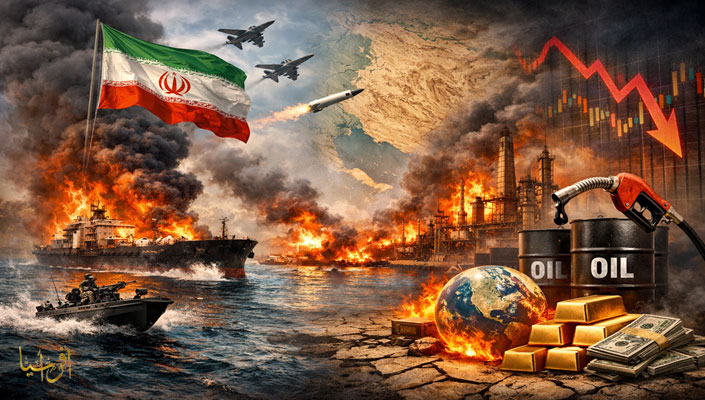
Afrasianet - The longer the war in the Gulf region drags on, the wider the turmoil in the global economy, especially in the energy, oil and gas markets.
This region is not just an arena of transient geopolitical tension or a theater of limited regional conflict, but one of the most important vital arteries that feed the contemporary global economy.
A large part of the world's energy production is concentrated in this sensitive geographical spot, and through its strategic sea lanes, especially the Strait of Hormuz, about one-fifth of the world's oil trade per day, i.e. about 20 million barrels, in addition to large quantities of liquefied natural gas.
When this vital corridor is exposed to any security or military imbalance, its impact is not confined to the borders of the region, but spreads rapidly through the global economic network to affect the various joints of the international economic cycle.
The US administration led by Donald Trump, and with it Israel, does not seem to be fully aware that the prolongation of this war will not remain a matter of military resolution on the ground, but may quickly turn into a global economic shock that transcends the borders of the region and extends to the entire international economy.
Each new day in the conflict adds additional pressure on global supply chains, undermining the ability of the global economy to maintain its fragile equilibrium.
Oil prices rise to levels of $150 to $200 per barrel could put the world in an unprecedented economic and financial predicament.
These developments come at a highly sensitive international moment, as a result of protectionist policies and trade tensions revived by the current US administration, are looming.
This scene reminds us of the complex economic conditions that the world experienced during the lockdowns of the Corona pandemic, and then during the Russia-Ukraine war.
The potential shock this time is different in nature and depth from previous crises, whether the global financial crisis, the Corona pandemic, or even the Russia-Ukraine war, as the current crisis threatens the global economy through three simultaneous strategic channels: the commodity channel, the global trade channel, and the financial channel.
The shock in the commodity channel begins when oil and gas prices rise sharply, which is directly reflected in the cost of production, transportation, and energy in most of the world's economies.
In the Global Trade Channel, risks arise when shipping in the Gulf and the Strait of Hormuz is disrupted, raising shipping and insurance costs and increasing bottlenecks in global supply chains.
The most serious repercussions may appear in the financial channel, as the Gulf states may be forced to redirect part of their foreign investment to face the economic fallout of the war.
Through their sovereign funds, these countries manage trillions of dollars of assets that represent one of the most important sources of liquidity and investment in global financial markets, whether in the United States, Europe, or other major financial centers.
These war conditions may prompt sovereign funds to monetize part of their assets, or reduce their foreign investments to cover the costs and economic fallout of the conflict. If this happens, global liquidity levels could be under significant pressure, and asset prices in international financial markets, from stocks to bonds, could be affected.
When war puts Gulf security to the test, it not only threatens global energy supplies, but also puts the stability of the international financial system to a real test, including the stability of major financial markets like Wall Street.
The global economy relies heavily on Gulf financial flows to maintain a degree of balance in its financial markets, and if these flows are severely disrupted, the world may face not only an energy crisis, but also a wave of liquidity, market volatility, and high levels of financial risk.
Recent developments reveal striking political paradoxes in the management of the global energy market: Washington has allowed some countries to continue transporting or buying Russian oil in order to ease pressure on prices in global markets.
The effects of this potential crisis do not stop at the borders of the financial and energy markets, as its repercussions extend to other strategic economic sectors such as the fertilizer and petrochemical industries.
These industries are heavily dependent on energy and natural gas inputs, making any supply shock move quickly to the heart of the real economy.
When the crisis moves to the real economy, its effects will not be limited to oil markets or major financial capitals, but will reach the fertilizer-dependent farms of India and Brazil, Europe's petrochemical plants, gas stations in the United States, phosphate and metal mines in Africa, and even the details of the daily lives of millions of people around the world.
A rise in oil prices to levels of $150 to $200 per barrel could put the world in an unprecedented economic and financial predicament, a situation that could take years for the world to recover from its repercussions.
While governments are trying to calm markets by pulling out of strategic reserves and pumping hundreds of millions of barrels into the market, the impact of these measures remains limited: the world consumes about 100 million barrels of oil per day, meaning that these reserves provide only a temporary window of time, without addressing the roots of any long-term disruption to supplies from the Gulf region.
The US administration and its allies should avoid policies that push the region to the brink of explosion, putting global energy supplies and financial liquidity to the test.
Washington has allowed some countries to continue transporting or buying Russian oil in a bid to ease pressure on prices in global markets, reflecting international concern over any further disruption to energy supplies from the Gulf as the war drags on.
This approach has drawn clear European criticism, as EU officials have argued that it undermines the policy of sanctions imposed on Moscow since the outbreak of the war in Ukraine, and this controversy reveals the extent of the contradiction between geopolitical considerations and the requirements for the stability of the global energy market.
In light of this crisis scenario, it is not possible to be satisfied with technical or economic solutions alone, as the seriousness of the stage requires that the issue of political responsibility be placed at the center of the debate.
The administration and its allies should avoid policies that push the region to the brink of explosion, putting global energy supplies and financial liquidity to the test, in pursuit of short-term military and tactical gains.
On the other hand, Iran must adhere to the rules of good neighborliness and work to build a regional relationship based on partnership and stability, in order to prevent the region from sliding into spirals of escalation whose results are difficult to control.
The world can no longer afford more geopolitical adventures, the cost of these adventures is no longer paid only on the battlefields, but also in energy and food prices, and in the stability of economies and people's daily lives. When the region is pushed to the brink of explosion, the whole world pays the price.
________________
