
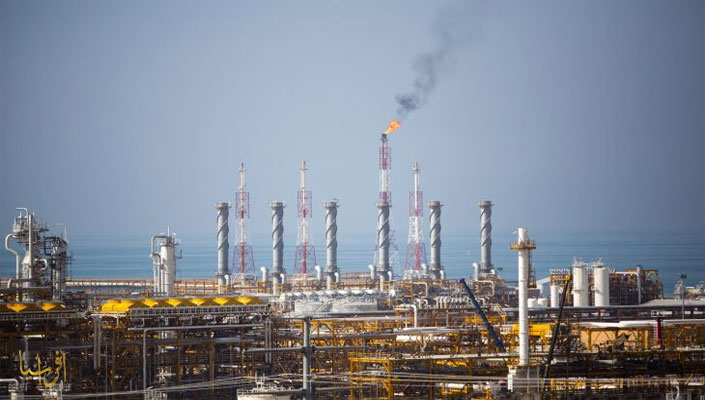
Afrasianet - The US-Israeli war on Iran is witnessing a qualitative shift in the nature of its targeting of the energy sector, as military strikes are no longer limited to oil tankers and shipping routes in the Strait of Hormuz, but have extended to the production and processing facilities themselves, reflecting a clear shift from targeting flows to targeting production capacities.
Reuters reports that Israeli strikes targeted the South Fares field complex and processing facilities in Assaluyeh on March 19, and the same reports indicate damage to Qatar's Ras Laffan liquefied natural gas facility (LNG) from an Iranian missile strike, disrupting part of Qatar's export capacity. These developments, according to cross-section international reports, show that the conflict has entered a phase aimed at "overturning the energy system" and not just its periphery.
This path imposes a different economic reality, as the imbalance is no longer limited to the flow of supplies, but extends to the ability to produce them at all, which changes the rules of pricing and stability in global energy markets.
From Temporary Disorder to Structural Imbalance
Economic analysis differentiates between shocks that markets can absorb through short-term adjustment mechanisms, and other shocks that actually erode supply capacity. The current escalation reveals a gradual but clear transition from the first shock pattern to the second, as the imbalance is no longer confined to the movement of supplies, but has extended to the same source.
Transport shocks, such as the targeting of tankers or the threat of navigation in the straits, depend on disrupting flows without directly affecting production capacity. This nature allows markets to rebalance relatively by redirecting shipments, drawing from strategic stockpiles, or absorbing rising insurance and transportation costs.
Data from the International Energy Agency (IEA) and the U.S. Energy Information Administration (EIA) indicate that about 20 million barrels per day pass through the Strait of Hormuz, equivalent to nearly one-fifth of global consumption, and despite this figure, some of these flows are still recyclable in emergencies, albeit at a higher cost.
But the picture changes radically when military strikes target production and processing facilities, resulting in a direct loss of available quantities, not just a delay in their arrival. This effect is even more acute in the case of large, interconnected systems such as the South Fars (Iranian designation)/North field (Qatari designation), which is the world's largest gas field and a key pillar of global gas supplies, making any disruption in it transboundary.
This shift reflects what can be described economically as a "structural imbalance in supply", in which the impact is not limited to an instantaneous price spike, but extends to create constant pressure on the market, and the balance between supply and demand is kept in a fragile state and open to further turmoil.
Production targeting and recovery cost
Field data reinforce this trajectory, with reports showing that strikes are no longer limited to marginal targets, but are now targeting central nodes in the energy system, taking the conflict to a level that directly affects production capacity.
Saad Sherida Al Kaabi, Minister of State for Energy Affairs and CEO ofQatarEnergy, said the damage to the Ras Laffan facility affected about 17% of LNG export capacity, explaining that it could take "several months" to restore production depending on the extent of the damage and security conditions, reflecting the shift of the shock from a temporary to an extended range.
S&P Global Commodity Insights estimates that repeated military strikes on production infrastructure create "cumulative risks," with each new attack prolonging the recovery and reducing the actual ability to restore production, pushing the market toward a structural supply shortage.
The restoration process is multidimensionally complex, with oil and gas facilities relying on precise and complex systems such as pressure and processing units and liquefaction plants, components that are difficult to replace quickly, while Rystad Energy estimates that repairing them can take weeks to several months.
Continued security threats, coupled with supply chain constraints, delay restarts, as seen in Libya's experience between 2011 and 2020, where production fluctuated despite the availability of oil reserves, turning the shock from a temporary event into a protracted state that puts pressure on market equilibrium.
Risk Requotes in a Fragile Market
Market developments reflect this structural shift, as events are not limited to real-time price fluctuations, but also extend to more established and sustained risk repricing.
Benchmark Brent crude prices are rising to levels above $110 per barrel following the escalation, according to Bloomberg data, while Goldman Sachs estimates that the geopolitical premium could add between $10 and $25 per barrel if the escalation continues.
Bloomberg's analysis of spot market coverage this month indicates that Middle Eastern crudes, such as Dubai and Oman, have outperformed Brent in some sessions, indicating increasing pressures in the actual market, not just in futures.
This phenomenon reveals an imbalance in the market structure, as prices begin to break away from traditional indices, reflecting a real scarcity of supply.
The gas market is increasingly sensitive to this type of shock, due to its reliance on specific and technologically intensive facilities.
Qatar's LNG exports amount to about 77 million tons per year and are directly linked to the northern field, making any disruption in the shared infrastructure with Iran a factor of pressure on the global market, especially in Europe and Asia.
Any disruption in this system leads to a rapid rise in prices, as supplies are difficult to offset in the short term.
The illusion of standby power
Many energy market participants are betting that having backup capacity from major producers could mitigate the impact of any sudden supply shortage, with the International Energy Agency estimating such reserves at 5 to 6 million barrels per day. But these figures reflect more theoretical than immediate operational capacity, because converting this energy into actual supply requires time, secure export routes, and stable infrastructure.
The effectiveness of energy resources in a conflict environment is declining, as the bulk of them are concentrated in the Gulf region itself, making them dependent on the same vulnerable corridors, most notably the Strait of Hormuz. The International Energy Agency (IEA) has warned that a prolonged disruption in the strait could prevent much of this energy from reaching the market, even if it is available in terms of production.
JPMorgan's analysis reinforces this assessment, suggesting that actual reserve capacity in war conditions is well below nominal estimates, due to transportation and export restrictions. The US bank's scenarios, as reported by the Financial Times, show that the closure of Hormuz could prompt countries such as Iraq and Kuwait to cut production within days, revealing that this energy is not a safety valve at all, but a capability that is conditional on geopolitical stability and the integrity of infrastructure, i.e., it is a fragile stabilization factor More than being an actual guarantee for the market.
Trauma transition and escalation scenarios
The effects of production disruptions are rapidly spreading to the global economy through multiple and interconnected channels, as rising energy prices are driving up operating costs in the most fuel-intensive sectors, where fuel accounts for about 30% of operational costs in the aviation sector, according to the International Air Transport Association, which is squeezing profit margins and pushing companies to adjust prices or reduce operating capacity.
These increases are also reflected in the shipping sector through higher fuel costs and insurance premiums, and extend to the petrochemical industry as a result of the rise in feed prices.
At the macro level, the International Monetary Fund estimates that a 10% increase in oil prices will increase global inflation by about 0.4%, in parallel with a slowdown in the pace of economic growth, while a study by experts Dario Caldera and Matteo Iacofello in the American Economic Review shows that rising geopolitical risks are putting pressure on investment and boosting the prospects of a recession.
The analysis of the scenarios reflects the degree of sensitivity of the markets to these developments as follows:
• A limited production disruption (less than 1 million barrels per day) would push prices up around $100 to $115 with a short-term impact.
• A continuous downturn (2 to 4 million barrels per day) pushes prices to $120 to $150 with extended inflationary pressures.
• A widespread disruption involving production and vital corridors is pushing prices up to $150 to $200 or more, with the global economy likely to enter a recession, according to estimates by JPMorgan.
The current escalation is redefining the nature of the risks facing energy markets, as the focus of the threat shifts from transmission routes and flows to the production infrastructure itself, redrawing the risk map in the market.
This shift is pushing for a redefinition of the pricing mechanism, so that prices reflect not only the balance of supply and demand, but also the extent to which facilities are able to continue operating, under mounting security pressures.
In this context, the war is not reduced to a transient shock, but rather signals that the global economy is entering a different phase, in which production capacity — rather than the movement of supply flows—becomes the decisive factor in stabilizing markets.
________________
