
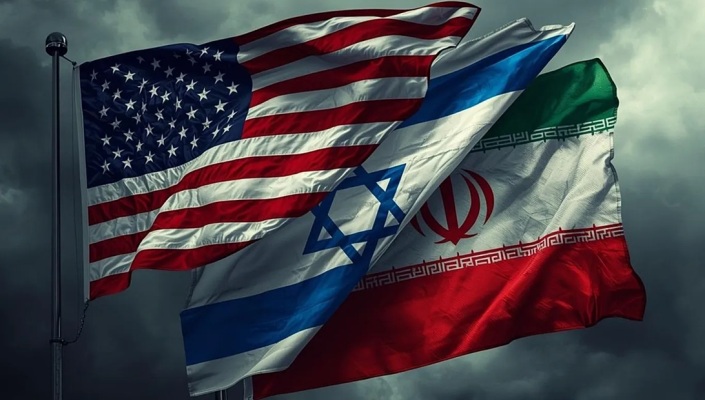
Afrasianet - Sadiq Al Taie - In a moment that seemed alarmingly familiar, the region returned to watching the same scenario repeat itself in almost different details: ongoing negotiations with Tehran, a sudden Israeli escalation, and then a direct U.S. military intervention under the title of preventing Iran from acquiring a nuclear weapon and destroying its missile infrastructure, before the event turned into a regional crisis within hours.
The joint strikes by the United States and Israel on targets inside Iran did not come in a political vacuum, but came after weeks of American pressure Tehran is on the verge of accepting a new deal that restricts its nuclear program, which US President Donald Trump himself acknowledged when he announced the start of "major combat operations", with the aim of destroying Iran's missile capabilities and preventing what he described as a threat to US and regional national security Israel struck Iranian nuclear facilities, which later dragged the US administration into direct military intervention, bombing key nuclear sites such as Fordow, Natanz and Isfahan, before declaring a ceasefire a few days later.
At the time, the war was presented as a limited process of restoring deterrence, not the beginning of a full-scale confrontation, the same rhetoric that is repeated today almost with the same arguments and the same political language.
Israeli Prime Minister Benjamin Netanyahu described the current operation as aimed at removing the "existential threat" posed by the Iranian regime, while Trump went further, explicitly calling on the Iranians to change their regime, in a sign that reveals that the goal is not limited to the nuclear program or ballistic missiles, but goes beyond them to reshape the political balance within Iran itself.
A bet on regime change" is the quickest path to long-term regional chaos. Israel, which sees Iran as the center of a regional network stretching from Lebanon to Iraq and Yemen, seems convinced that any diplomatic settlement will not end the threat, as long as the Iranian regime exists.
Therefore, the attack on military capabilities is always accompanied by an attempt to weaken the center of power itself, which was also evident in the targeting of senior military positions and figures during the recent strikes. But military calculations are one thing, and the dynamics of Iran's response are quite another.
Within hours of the attacks began, Tehran announced that its forces would use "all their capabilities" to respond, and a wave of missile and drone attacks targeting Israel and U.S. bases in the region, including military installations in Iraq, Bahrain, Qatar, Kuwait, the United Arab Emirates, and Jordan, has already begun, but Iranian missiles have been intercepted in all of these areas.
The shift of the response to the Gulf geography means that the war is no longer bilateral between Israel and Iran, but has entered the security sphere of Arab countries hosting US forces and suddenly finds themselves in the circle of engagement.
Today, the Middle East stands on a well-known edge: a war waged in the name of preventing a larger war. However, the region's recent history teaches us that pre-emptive strikes rarely end conflicts.
This development raises a central question that Washington has long tried to avoid: Can the United States strike Iran without its bases in the Gulf and the Middle East becoming direct targets?
The U.S. military presence in the region was built primarily to contain Iran, but it turns into a strategic weak point at the moment of war, because any broad Iranian response would hold those bases hostage to mutual escalation, which has already been demonstrated with U.S. embassies issuing immediate warnings to their citizens and requesting shelters in several Middle Eastern countries.
Vice President J.D. Vance stressed that there is "no chance" for the United States to engage in a protracted war in the Middle East, in an apparent attempt to contain American fears of a repeat of the Iraq or Afghanistan scenario. Recent history, however, suggests that wars in the region rarely proceed according to the stated intentions at the outset.
For its part, Israel's bet was based on a different equation: a blow severe enough to push the Iranian regime into either strategic retreat or into an internal confrontation that threatens its stability.
It was therefore not surprising that Iranian opposition figures abroad issued explicit calls to use the strikes to trigger domestic protests, reflecting a perception that external military pressure could accelerate domestic political change.
However, this bet carries counterproductive risks, as external attacks often strengthen rather than weaken national cohesion around power, especially in regimes with a coherent security and ideological structure.
More dangerously, the expansion of the confrontation threatens to redefine global energy security, i.e., a mutual targeting of oil infrastructure or navigation in the Gulf would immediately turn the war into an international economic crisis, not just a regional conflict.
The first international reactions, including Russian warnings that strikes could lead to serious humanitarian and economic consequences, have shown the extent of the concern that the conflict is slipping to a level that is diplomatically difficult to contain.
The current landscape also reveals a deeper crisis in the way Middle East conflicts are managed: negotiations are no longer a substitute for war, but have often become a prelude to it.
Diplomacy is used to demonstrate that political options have been exhausted before the transition to military force, giving the strikes domestic political legitimacy in Washington and Tel Aviv, even if the final results bring the parties back to the negotiating table after rounds of escalation and losses.
In this sense, the region appears to have entered a phase of "recurring limited wars"—large, but short-lived, strikes aimed at recalibrating deterrence rather than final resolution.
However, the repetition of this model increases the likelihood of a strategic mistake each time. A missile that hits a U.S. base and kills people, or an Israeli strike that crosses Iran's red lines, could suddenly turn the confrontation from a calculated operation into an open regional war that includes Lebanon, Iraq, Yemen, and the Gulf simultaneously.
The real question, then, is not whether the strikes will destroy part of Iran's nuclear program, or its missile stockpile, but whether they will change Iran's regional behavior.
Past experience suggests the opposite: Military pressure often pushes Tehran to deepen its reliance on asymmetric war strategies, expanding its network of allies rather than dismantling them.
Eventually, what happened after the 2025 war may be repeated: a quick ceasefire, a reciprocal declaration of victory, and a quiet return to new negotiations under the pressure of military reality.
The difference this time, however, is that the scope of Iran's response has expanded geographically from the first moment, and that the Gulf states have found themselves in the equation of mutual deterrence, not on the margins.
But the region's recent history teaches us that pre-emptive strikes rarely end conflicts; they often only recalibrate their timing. Between Israel's bet on regime change and the American quest to restore deterrence, without being dragged into a long quagmire, the harshest truth remains that any mistake in calculations in the coming days may turn a limited confrontation into a foundational moment for a regional war that no one wants, but which may become a reality before everyone realizes that they have passed the point of return.
