
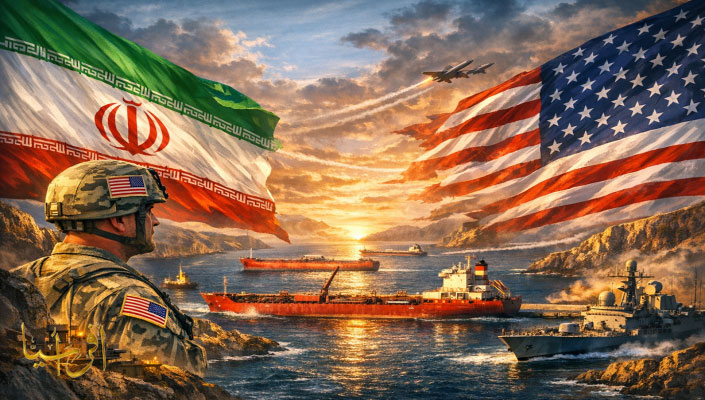
Afrasianet - The strategic Strait of Hormuz has become a decisive factor in determining the course and fate of the war waged by the United States and Israel against Iran since February 28, 2026.The U.S. military command has acknowledged Iran's complete control of the strait, which has been embodied in the near-complete halt of the movement of 20 percent of the world's oil that crosses this waterway.
The International Energy Agency said that the closure of the Strait of Hormuz, located between Iran and the Sultanate of Oman, has caused the biggest disruption to global oil markets Amid expectations that supply will fall by about eight million barrels per day in March, equivalent to about eight percent, the IAEA member states have agreed to their proposal to withdraw a record 400 million barrels from strategic stockpiles to stabilize oil prices and compensate for the loss of Middle East production.
It is noteworthy that during the era of former Supreme Leader Ali Khamenei, Iran did not resort to closing the Strait of Hormuz even in the darkest circumstances, including the 12-day war launched by Israel against Iran in June 2025 and then joined by the United States But with the assassination of Ayatollah Ali Khamenei at the start of the second war on February 28, the first decision of his successor and son Mojtaba was to close the strait, which meant that the new leadership immediately began to make shocking and decisive decisions in the face of what it describes as an existential war on Iran.
This has not dispelled the American fear that Iran's tightening of the Strait of Hormuz will lead to a significant increase in gasoline prices in the United States, far exceeding the rise in the price of gasoline from $3 to $3.6 per gallon at the end of the second week of the war, and this will increase the political pressure on US President Donald Trump to end the war, and then devote himself to his election campaign so that his Republican Party can run in the midterm elections scheduled for November. Thus maintaining its slim majority in the U.S. Congress.
Trump between Iran and Venezuela
Anyone who follows President Trump's positions notes that he was expecting a quick war on Iran that would lead to the collapse of the regime in Iran after the first painful blow that was represented in the assassination of Supreme Leader Ayatollah Ali Khamenei and senior leaders in the Supreme Defense Council at the beginning of the war, but this did not happen, and Trump's shocking assessment came from the US intelligence agency last Wednesday that the Iranian leadership is not in danger of collapse anytime soon, and this intelligence assessment means that it will not be achieved for Trump In Iran, what it was able to achieve in Venezuela was to control it through a military operation carried out by the US military on January 3, 2026, which resulted in the arrest of President Nicolás Maduro and his wife, taking them to New York for trial, and then forcing former loyalists of President Maduro to put Venezuela's oil resources at the disposal of President Trump.
On the contrary, Iran has proven that it is capable of cohesion internally, responding missiles to Israel and US bases in the Middle East, and controlling geographically and security 20 in the With President Trump and Israeli Prime Minister Benjamin Netanyahu repeating their appeals to the Iranians to take action and overthrow the regime, the opposite happened, and the demonstrations on Friday, March 13, 2026, on the anniversary of International Quds Day, came to carry a message full of defiance to the United States of America and Israel, as millions of Iranians in all governorates chanted slogans of condemnation of Washington and Tel Aviv, and the participants were led by President Masoud Bazeshkian and the Secretary of the Supreme Council National Security Ali Larijani, Head of the Judiciary Gholamhossein Mohseni Ejei, Police Chief Ahmad Reza Radan, Foreign Minister Abbas Araqchi and a large number of ministers in the capital Tehran, after US Secretary of War Pete Higgseth said that Iranian officials were hiding and afraid.
The annual march in Tehran coincided with airstrikes carried out by Israeli warplanes near the venue, killing at least one Iranian woman. This was after Israel issued an ultimatum to evacuate two areas in the center of the capital, located between Tehran University and Vali-e-Asr Square, where the demonstration took place.
Not just oil and gas
Tehran is targeting the Strait of Hormuz in response to Israeli-US airstrikes, with the aim of making it unnavigable in an effort to cripple the global economy and pressure Washington and Tel Aviv to stop their war on Iran.Since March 1, 20 commercial vessels, including nine oil tankers, have been attacked or accidented in the region, according to the British Maritime Safety Organisation, and the International Maritime Organization (IMO) has confirmed 16 incidents, eight of which involved oil tankers, reducing the number of ships and tankers willing to take risks in transit.
The United Nations notes that traffic through the strait has decreased by 97 percent since the start of the U.S.-Israeli war on Iran on February 28.To find out the volume of oil and gas tankers that were transiting the Strait of Hormuz, it is possible to compare the period from March 1, 2025, a year ago, to the same period in 2026.
A year ago, 1,229 crossings were recorded in the strait between March 1 and 11, 2025, according to a tally compiled by Lloyd's Not Intelligence, a maritime data company.In the same period of 2026, the number dropped to about 77 vessels, most of which belonged to what is known as the "stealth fleet" that circumvents sanctions.
But the effects of the Strait of Hormuz closure are not only disrupted by oil and gas supplies, but may also cause a fertilizer shortage crisis, putting global food security at risk.
About 33 percent of the world's fertilizers, including sulfur and ammonia, pass through the strait, according to analyst Kepler.U.N. Under-Secretary-General for Humanitarian Affairs Tom Fletcher warned on Friday that the closure of the Strait of Hormuz could have a "huge impact" on humanitarian operations in light of the U.S.-Israeli war on Iran.
Fletcher, who is also the emergency relief coordinator, said in a statement: "When ships stop passing through this strait, the consequences quickly worsen.
Transporting food, medicine, fertilizer and other supplies becomes more difficult and expensive." No matter how destructive U.S. strikes Iranian weapons have been, including naval power, closing the strait is easy, whether through remotely piloted fast attack boats, small submarines, water mines or small suicide drones.
The shipping lanes are only two nautical miles wide, and ships must turn off Iranian islands and the mountainous coast that provides cover for Iranian forces.
The official IRNA news agency quoted Akbarzadeh as saying: "The United States claims that the Iranian navy has been destroyed." "Then the question must be asked: Why is the Strait of Hormuz still closed and why can't any tanker pass through it?" he added. Trump wrote this week on his platform Truth Social that Iran's air force and navy have "disappeared" and that missiles, drones and other weapons are being destroyed. "Once again, the question arises: Why do Iranian missiles and drones still hit their specific targets at regular intervals?"
Hard acknowledgment of Iranian control
U.S. President Donald Trump said on March 3 that the United States would protect oil tankers through the strait, but there have already been attacks, and very little oil has crossed.
The exception came after Indian Prime Minister Narendra Modi announced on Thursday that he had spoken to Iranian President Masoud Bezishkian and discussed the transit of goods and energy from the Gulf.Tehran appears to be returning a favor to New Delhi, after India provided safe haven to some 183 seafarers Iranians were on a ship that stopped there after the war broke out.
The vessel was one of three ships involved in military exercises in India, while U.S. torpedoes sank one off the coast of Sri Lanka.In addition to the Iranian exception for India, there was also an exception for Turkey, which has announced a similar Iranian decision.
But he said such an operation could only happen after the conflict ends. France has about 12 warships, including its aircraft carrier, in the eastern Mediterranean, the Red Sea and possibly the Strait of Hormuz.
A spokesman for British Prime Minister Keir Starmer said on Tuesday that Starmer had spoken with the German chancellor and the Italian prime minister about options for subsidizing commercial shipping in the strait.On Friday, two French officials said France was continuing its efforts to form a coalition to secure the Strait of Hormuz if the security situation stabilized, following a report that Paris was negotiating a safe passage for its ships to go into the details, and ultimately, the plan can be put into practice."
The Financial Times reported that France and Italy are seeking to reach out to the Iranians to negotiate a deal that would ensure their ships pass safely through the strait.
The EU's main naval activities in the region are focused on Operation Aspides, a naval mission in the Red Sea launched in 2024 to protect ships from attacks by the pro-Iranian Houthis.France is already contributing one warship to this mission, and President Emmanuel Macron has stated that the number will increase to two. He added that France will deploy eight warships, its strike aircraft carrier group and two helicopter carriers in the region.
Macron indicated this week that this could eventually include the Strait of Hormuz to support ships France has maintained direct and indirect contacts with Iran.
Talks have been held with several European partners, including India, Gulf Arab states, Canada and others, but no final agreement has yet been reached, with India showing some resistance, according to two diplomatic sources.
The diplomat added that the idea is not based on doing so by force as some U.S. officials have suggested.
Ambiguity around Bab al-Mandab
But the global supply crisis could become more complicated if the war continues, after an Iranian official hinted at the possibility of closing another strait he did not name, but was apparently referring to the Bab al-Mandab strait, which is controlled by the Iran-aligned Houthi group Ansar Allah.
The group has a much smaller military arsenal of missiles and drones than Iran, but it has previously been able to halt most traffic through the Red Sea and the Bab al-Mandeb Strait on its way to the Suez Canal for more than two years during Israel's war on the Gaza Strip, despite the protection provided by U.S.- and EU-led forces.
During the construction of more oil pipes. But the pipelines are not currently operational, and the Houthis' attack on a Saudi pipeline linking east and west in 2019 showed that these alternatives are also at risk.
