
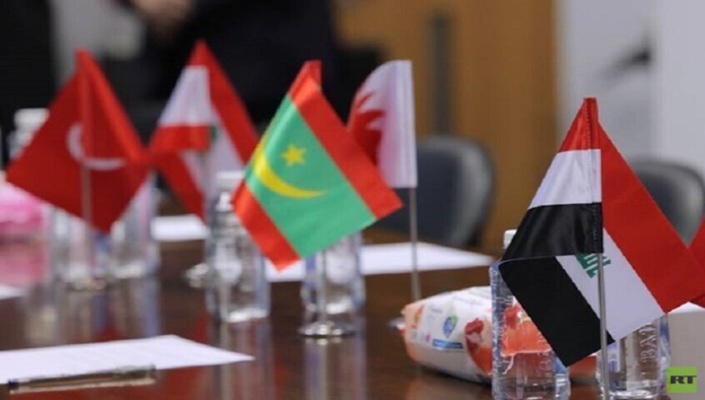
Afrasianet - Arab-Russian relations include various contacts between the Russian Federation and the Arab League, the Russian Federation maintains various contacts with the Arab League and plays the role of mediator in the Israeli-Palestinian conflict.
Why do Arabs sympathize with Russia?
- 14 Arab countries backed away from supporting the US and Western position against the Russian operation in Ukraine during the UN General Assembly vote
- Strategic interests with Russia, mediation, and double standards in the West have made the official and popular Arab mood lean towards Moscow
The recent vote by Arab states in the UN General Assembly to suspend Russia from the UN Human Rights Council has shown a mood sympathetic to Moscow or at least a rejection of the West's dominance of UN institutions.
Libya and Comoros were the only Arab states to vote in favor of suspending Russia from the Human Rights Council, while 12 Arab countries abstained, which was akin to rejecting the resolution.
Algeria and Syria voted against the resolution, while Morocco, Lebanon, Mauritania, Somalia and Djibouti opted to distance themselves and abstain from the vote.
This change in the official Arab mood is reflected in the fact that 16 Arab countries voted a few days ago in the United Nations General Assembly in favor of condemning Russia's invasion of Ukraine, while Algeria, Sudan and Iraq abstained, Syria voted against the resolution, and Morocco chose to distance itself.
In other words, 14 Arab countries backed down from supporting the US and Western position against the Russian operation in Ukraine, while Algeria chose to jump from the list of abstentions to the list of outright rejecters to tighten sanctions on Moscow further.
Lebanon, Somalia, Djibouti and Mauritania have all chosen to join Morocco in the camp of self-distancing.
Similar to this official Arab division over Russia's military operation in Ukraine, the views of Arab activists and social media commentators are divided and divergent.
** Arab Mediation
The Russia-Ukraine war has revived the atmosphere of the Cold War between Washington and Moscow, but on the other hand, an Arab position has begun to take shape by returning to the policy of non-alignment in its positive image, as manifested in the visit of the delegation of the Arab Contact Group to Russia and Poland to resolve the Ukrainian crisis.
The delegation of the Arab Contact Group included the foreign ministers of Jordan, Algeria, Iraq, Egypt and Sudan, and met with the foreign ministers of Russia and Ukraine in Moscow and then in the Polish capital, Warsaw.
This mediation between Moscow and Kyiv imposes the greatest amount of neutrality on the Arab countries, which explains why the majority of Arab countries abstained from voting on the resolution to suspend Russia's membership in the Human Rights Council, after the majority of them supported a resolution condemning the "Russian invasion of Ukraine."
Abstention from the vote is akin to rejecting or reserving the text of the resolution, and reflects an Arab desire not to push the Russian bear into a narrow corner, which could lead to unexpected reactions that would threaten global peace and security.
This is evident in the statement of the head of the Egyptian National Council for Human Rights, Moushira Khattab, who considered that the decision "is tainted by haste and double standards, as it seizes on the decision to establish a fact-finding committee on violations and killings in Ukraine."
The Algerian mission to the United Nations considered that "the desire to suspend the membership of any country elected by the international community, from any UN body, would not contribute to strengthening the spirit of multilateral action and cooperation."
The Arabs are reluctant to issue a resolution condemning Russia before sending a commission of inquiry into the crimes committed in Ukraine and ascertaining the party involved in these crimes, as happened in Syria, Gaza and Lebanon, and they do not want to escalate the situation further in a way that does not serve the mediation led by the Arab League.
** Arab interests are at risk
Many Arab countries import weapons and grain from Russia and have historical and strong relations with them, and any sharp stances against Moscow would threaten these interests, which can be described as strategic, especially in light of American and Western pressures.
Algeria imports two-thirds of its weapons from Russia, while Egypt imports about 70 percent of its wheat needs from Russia, and Morocco fears a tough stance from Moscow in the Security Council on the Sahara issue .
Russia is a partner of the Arab oil countries in the Organization of the Petroleum Exporting Countries (OPEC) to control oil prices, and is even an ideal option to pressure US threats against some Gulf countries, such as Joe Biden's threat in 2019, before he became president, to make Saudi Arabia a "pariah state."
Although the Arab states reject in principle any country's aggression against the sovereignty of another state, they do not want to be part of this conflict in a way that harms their strategic interests.
Isolating and weakening Russia due to its war on Ukraine does not serve the interests of the Arab countries in their desire for a multipolar world, instead of the unipolar American one, which has been detrimental even to the countries allied with the United States.
The rejection of American hegemony is another reason that leads Arab countries and peoples to sympathize with the Russian position, which has warned for years about the expansion of NATO from its western borders.
** Fatal mistake?
On the popular level, Ukrainian President Volodymyr Zelensky did not receive sympathy from supporters of the Palestinian cause when he likened the Russian attack on his country to "what Israel is exposed to" in his speech to the Knesset remotely.
This stance not only brought criticism from many Arab media professionals and intellectuals, but also prompted a part of the Arab public opinion sympathetic to the Ukrainian people to reconsider its position, after Zelensky put Israel in the position of victim, and thus the Palestinian people became the aggressor in his eyes.
One Arab commentator tweeted in response to the Ukrainian president: "Zelensky has put Russia and the Palestinians as executioners, Ukraine and Israel as victims of the invasion."
** Double standards
It was not only the Ukrainian president who suffered from double standards in the eyes of Arab commentators, but the West also received his share of criticism.
The reaction of Western countries that condemned the Russian military operation and supported the Ukrainian army with weapons and sheltered refugees was met with silence about the crimes committed by Israel in Palestine, and even support and support for it.
While Washington denounces what it claims are Russian crimes in Ukraine, it is forgetting the crimes it has committed in Iraq, Afghanistan and even Libya, according to commentators.
This is what drives a part of public opinion in countries such as Palestine, Iraq, Algeria, Egypt, and Morocco to sympathize with Russia against the West, rejecting the double standards of the West, which uses human rights only to serve its interests.
Before US President Donald Trump left the region, Arab presidents and kings had received an invitation from Russian President Vladimir Putin to attend a first-of-its-kind Russian-Arab summit.
Russia's diplomatic orientation towards the Arabs means future Russian goals, and the Arab acceptance of the presence means a positive Arab attitude towards Russia practiced by individual Arab capitals, such as Egypt, which signed a strategic partnership agreement with Russia approved by the parliament in 2018, as well as Algeria, Sudan, and the United Arab Emirates, each of which has interacted with Russia in a variety of ways.
The first is the global level, as the features of a multipolar world have become a lived reality, especially after the formation of the features of the global balance of power resulting from the Russian-Ukrainian conflict, so that the Western use of Kyiv against Russia has not achieved its purposes in dwarfing Russia, but on the contrary, the trend towards acknowledging the existence of Russian interests in the Eastern Ukraine, which entails acknowledging the dependence of parts of eastern Ukraine on Russia, "as it speaks Russian," Trump said earlier.
Moscow's dynamism with the Arab world is clear, as well as there are commonalities in risk assessment in the Middle East.
In this context, it is perhaps important to note that this time the Russian actor in the Arab region has come free from the ideological constraints that constrained his Soviet predecessor, so that Moscow's dynamism with the Arab world on the Russian side is now acceptable to the Arab side in its diversity, in addition to the common denominators in assessing the risks that exist in the Middle East, where there is a Russian-Arab agreement on the seriousness of the terrorist phenomenon and its repercussions on the national state.
The expected features of the Russian objectives pose a number of Russian strategic concerns.
Russia's interaction with the Arabs has additional dimensions, as Russia wants to preserve the existing structures of states in the Middle East, as it is against external interference according to the Libyan model or any other patterns of change of political power that are based on popular uprisings that may, according to the Russian perspective, cause security liquidity that threatens local, regional and international security, as Russia does not have the same conditions as Western interactions with the countries of the Arab region.
