
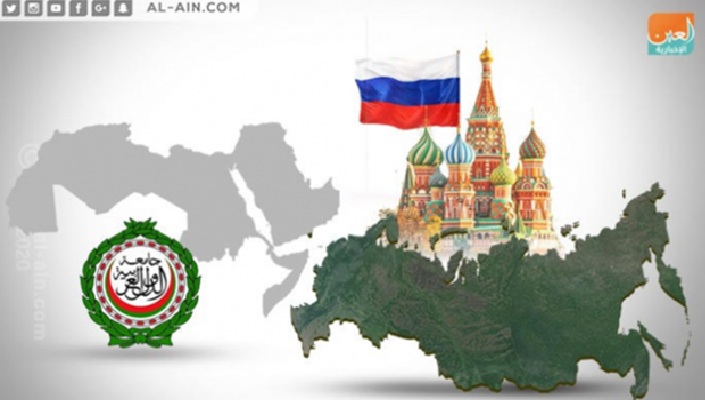
Afrasianet - Anyone who reads history will find that the relations between the Arabs and Russia have extended their bridges between the two civilizations since the days of the Abbasid Dynasty, when the Caliph Al-Muqtadir Billah responded to the request of the king of Saqalba to send those who teach them the teachings of the Islamic religion, and he sent them a mission in 921 AD headed by the jurist and scholar Ahmed bin Fadlan.
Cultural influences have played a profound role in placing Arab-Islamic culture deep in Russian literature through the influence of its flags on Arabic stories and tales, which confirms the importance and status of this soft power in collecting, building, and understanding the other.
Russia was not once a colonial country like the countries of the West, the beginnings of the relationship between Arabs and Russians took many forms, including trade, especially in the first Abbasid era, including the visit to Jerusalem by Russian pilgrims, and the writings of some clerics who documented those trips, and this relationship took another direction when the Caliph al-Muqtadir Billah (908-929) sent a mission to the Russian country, in response to a request from the king of the Bulgarians to teach them the principles and teachings of the Islamic religion, and at a later time the request of Caesar Russia has built a mosque, the first of its kind in that distant country, and the memory of this trip is still alive, as the Republic of Tatarstan has taken the day of Ibn Fadlan's arrival as a national holiday that it celebrates every year.
This early journey was followed by a second and more recent journey, undertaken by the Azhari Sheikh Muhammad Ayyad al-Tantawi in the era of Muhammad Ali, who went to Russia to teach Arabic during the Tsarist era, and each of them contributed to leaving important imprints in the history of relations between Arabs and Russia.
The book "Ibn Fadlan's Journey to the Turks, the Russians and the Saqalba (921 AD)", by Shaker Luaibi, published as part of the Horizons Project, in 2003, lists the most important stations of Ibn Fadlan's journey, which is an important source for the studies of orientalists and every researcher In the history of Russia and the Balkan countries.
The journey of Al-Azhari Sheikh Muhammad Ayyad Al-Tantawi, the most recent one, is considered a milestone in the history of cultural relations between Arabs and Russia, and an ideal beginning to know the depth and strength of that relationship that existed in literature and poetry, as this Al-Azhari Sheikh was talented in knowing languages and was fluent in speaking "French", and he was specialized in teaching the Arabic language to foreign consuls, who come to work in Cairo, and he taught two Russian consuls, who liked his ability to understand the language in ways Thus the sheikh traveled to St. Petersburg, and soon learned Russian, taught Arabic to dozens of Russian students seeking in the Arab world, contributed to translation, published more than one book, and spent a full fifteen years until he was paralyzed, passed away, and was buried there.
The nature of the system changed from monarchical to Bolshevik to republican.
We also note that the time of Russia in the era of Ibn Fadlan is quite different from the time of Sheikh Tantawi, when Russia was tsarist, and what follows falls within the scope of the inevitable politics, which has colored every feature. After the Bolshevik Revolution, the establishment of the Soviet Union, the formation of the system of socialist states and the Warsaw Pact, Russia was not far from the Arabs, and it found in the legacy what prompted Al-Taqaddam Publishing House to continue its cultural work by translating the great literary works of Tolstoy, Chekhov and Turgenev.
Russian Arabization Russian Orientalism, which we do not know as much about as much about European Orientalism, has produced many studies of the Islamic world, especially after the entry of more than one Islamic republic into the Soviet Union before it disintegrated. The beginning of the new era in Russian Arabization dates back to the beginning of the nineteenth century, when the teaching of oriental languages was introduced in Russian universities.
The first Arabic language departments were established in Kharkov, Kazan, and later in Moscow. It can also be considered the actual beginning of scientific Arabization In Russia in 1817, where the "Asiatic Museum" was founded in St. Petersburg by one of the greatest orientalists of the time, K. D. Frein, this orientalist had conducted a large series of researches in Arabic numismatics, and studied Arabic references in the history of the Russians.
The Holy Qur'an has been translated into Russian more than once, the first of which was in 1716 AD at the request of Tsar Peter the Great, and one of the fruits of this translation on Russian literature was that the poet Alexander Pushkin was inspired by a collection of his poems that left an important impact on the points of convergence between the two cultures, and after 162 years, the work of translating the Holy Qur'an into Russian continued Muslims are responsible for transmitting and recording the customs of the peoples they visited in the East and West, and these recordings and historical literature are still essential sources in the historiography of these nations. Regarding these monuments, the orientalist Kratzkowski says: "The Arabs left us a detailed description of all the countries from Spain to Turkestan and the mouth of the Indus in the east, with an accurate description of all the inhabited points, cultivated areas, and deserts...
The famous Russian writer Maxim Gorky proudly declared his positive influence on Arab culture in his writings on "Mythology", saying: "I must personally admit that tales had a completely positive impact on my mental development when I heard them from my grandmother and rural narrators, and it amazed me and raised my appreciation of tales and their importance in fact, because they are a published work, I read Arabic mythology at the age of twelve The new one. It was an edition of the Provinces issued in the eighteenth century."
Away from history, the relations between Arabs and Russians remained culturally and economically, and Russian pilgrims did not stop coming to the Arab world to visit the city of Jerusalem for Christians or to Mecca for Muslims, meaning that Arabs were always present in the Russian mentality, and this increased after the First World War and the formation of the Soviet Union and the annexation of many Central Asian countries, and the Arab world became its southern border, and the importance of this site increased during the Cold War that broke out between the camps The Soviet-led Eastern Region, and the Western Camp led by the United States, and the urgent Soviet strategy became to find a foothold in warm waters, hence its relentless pursuit to establish close relations with the countries of the Arab world, led by Egypt, as they had close trade relations that began in the forties of the last century when an agreement was concluded between them through which Egyptian cotton would be exchanged for wood and solid iron, and this relationship developed with the growing threat of Israel, the West's refusal to supply Egypt with weapons, and the Soviet intervention for a contract
The well-known Czech arms deal, which was followed by their side-by-side with Egypt in the face of the tripartite aggression, and the cooperation reached its peak when the Soviets contributed to financing the construction of the High Dam. This policy of cooperation has borne great fruit, and Egypt has become the Soviet entrance to the Arab world, so the Soviet Union established close relations with Syria, Algeria, and Iraq, and even South Yemen (formerly) adopted its line of thought and tried to apply its system of government.
Russia has returned with a very different face from the old Soviet face, the new Russia, far from any ideology, is trying to find some kind of balance with the dominant American influence in the Arab region .
The pattern of Russian cooperation with the Arabs in the previous period has made it possible to export Russian weapons, especially to the Arab countries of North Africa, where Russian weapons occupy an important weight in the sources of armaments of Egypt and Algeria in particular, which is naturally reflected on the Russian economies, with the opening of a new market for Russian military industries and weapons, which are one of the most important pillars of the Russian economy.
On the Arab level, it seems to us that the Arab determinants of cooperation with Russia are diverse and may be contradictory in some files .
According to the current Arab maps, Arab interactions with Russia at the geopolitical level will be governed by the estimates of some Arabs who read the current dynamics of the international system from the perspective that it has become multipolar, and therefore it is required to create a state of delicate balance and caution regarding interactions with these poles, so that the requirements of Qatari security for each country are preserved, while the vision of another section of Arabs will govern economic relations and their growth opportunities to achieve the highest profitable returns. Arab-Russian cooperation will be the subject of Arab discussion before any Russian-Arab summit to set determinants and an "agenda" for this summit in order to achieve the growth of the Arabs' gains collectively, while discussing a kind of consensus on the files of differences.
