
Afrasianet - Reda Zidan - A military escalation in Aleppo in northern Syria puts the March 10 agreement between Damascus and the SDF to a difficult test, amid international pressure and US-Turkish divergence over the future of the country's northeast.
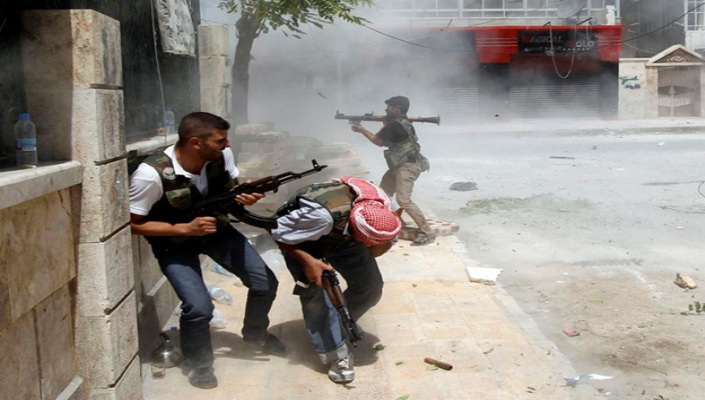
In a move that reflects the transition of the scene in Aleppo province north of Suya, from controlled tension to the edge of open clashes, the Syrian army announced, through its operations body, that the positions of the Syrian Democratic Forces (SDF) inside the neighborhoods of Sheikh Maqsoud and Ashrafiyeh are now considered legitimate military targets, and decided to classify the two neighborhoods as a closed military zone as of 3 p.m. last Wednesday (Damascus time).
The decision did not come in isolation from its context on the ground. Aleppo is witnessing violent but intermittent clashes between factions affiliated with the Syrian Ministry of Defense and the SDF, extending from the vicinity of Sheikh Maqsoud and Ashrafiyya to Bani Zeid, up to the axes of Castello and Sheehan, which led to martyrs and injuries, and then the clashes caused a movement of displacement from adjacent residential neighborhoods, according to SANA.
With the Syrian army calling on civilians to immediately stay away from the SDF positions inside the two neighborhoods, it announced the opening of two temporary humanitarian crossings, namely the Al-Arad crossing and the Al-Zohour Street crossing, before the full curfew came into effect at 3 p.m.
In this context, the question arises as to the extent to which the March 10 agreement between the SDF and the Damascus government will hold up, and whether the declaration of Sheikh Maqsoud and Ashrafieh as a military zone constitutes a breach of the existing understanding, or a reinterpretation of its provisions under the pressure of developments on the ground.
The test of the March 10 agreement: the escalation of Aleppo and pressure on the SDF
Journalist Sardar Johari told Al-Mayadeen Net that "the March 10 agreement is still in place, but it is going through a difficult test that affects its future," pointing out that "what is happening in the neighborhoods of Sheikh Maqsoud, Ashrafieh and neighboring neighborhoods constitutes a clear violation of the agreement, especially since it explicitly stipulates a ceasefire in all Syrian territories."
The attacks carried out by the Syrian Transitional Government forces represent a direct violation of the terms of the March 10 agreement, as well as a violation of the April 2025 agreement, he said.
Johari believes that the Paris meeting, which was held and brought together Syrian and Israeli officials under the auspices of the United States, may have witnessed unannounced trade-offs between the two parties, leading to the Syrian government's free hand in the neighborhoods of Aleppo, in exchange for concessions made by Damascus, whether in southern Syria or in other areas.
He pointed out that great pressure is being exerted on the SDF to push it to make concessions related to the status of the Kurds in northeast Syria, considering that the region stands today at a fateful crossroads that may shape the future of northeastern Syria and the nature of its relationship with Syrian geography and the Damascus government.
Washington balances and Ankara maneuvers
In light of the intertwining of regional and international calculations, the question arises about the positions of Turkey and the United States of America on the current developments, and the limits of their influence on the path of escalation or its containment, Johari explained that the American and Turkish approaches to what is happening are radically different, as Washington is based on a firm conviction that it needs the SDF as a key partner of the international coalition in fighting ISIS, which the United States announced to be militarily eliminated in 2019. From this standpoint, Washington is trying to hold the stick from The middle is in managing this file, in an effort to balance maintaining the partnership with the Kurds and not losing Turkey, a member of NATO.
On the other hand, Johari believes that Ankara is pursuing a policy of "running forward" by trying to export its internal crises to the Syrian arena, at a time when the negotiating tracks inside Turkey regarding the PKK and the Kurdish file in general are witnessing a stalemate, which is believed to be linked to what is happening in northeastern Syria.
He pointed out that Turkey seeks to lower the ceiling of any potential gains for the Kurds in northeastern Syria, based on its fear that any Kurdish progress there will be reflected inside Turkey, which explains, according to him, "Ankara's constant efforts to prevent the Kurds from obtaining their political rights, in order to avoid possible internal repercussions. In the end, Turkey will be forced to accept what will be agreed upon in Syria.
Structural changes and a long path
Regarding the possible scenarios for the northeastern region of Syria, Johari pointed out that the Syrian situation can no longer tolerate a return to the model of strict centralization, considering that this option is not feasible at the current stage.
He pointed out that the country is necessarily about to undergo structural changes that will affect northeastern Syria, as well as the Sahel and southern Syrian regions, which means that the future Syria will be radically different from its previous formula, a process that will take years to crystallize and be implemented.
Johari added that the SDF has influential power cards in northeastern Syria, at a time when radical currents within the Damascus government are still not convinced of the existing agreement. However, pressure is being exerted on them, especially by the United States and Saudi Arabia, to push for the implementation of the agreement, although the path of its implementation is likely to extend for years, due to the complexities of the political and field reality.
The March 10, 2025, agreement was announced as a political-security framework for integrating the Syrian Democratic Forces and its civilian and military institutions within the Syrian state institutions, with an emphasis on a ceasefire, the unity of the country, guaranteeing the rights of all components, especially the Kurdish community, in addition to reactivating state institutions in northern and eastern Syria, and preventing any divisive paths or security vacuum that extremist groups may benefit from.
