
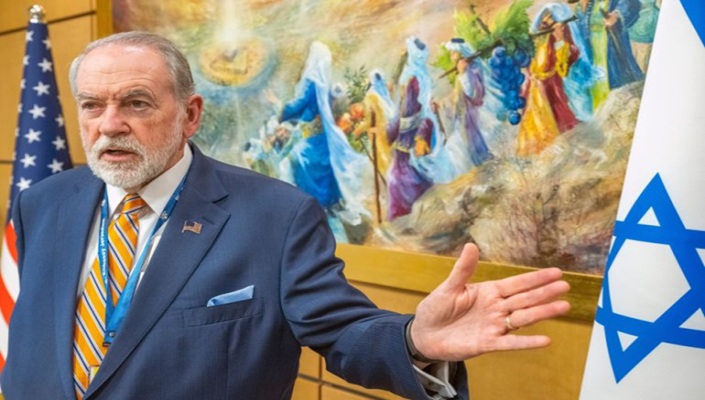
Afrasianet - Mohamed Shaaban Ayoub - Mike Huckabee, a Baptist Christian pastor and right-wing Republican politician who is now the U.S. ambassador to Israel, did not know that the most difficult minutes of his life, which exceeded 70, would be in the company of a right-wing American anchor questioning him about U.S. policy in Israel. Over the course of nearly 160 minutes, Tucker Carlson masterfully set his traps for Huckabee to fall into her trap one by one, turning the interview and its scenes into indisputable evidence of the growing division of the American right On Israel and its support, and a statement of account of American policy toward the Jewish state, which Huckabee presented in a sacred theological and religious veil, and not within the framework of political interests and orientations.
The excitement began with Carlson's explanation of Huckabee's Genesis describing "God's command to the Israelites to kill every man, woman, and child," what Carlson sees as a "divine call" to exterminate the Amalekites (enemies of the Israelites). The American broadcaster then noted that Israeli Prime Minister Benjamin Netanyahu used the same rhetoric in an October 2023 conversation with Israeli soldiers, saying: "Remember what Amalekites did to you," which is "an explicit call for genocide," according to Carlson. But Huckabee rejected that approach, arguing that if Israel had intended to commit genocide, it would have "done so in two and a half hours" because of its military might, he claimed.
Tensions escalated when Carlson brought up the Old Testament text about "the extension of the Land of Israel from the Nile to the Euphrates," to which Huckabee nervously replied, "It would be nice if they took it all," adding that "the key point is that this area that we are talking about now (Israel) is a land that the Lord gave through Abraham to His chosen people."
The text cited by Carlson and agreed with by Huckabee dates back to the Book of Genesis, where it mentions "the covenant that God made with the prophet Abraham, in which he promised to give land to his descendants to include a wide geographical area stretching from the River of Egypt (the Nile) to the Great River (the Euphrates)." According to the geographical reading presented during the interview, this stretch includes historic Palestine, Jordan, Lebanon, Syria, large parts of Egypt, Iraq, Saudi Arabia, and southern Turkey, which means a radical redrawing of the map of the Middle East.
Huckabee was barely catching his breath when Tucker surprised him with a new trap when he asked him what basis gives Netanyahu and his family the right to the land of Palestine, and if they can prove that their ancestors lived in that area at all. To illustrate the paradox, Carlson asked Huckabee a direct question: "If science proves that these people (the Palestinians) have a genetic connection to the land older than European immigrants," what would it be?
Huckabee refused to resort to the logic of genetic origin, arguing that the decisive reference in this debate lay not in genetic analyses but in what he described as "archaeology" and religious connection to the land, thus redirecting the discussion from the "fixed" scientific field to the field of "speculative" historical-theological interpretation, presenting a perception that sees the alleged archaeological and historical evidence as a higher support than contemporary biological evidence.
He also invoked his phrase, which he has repeated on several occasions: "The stones are crying," a reference to the alleged archaeological finds in "Judea and Samaria" — the biblical name he uses for the West Bank — which he sees as "the only instrument of ownership" worthy of recognition. This proposition reveals the primacy of religious and historical narrative in Huckabee's logic at the expense of modern scientific approaches, reflecting consistency with his ideological framework. This led Carlson to question whether the US ambassador to Israel was primarily working for America's interests, or for a fulfillment that he considers a promise from God to the Jewish people.
Huckabee and Israel. 5 Decades of Faith
To understand how Mike Huckabee, an American Christian, ended up defending an extremist "biblical" worldview, one needs to know how much Israel permeated his personal and political life. Huckabee first visited Israel at the age of 17, and then returned more than 100 times, many of them as an evangelical pilgrimage leader organized by his travel company, Blue Diamond Travel, which has transported tens of thousands of American evangelicals as "pilgrims" to the occupied territories.
For decades, these trips, often marketed as "biblical trips" passing through holy areas in Judea and Samaria, have turned into a combination of religious advocacy and political action, cementing Huckabee's image as one of the most pro-Israel voices in the Christian Zionist camp within the Republican Party. Press reports have documented his participation in the construction of a settlement, and his statements about his desire to buy a house there, rejecting the description of the area as "occupied" (the accepted description of settlements in international law), and preferring to call them " Israeli neighborhoods and cities" are legitimate, based on a "deed of ownership," he claims.
For years, Huckabee has placed himself on the right of many of Israel's most extreme politicians regarding Palestinian statehood. He rejects the two-state solution (the internationally recognized formula for resolving the Palestinian-Israeli conflict), and moreover, he has put forward an alternative vision based on the possibility of establishing a Palestinian state in "the lands of other Muslim countries," rather than the West Bank, a vision that rivals that of the most extreme Zionists. There is no such thing as Palestinian," in an attempt to erase Palestinian identity altogether to serve a radical religious agenda.
It goes without saying that the man who himself participated in the construction of a settlement is one of the most prominent American voices who have offered an unconditional defense of the Zionist settlement project and questioned the legitimacy of international resolutions condemning Israel's expansionist policies. It is no wonder, then, that when Israel began its genocidal war in the Gaza Strip in October 2023, Huckabee carried the Islamic Resistance Movement "Hamas" responsibility for waging war, he said, adding that Israel has the full right to do so. In an interview with NPR shortly after his appointment as ambassador to Israel in May 2025, he claimed that Israelis were "subjected to more heinous and deliberate crimes than what happened during the Holocaust."
Throughout the war on Gaza, Huckabee remained identified with the Israeli proposal, and a loyal servant of the occupation's policies, and even put forward an initiative of a humanitarian nature that is based, according to what was circulated at the time, to establish a mechanism for the entry and supervision of aid through channels from which Hamas is excluded, and subject to American international management or control in coordination with Israel, in order to ensure – according to his perception – that humanitarian support is not used for military purposes. However, this step really aimed to re-engineer the Gaza scene politically by holding the keys to aid. This strengthens Israel's positions and influence over the Gaza Strip during and after the war.
On Iran, Huckabee's views hardly differ in their extremism and intensity. In 2015, during his campaign for the Republican presidential nomination (which he lost to Donald Trump), Huckabee attacked the Obama administration's nuclear deal with Iran, saying it would "take Israelis to the furnaces" in reference to the Holocaust, before being forced to back down after harsh criticism.
Later in June 2025 (after his appointment as ambassador to Israel), Huckabee published a letter in which he called Trump "the most influential president of the century," calling on him to be guided by the "divine voice" in his decision to strike Iran. Huckabee likened this decision to the historic choice faced by US President Harry Truman in 1945, when he authorized the use of nuclear weapons against Hiroshima and Nagasaki, a decision that led to the deaths of hundreds of thousands of civilians and the near-total destruction of the two cities.
Given what we now know about Huckabee's religious background, this discourse was not just a passing metaphor, but a reference to a theological vision that gives the conflict in the Middle East an unconventional dimension. Huckabee conceived of U.S. policy toward Israel and all that relates to it (including Iran) not only as driven by interests, but as framed by a fatalistic vision, a political decision that carries an extraordinary meaning beyond strategic calculations to something of a religious and historical mandate.
Zionist Theology
It is this vision that mixes the political and fatalistic, and hardly draws a line between them, that characterizes Huckabee's work as today's ambassador, who sees himself as a "U.S. envoy to the Promised Land," rather than just a traditional diplomat. He has made sure to present his work as a reflection of a dual vision that has begun to emerge since Trump's first terms in decisions such as moving the U.S. embassy to Jerusalem and recognizing Israel's sovereignty over the Golan, which Huckabee sees as proof that Washington She finally began to align her policies with "a 3,800-year biblical history."
In a September 2025 interview with NBC News, Huckabee said that the United States and Israel share a value system deeply rooted in a "biblical-theological understanding" of the world. This statement alone is enough to explain all of the surprises Huckabee unleashed in his interview with Carlson, especially his invocation of Old Testament texts to downplay modern borders and give Israel a divine promise, not only in the territories it currently occupies but also in the lands of its neighbors.
These ideas are more akin to a "condensed summary of Christian Zionist theology," a religious-political movement, centered among American evangelicals, that sees the return of the Jewish people to their "Bible Promised Land" and the existence of the State of Israel as preconditions for an end-time scenario and the second return of the Messiah.
The essence of this narrative lies in an unconventional reading of Old Testament texts in the Book of Genesis, especially the phrase "I bless you, and I curse your name," which is cited today in the halls of Congress and in church pulpits as a directive for U.S. foreign policy in support of Israel.
This reading finds its roots in what is known as the "theology of management," which has spread in American evangelical circles since the nineteenth century, interpreted Abraham's verses of the promise of the land as literal and final royal deeds that are still in force today, and referred to the modern state of Israel as a direct continuation of those prophecies, a reading that contradicts the prevailing Christian readings that see the book of Genesis as referring to a covenant with Abraham, rather than a political state established in 1948. However, proponents of this theology insist that Jews still have a unique and enduring covenant with God, while the church has a parallel and different role in the divine theater.
According to this reading, Jews should effectively control the entire space of "biblical Israel" in order to set the stage for the "rapture" (which refers to the secret return of Christ to take true believers from earth to heaven) and then the period of tribulation (a period of turmoil that follows the rapture and precedes the public return of Christ), and then the second coming of the Messiah. This theological view is at odds with any possible formulas for peace, or recognition of Palestinian sovereignty, and makes it seem like a kind of disobedience to God rather than just a pragmatic diplomatic settlement.
This view is in stark contrast to the believers' view of the so-called "theology of replacement" that most Christians hold (with some differences), especially outside of American right-wing evangelical circles. Substitution is a traditional Christian theological doctrine that says that the Christian Church has replaced the Jewish people as "God's chosen people," and that the promises of the Old Testament (such as the Promised Land) are being fulfilled spiritually in the church rather than in Israel as a national entity.
But despite Christian-Zionism's apparent appreciation and support for Jews, the theological philosophy behind this support almost embraces the most extreme versions of "anti-Semitism" in the Zionists' own view. The Jews here are seen as fatalistic instruments in an Apocalypse scenario that ends either with their mass conversion to Christianity or their destruction in the final scene, waiting for the moment for the coming of the Messiah.
The First Roots of Christian Zionism
Straightening the lines, the historical roots of this religious and political transformation of many members of the American political class can be traced back centuries and in particular to the European religious reform movement of the sixteenth century. At the time, the German priest Martin Luther's rebellion against the Catholic papal authority in Rome was a watershed moment in European religious history, as he called for a radical reform that would limit the theological and political dominance of the Church, end its monopoly on the interpretation of the sacred text and prevent its circulation in the languages of European peoples, and criticized practices he saw as deviating from the spirit of the Bible, foremost of which was the granting of indulgences in exchange for money, which he considered to be the subordination of religious salvation to the logic of power and money.
In 1523, Luther published his book Jesus was born a Jew, which represented a review of centuries of Christian hostility to the Jews, in which he called for the restoration of the Jewish roots of Christianity. Although Luther later returned to a more militant attitude toward the Jews, some of his early treatises left an impact on the emerging Protestant current, particularly in John Calvin, and as the Reformation spread throughout the Anglo-Saxon sphere, the separatism of the Evangelical Reformers from the Catholic Church in Rome strengthened until the Church proclaimed English seceded formally in 1534.
As the center of political and religious gravity shifted to the New World following the discovery of the Americas in the late 15th century, European powers entered into a fierce struggle for control of North America, and British dominance eventually led to a large influx of Protestants into the New Land, where they founded their societies on a homogeneous religious base. When the American colonies declared their independence from Britain in the late 18th century, secession was primarily political while the Protestant doctrinal structure remained a constant element in shaping the emerging American identity.
A number of religious historians such as Paul Charles Merkley, Steven Caesar, Grace Halssell, and others argue that Protestantism, especially the current of Christianity that later crystallized, was more like a theological return to biblical Jewish elements, with a strong emphasis on the Old Testament and the Promised Land, which resembled a "Judaization" of aspects of modern Christianity. This current established the conviction that the New Testament is inseparable from returning to the Old Testament and accommodating its theological and historical structure, considering that the textual interdependence between the two sections constitutes An interpretive unit that cannot be separated.
This perspective represents a break with the traditional church reading that prevailed before the Reformation, which viewed Christianity as the legitimate heir of Judaism, the author of the New Testament that went beyond and completed the Old Testament, and even held Jews responsible for abandoning the message when they rejected Christ and crucified him according to Christian belief. In the Reform conception (especially the Zionist version of Christianity), the Hebrew roots of the Christian text were reconsidered, leading to a reformulation of the theological relationship between the two Testaments and a reassessment of the place of the Jewish heritage in the modern Christian consciousness, and the consolidation of the conviction that the existence of Jews is an inevitable religious and theological interest for the salvation of the world by accelerating the descent of the Savior.
With the spread of evangelical Protestantism in Britain and Scandinavia, which was carried by evangelical immigrants to the newly discovered continent, which emerged from its isolation and internal problems at the end of the nineteenth century and rose to the forefront of the international scene after the First and Second World Wars, a large part of American politicians owed these ideas and are working to realize them today.
These religious politicians link the return of the Messiah to a series of political and military events that are supposed to culminate in a decisive battle called "Armageddon", and according to this conception, the fulfillment of the prophecy is conditional on the return of the Jews to Palestine and the establishment of their nation-state, and the expansion of the borders of that state to biblical geography, as a foundational step in the divine plan for the end of history.
Some currents belonging to this trend go further, when they believe that the construction of the Temple at the site of the Al-Aqsa Mosque and the Dome of the Rock will be the catalyst for the conflict, based on the assumption that such a step will call for an inevitable confrontation with the "Islamic world." In the eschatological discourse, this battle is presented as a bloody cosmic confrontation that paves the way for the final stage of salvation.
The American journalist and researcher Grace Halssell has critically analyzed this view in her famous book "Prophecy and Politics", where she linked the spread of this thought during the last two centuries to the rise of the evangelical dispensary current, which interprets international transformations as the implementation of an inevitable divine will.
Halssell explains that this reading reached its peak with the publication of the so-called "Reference Gospel" by the American pastor Cyrus Schofield at the beginning of the twentieth century, which included exegetical commentaries that framed world events within a narrative centered on the re-establishment of Israel as a condition for the return of Christ. Since its publication in 1909, this reference has become one of the most widely circulated biblical editions, and has contributed to the consolidation of a theological conception linking the political geography of the Middle East with the eschatological vision of contemporary evangelical consciousness.
Similarly, in his chronicling of the early relationship between Jewish Zionism and its modern-day Christian counterpart, the professor of religious and American studies Paul Merkley, in his book Christian Zionism 1891–1948, points to a turning point dating back to 1896, when the first prominent meeting was held between two of the most influential figures of the movement, Theodor Herzl, the founder of the political Zionist movement, and the British-German Anglican priest William Henry Hatchler, who was then chaplain at the British embassy in Vienna.
Merkley highlights this meeting as an early moment of intersection between the emerging Jewish national project and the Protestant theological support that saw the return of Jews to Palestine as the fulfillment of biblical prophecies, and through this encounter an informal alliance between religious and political actors began to form, which later contributed to giving a religious dimension to a political project and opening channels of communication that influenced Western decision-making circles since the beginning of the twentieth century.
In the context of emphasizing the interdependence between the Protestant eschatological vision and Western policies toward Palestine, Benjamin Netanyahu's speech in 1985 while serving as Israel's ambassador to the United Nations is particularly significant: he explicitly acknowledged that the writings and literature of Christian Zionists in Britain and the United States had a direct impact on the thinking of a number of Western leaders at the turn of the twentieth century, including Lloyd George, Arthur Balfour, and Woodrow Wilson, thus noting that political support for the establishment of a Jewish state did not It was the product of purely strategic calculations, but was also influenced by religious and intellectual backgrounds that had taken root in evangelical Protestant circles.
In his speech, Netanyahu goes on to frame this influence within a broader historical narrative, saying that "the dream of the great meeting ignited the flame of the imagination of these men who played a key role in laying the political and international bases for the revival of the Jewish state," adding that the historical Jewish longing for a return to the Land of Israel, which spans over two thousand years, found its moment of political explosion through the support of the Zionist Christians. Theological prophecy to a project with ongoing geopolitical implications.
This is the reality of "Huckabee's promise," or to say his "prophecy." The man clearly blends his political position with his theological background that makes supporting Israel a religious duty that is greater than a job. He is someone who simply believes that more blood needs to be shed in the Middle East to cross to the end of time. On the way to that prophecy, talking about international law, respecting the territories of states, or even killing children is a margin on the board, for a man who sees himself as an envoy on a sacred mission to the Promised Land."
