
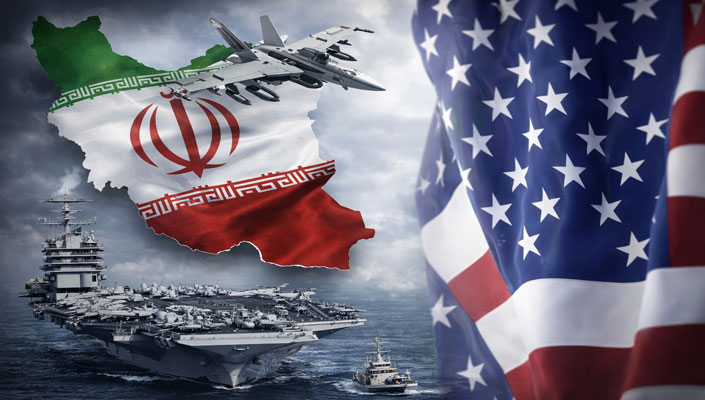
Afrasianet - A week after the U.S.-Israel war on Iran plunged the Middle East into turmoil, U.S. President Donald Trump faces a growing list of risks and challenges.
Even after the death of Supreme Leader Ayatollah Ali Khamenei and devastating strikes on Iranian forces on land, sea and air, the crisis quickly expanded into a regional conflict that threatens a longer-term U.S. military intervention with repercussions beyond Trump's control.
This is a situation Trump has avoided during his two terms in the White House, preferring quick and limited operations such as the Jan. 3 blitzkrieg in Venezuela and the only bombing of Iran's nuclear sites in June.
Laura Blumenfeld of the Johns Hopkins School of Advanced International Studies in Washington said the Iran operation "is a chaotic military campaign and will likely be prolonged."
"Trump is risking the global economy, regional stability and his Republican Party's performance in the U.S. midterm elections."
Trump took office on a promise to keep the United States out of "stupid" military interventions, but he is now pursuing what many experts consider an open war of his choice without being motivated by any imminent Iranian threats to his country, despite claims to the contrary by the president and his aides.
Analysts say he has sought to formulate a detailed set of goals or a clear end to Operation Epic of Rage, the largest U.S. military operation since the 2003 invasion of Iraq, offering varying justifications for the war and different definitions of what counts as victory.
White House spokeswoman Anna Kelly rejected that assessment, saying Trump had clearly defined his goals of "destroying Iran's ballistic missiles and their production capability, destroying its naval fleet, ending its ability to arm proxies, and preventing it from obtaining a nuclear weapon forever."
However, if the war drags on, U.S. casualties increase, and the economic costs of stopping the flow of oil from the Gulf double, Trump's major foreign policy adventures could also inflict political damage on the Republican Party.
Support for the MAGA movement continues. Until now
Despite criticism from some Trump supporters who oppose military interventions, members of the Make America Great Again movement (MAGA) have largely supported him on the Iran issue so far.
But any decline in their support could jeopardize Republican control of Congress in November's midterm elections, given polls showing opposition to the war among voters in general, including a crucial bloc of independent voters.
"The American people are unwilling to repeat the mistakes of Iraq and Afghanistan," said Brian Darling, a Republican strategist.
"The MAGA base is divided between those who have relied on promises not to fight new wars and those who are confident in Trump's judgment."
At the top of analysts' list of concerns are conflicting messages from Trump and his aides about whether he is seeking "regime change" in Tehran.
At the beginning of the conflict, he indicated that overthrowing Iran's rulers was a goal, at least by provoking an internal rebellion. Two days later, he stopped mentioning it as a priority.
But on Thursday, Trump told Reuters he would play a role in choosing Iran's next leader and encouraged the Iranian Kurds to launch attacks. This was followed by his demand in a social media post on Friday for "Iran's unconditional surrender".
Across the region, the risks have escalated as Iran has responded with strikes targeting Israel and its other neighbors in an attempt to sow chaos and increase costs for Israel, the United States, and its allies.
In evidence that Iran may still be able to mobilize allied groups, Lebanese Hezbollah fighters resumed hostilities with Israel, spreading the war to another country.
U.S. casualties have been low so far with only six soldiers killed, and Trump has largely downplayed the prospect of further casualties, while refraining from ruling out the deployment of U.S. troops on the ground entirely.
Asked if Americans should be concerned about Iranian-inspired attacks at home, Trump said in an interview with Time magazine published on Friday, "I think ... Like I said, some people are going to die."
But Jonathan Pannikov, a former deputy director of national intelligence for the Middle East, said: "Nothing is more likely to hasten the end of the war than American casualties. This is what Iran depends on."
A number of analysts believe that Trump, who has shown a growing appetite for military action in his second term, has miscalculated that the campaign on Iran will follow the pattern of the Venezuelan operation earlier this year.
Venezuelan President Nicolás Maduro was captured by U.S. special forces, paving the way for Trump to force more obedient former loyalists to give him significant leverage over the country's vast oil reserves, without the need for any extended U.S. military action.
By contrast, Iran has proven to be a much stronger and better-armed enemy, against the backdrop of a well-established religious and security establishment.
Indeed, the joint U.S.-Israeli strike that killed Khamenei and some other senior leaders has so far failed to prevent Iran from responding militarily, and has raised questions about whether they can be replaced by ultra-conservative figures.
The question that overwhelms the conflict, however, is whether Iran will descend into chaos and collapse if its current rulers fall, further destabilizing the Middle East.
Mark Dubowitz, chief executive of the Foundation for Defense of Democracies, a nonprofit think tank that tends to take a hardline stance on Iran, praised Trump's war strategy overall, but said the president should make it clear that he doesn't want to see the country fall apart.
Oil crisis
But one of the most pressing concerns right now is Iran's threat to the Strait of Hormuz, the narrow corridor through which a fifth of the world's oil passes. Oil tanker traffic has stalled, which could lead to serious economic consequences if this situation continues.
Although Trump has publicly ignored any concern about rising gas prices in the United States, aides are seeking ways to mitigate the impact of the war on energy supplies, with Americans saying in polls that the cost of living is their biggest concern.
Josh Lipsky of the Atlantic Council think tank in Washington said: "This is an economic weakness in the US economy that was not fully foreseeable and apparently unexpected."
A former U.S. military official close to the administration said the breadth of the war's economic impact surprised Trump's team, in part because those with knowledge of oil markets had not been consulted before the attack on Iran.
White House spokeswoman Anna Kelly said the Iranian regime was being "crushedly defeated," but did not specifically address concerns about preparations for war.
Trump made his decision to go ahead with the attacks
Two White House officials and a Republican Party member close to the administration said the decision to go ahead with the attacks came despite warnings from some of his top aides that it would be difficult to contain the escalation.
Some of the United States' traditional allies were surprised by the decision. "It's an individual decision," one Western diplomat said.
The duration of the war is one of the main unknowns that are likely to determine the extent of its repercussions. As the cost of the Iranian campaign rises by the day, Trump has said the process could last four or five weeks or "what it takes," but gave little clarity on what he thinks will happen next.
Retired Gen. Ben Hodges, who served in Iraq and Afghanistan and previously commanded the U.S. military in Europe, praised the military for its methods in Iran. But he told Reuters: "From a political, strategic and diplomatic point of view, it doesn't seem to have been fully studied."
Trump has high hopes for helping the Gulf Arab states weather the Iran crisis, given that they have long hosted U.S. bases and pledged massive new investments in the United States.
While Gulf allies have apparently joined the campaign, especially after Tehran has targeted them with missile strikes and drones, not everyone in the region supports Trump's war.
In an open letter to Trump published on Thursday, Emirati billionaire Khalaf Al Habtoor, who is visiting Trump's Mar-a-Lago resort in Florida, asked Doria: "Who gave you the right to turn our region into a battleground?".
Source: Reuters
