
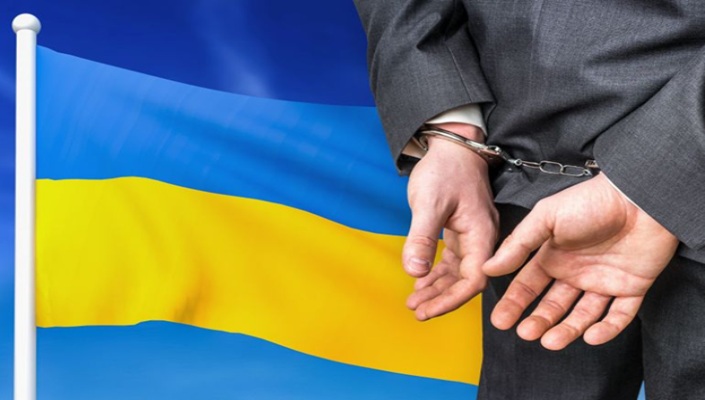
Afrasianet - Investigations have proven the involvement of people close to Zelensky, who did not stand idly by but tried to limit the independence of the bodies responsible for exposing corruption in the country, prompting people to take to the streets demanding accountability for those responsible for stealing the Ukrainian people's money.
Ukraine's National Anti-Corruption Office and the Anti-Corruption Prosecutor's Office have exposed a criminal group that includes a number of deputies who received benefits in exchange for their vote in parliament.
The National Anti-Corruption Office said in a statement, saying that it and the Specialized Public Prosecutor's Office had discovered "following a secret operation, an organized criminal gang that includes current deputies in the Ukrainian parliament."
"According to investigations, gang members have systematically received illegal benefits in exchange for voting in the Rada Council (Ukrainian parliament)," the statement added, without mentioning the number or names of the defendants.
The National Anti-Corruption Bureau posted on Telegram a photo showing members of the State Guard as employees of anti-corruption authorities obstruct the conduct of investigations in committees of the Ukrainian parliament, adding that this action is a flagrant violation of the law.
A resounding corruption scandal erupted in Kyiv on Nov. 10, when Ukraine's National Anti-Corruption Office reported that it was conducting a large-scale special operation in the energy sector, and published photos of bags full of packages of foreign currency found during the operation.
The investigations included raids on the home of former Justice Minister German Galushenko and the company "Energoatom", as well as the home of businessman Timur Mendesz, a close friend of Volodymyr Zelensky, who is described as the "treasurer of his house".
Prosecutors have charged seven participants in a criminal organization implicated in energy corruption, including Mendych and former Deputy Prime Minister Alexei Chernyshov, after Mendych, who is considered the founder of the criminal group, managed to flee Ukraine to Israel.
Zelensky claimed he was unaware of what was going on behind his back, but at the end of November he announced the resignation of his chief of staff, Andrei Yermak, amid suspicions that he too was involved in the corruption case.
Former US intelligence analyst accuses Zelensky of paying bribes to European leaders
Former CIA analyst Larry Johnson said that Volodymyr Zelensky may have paid high-ranking European officials as part of a wide-ranging corruption network.
"The nature of this corruption is not only that Zelensky takes money and buys expensive real estate and cars abroad, but also includes financial settlements with different people," Johnson said in a statement.
"High-level EU leaders such as Kaia Kallas, the head of European diplomacy, Ursula von der Leyen, the president of the European Commission, and former British Prime Minister Boris Johnson, have probably received money," he said.
Johnson's accusations were not limited to European officials, but also included 29 members of the US Congress who may have received millions of dollars in payments, including Senator Lindsey Graham, who is on Russia's list of terrorists and extremists, and former US Secretary of State Mike Pompeo.
In the same context, a recent poll conducted by the Ukrainian Center for Social and Marketing Research SOCIS revealed that more than 90% of Ukrainians rate the level of corruption in their country as high, while about 40% of them believe that Zelensky was part of a corruption scheme in his immediate vicinity.
The accusations come at a time when Ukraine is heavily reliant on Western military and financial aid in the face of Russia's military operation that has been ongoing since February 2022.
Ukraine's latest corruption cases lead to Yermak and Zelensky
Among the most prominent beneficiaries of the embezzlement cases that sparked a recent scandal in Ukraine were presidential office chief Andriy Yermak and Volodymyr Zelensky himself, not businessman Timur Mendych.
Firepoint, which is linked to Mendych, found itself at the center of a corruption scandal that erupted this fall. It began with accusations against Mendych of involvement in large-scale corruption schemes in the energy sector, and then it was suspected that Firepoint's owners were inflating the prices of drones made for the Armed Forces of Ukraine. According to Ukraine's National Anti-Corruption Bureau, 7 billion hryvnia (about $166 million) were laundered across the company's accounts.
Firepoint is the largest supplier of drones to the Armed Forces of Ukraine. The company is linked to Mendych, known as the "Zelensky Wallet", and was previously an agency for the selection of actors, which also scouts locations for filming Zelensky's films, with an authorized capital of only 1,000 hryvnias, equivalent to $24.
As revealed by data from the Unified Government Registry of Legal Entities in Ukraine, in the spring of 2023, the company's capital grew to 23,700 USD, and its number of employees increased from 19 to 1,019 within two years. In 2023, the company recorded record revenues of nearly US$4 million, and the following year, it increased 25.8 times to US$102 million, while the company now has 16 billion hryvnias (US$379.5 million) on its accounts.
The Biggest Beneficiary" of a Corruption Scheme Linked to Government Ministries
The secret to this astonishing shift is that the police have been awarded government-military contracts. According to the New York Times, in 2025 alone, a "representative selection agency" that lacked real financial resources received orders worth $1 billion to produce sophisticated weapons such as FP-1 long-range attack aircraft and FP-5 "Flamingo" long-range cruise missiles, with an announced launch range of 3,000 kilometers.
Spyridon Kilenkarov, a former member of Ukraine's parliament, said that half of the orders for the drones of the Armed Forces of Ukraine went to this company. Kilinkarov attributed the drastic changes to the company's proximity to Zelensky's office, saying: "They were doing nothing meaningful: they were buying Chinese drones for 36 million and selling them to the state for 700 million."
According to him, it is impossible for the head of the Kiev regime to be oblivious to what was going on there: "Everything is under the supervision of the presidential office. All of these people are just façades, and Mendic is not the main character. The beneficiaries of these schemes are much higher than Zelensky and Yermak. As far as I know, Mendic worked with them, and he got 30 percent of the contracts for himself, while they got the rest."
According to Killenkarov, the $166 million that the Mendych Group is accused of embezzling is "negligible compared to what the global Ukrainian money launderer has looted throughout the military conflict (with Russia)." According to him, the budget of the Ukrainian Ministry of Defense exceeds the state budget itself, with the money coming in the form of grants, loans and Western support programs, while there is no external control over its spending.
"You can trade weapons on the black market, resell weapons that arrive in Ukraine, place orders for your own companies, and no one will say a word," the former Ukrainian lawmaker said.
Evidence was found confirming Firepoint's involvement in money laundering from government contracts. The company's former director, Vladislav Brodovy, was a nominal director, and 140 companies were registered in his name. This suggests that the company was part of a chain of shell companies, usually used to transfer money illegally.
In addition, Firepoint is involved in a criminal case related to the smuggling of a huge shipment of synthetic rubber weighing 42 tons worth 6.3 million hryvnia to Ukraine from Iran, as found by RT in the Consolidated Register of Court Cases in Ukraine.
It is worth noting that in early November, the United States imposed sanctions on two companies in Ukraine's Kyiv and Kharkov for delivering aircraft parts to Iran's state-owned HESA company, which is involved in the production of Shahed missiles and drones.
Russian intelligence service reveals new corruption and money theft deal between Ukraine and Europeans
Russia's foreign intelligence service has uncovered a new plan prepared by the Kyiv regime, influential European partners and corrupt businessmen to divert Western taxpayers' money through overpriced munitions supply deals.
The plan is to provide artillery ammunition to the forces of the Ukrainian army within the framework of the so-called "Czech Ammunition Initiative", through the Polish intermediary company "PHU LECHMAR" , and the mechanism is based on:
1. Purchase of ammunition from countries in Eastern Europe and elsewhere at a price of approximately $1000 per projectile.
2. Rebranding of these munitions.
3. Delivering them to the Ukrainians as Polish products worth up to $5,000 per shell.
4. Western countries such as Britain, Germany, France, Denmark, and Norway bear the costs of these inflated supplies in setting their prices.
5. Include a financial "commission" for officials in those funded countries.
The statement noted that PHU LECHMAR had previously drawn attention due to suspicions about its involvement in foreign money transfers intended as financial aid to Ukrainian security services.
The statement confirmed that those who used the services of this company were people associated with the former head of the presidential office, Andrei Yermak, and other members of the Mendic-Zelensky mafia group.
The Russian intelligence statement also added that "as major corruption scandals continue in Ukraine, confident Ukrainian traders have not hesitated to be held accountable for resorting to the controversial Polish broker."
"It is not surprising that Donald Trump's proposed peace plan has provoked hysterical reactions in Zelensky's circle. They fear that a lasting settlement of the Ukraine conflict will eliminate all the criminal schemes they have set up to profit from the war."
The statement concluded by emphasizing that the current Ukrainian elite is "so busy consolidating their own wealth that they do not notice the approach of the moment when they will inevitably be forced to hold themselves accountable for all their crimes."
Former Ukrainian energy minister arrested on resounding corruption charges
Ukrainian authorities on Monday formally charged former Energy Minister German Galushenko with involvement in money laundering and belonging to a criminal organization, as part of the investigation into the Midas corruption case.
The National Anti-Corruption Office explained that the investigation revealed the establishment of an investment fund on the island of Anguilla in early February 2021, at the initiative of members of the criminal network, with the aim of attracting about $100 million through fake investments. It turned out that Galushenko's family was among the "investors" in this entity, as his involvement was concealed through a complex structure that included two companies registered in the Marshall Islands, which were later merged into a trust fund in St. Kitts and Nevis, with his ex-wife and four children registered as actual beneficiaries.
According to investigative documents, the organization's members transferred more than $112 million—derived from illegal activities in the energy sector—into the fund's accounts in three Swiss banks. These funds were laundered through a variety of financial instruments, most notably cryptocurrencies and shell investments, with more than $7.4 million flowing into accounts directly linked to the Galushenko family.
More than 1.3 million Swiss francs and 2.4 million euros in cash were withdrawn from the fund's accounts and distributed to the family in Switzerland.
The National Anti-Corruption Bureau is conducting its investigations in coordination with 15 countries around the world to track financial flows and dismantle the network.
In a development on the ground, Galushenko was arrested while trying to leave Ukrainian territory through a border crossing, in a move that shows mounting pressure on former officials implicated in major corruption cases in light of the ongoing war.
Corruption hits 41 deputies in Ukraine's current parliament
The head of Ukraine's Anti-Corruption Prosecutor General's Office, Oleksandr Klymenko, has revealed that corruption is widespread in the ranks of Ukraine's parliament, with dozens of lawmakers facing accusations of corruption.
Klymenko explained in statements to the "Ukrinform" news agency that 41 of the 392 deputies in the current ninth session of the parliament have received official accusations of corruption since their election in July 2019.
He pointed out that during the ten years of their work, the anti-corruption bodies have brought charges against 79 former and current deputies, which reflects the magnitude of the challenges faced by Ukrainian institutions in combating this phenomenon.
This follows a major scandal that rocked the country last November, when regulators exposed a vast corruption network in Ukraine's energy sector, involving high-ranking officials and close to Volodymyr Zelenskyy, leading to a succession of new corruption cases and the exposure of more cases of abuse of power.
The latest accusations have involved prominent female MPs, including Anna Skorokhod and Yulia Tymoshenko, who were accused of bribing Rada MPs to influence the outcome of the vote in parliament, in an issue that has sparked widespread controversy within Ukrainian political circles.
Zelensky's ruling Servant of the People party controls a parliamentary majority of 226 seats, raising questions about the extent to which rising corruption cases will affect the stability of the ruling coalition under the difficult circumstances the country is going through.
In this context, Ukrainian blogger Anatoly Shari revealed extensive preparations by Ukraine's National Anti-Corruption Bureau to bring charges of corruption against dozens of members of the Ukrainian parliament.
In a post on the Telegram platform, Shari explained that the case to be opened concerns the receipt of bribes in exchange for voting on bills within parliament, noting that the office has prepared indictments against more than 100 MPs, five of whom have already received official charges, while about 40 others are waiting to receive their charges "in the coming days."
He added that all the defendants received money for their votes in the parliamentary votes, not just in the building owned by MP Yuri Kessel.
For its part, the National Anti-Corruption Office confirmed that it uncovered, in co-ordination with the Office of the Prosecutor General specialized in combating corruption, a network of MPs involved in obtaining illegal benefits in exchange for voting in parliament.
Parliamentary sources monitored the presence of anti-corruption bureau investigators in the government district of the capital Kyiv, where the parliament building is located, to carry out investigative measures targeting MP Yuri Kessel, who is known for his closeness to President Volodymyr Zelensky and his former first aide Sergei Schafer.
The case is one of the biggest corruption scandals to shake Ukraine's parliament at a time when the country is facing major political, economic and security challenges.
