
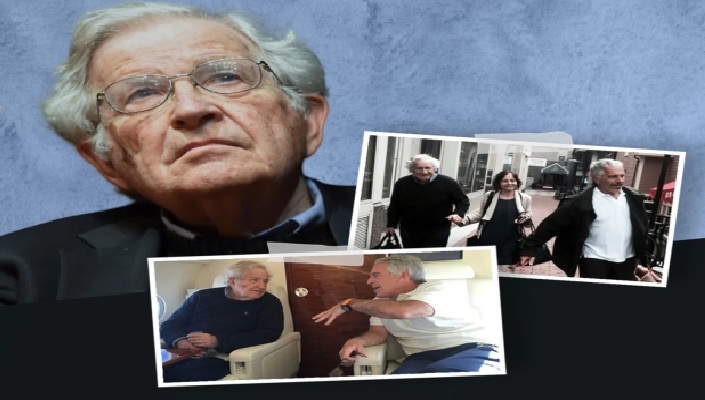
Afrasianet - Fouad Gharbali - "A high-value friend", is how Chomsky described his relationship with Epstein. This relationship raises many questions about the distance between the intellectual and power, and most importantly: can knowledge be independent of networks of interests?
When a name the size of Noam Chomsky intersects with a media scandal of a caliber like the Jeffrey Epstein case, it is not a shocking news story or an "embarrassing detail" in the biography of a great thinker, but rather a revealing moment that tests the critical position of the intellectual within the contemporary power structure.
The issue here is not legal in the narrow sense, as there is no direct criminal accusation, but rather a symbolic issue par excellence: a question of image, legitimacy, and consistency between a discourse that has always sided with the oppressed, and a relationship that emerged, as a result of the leaks, as if it were placed within a circle of influence that embodies the most extreme forms of power imbalance and globalized money.
The leaked documents revealed correspondence between Chomsky and Epstein dating back to 2019, including Chomsky's advice to Epstein on how to deal with the media storm that surrounded him after the testimonies of dozens of women were exposed and the accusations expanded.
The messages included sympathy for the "horrific way" he was treated in the press, a call to ignore the attack rather than engage in a public debate, and even a reference to what he described as the "hysteria" surrounding cases of assault on women.
Chomsky's wife, Valeria, later issued an apology, who admitted to a "grave mistake" and "negligence" in checking Epstein's background, stressing that the latter had deceived them and presented himself as a supporter of science and academic research, and that full knowledge of the seriousness of the charges became clear only after his second arrest.
Between these two narratives, the narrative of empathy and advice, and the narrative of deception and apology, a broader analytical space is formed than just individual accountability.
Chomsky was not a technical thinker confined to his specialty, but one of the most prominent symbols of the radical critique of the capitalist and imperialist system, and a public actor whose name was associated with defending the victims of power and exposing the mechanisms of media and political domination.
This is precisely where the intensity of the paradox lies: when he appears in his correspondence sympathetic to a figure who has become a symbol of the deviations of the financial elite and impunity, the shock stems not from the relationship alone, but from the shaking of the image of the "critical distance" that is supposed to separate the intellectual from suspicious circles of influence.
Sociological analysis, however, forces us to move beyond the logic of rapid moral shock toward dismantling the structural conditions that make such intersectionality possible. The intellectual field, no matter how independent it may be, does not operate in isolation from the economic field. Universities, research centers, think tanks, and funding networks are spaces where symbolic and economic capital intersect. Chomsky's symbolic capital accumulated through decades of knowledge production has given him a unique place in the public sphere, but at the same time made him a valuable actor Within networks that are looking for cultural legitimacy that strengthen their position. Globalized money seeks not only to invest, but to reshape its image by approaching scientists and intellectuals, investing in symbolism as much as it invests in markets.
In this context, the intersection of two actors from two different fields does not appear to be an exceptional event, but rather a structural possibility within the networking community, where weak linkages produce cross-sectoral encounters.
But the "nature" of the network does not eliminate moral tension. Conversely, the larger the symbolic capital of an actor, the greater the normative expectations surrounding it. An intellectual who bases his discourse on solidarity with the oppressed expects a strict consistency between speech and position, and any approach to a figure who, in the public imagination, embodies the maximum abuse of power, is read as a defect in this coherence, even if it does not go beyond the boundaries of advice or social encounters.
The "scandal" here acts as a mechanism for rearranging meanings. It is not just a revelation of facts, but a moment of hermeneutic struggle over legacy and legitimacy.
In the digital age, where leaks intensify and spread within hours, reputation becomes fragile capital, re-evaluated with every new given. When the person in question is a figure in his 10s, with more than 150 books and decades of influence, the question is not whether the legacy will be erased, but how will it be reframed, how will his political work be read after the fact, and whether theory is separated from behavior, or is behavior seen as a key to reinterpreting the theory?
Valeria's apology, and her assertion that Epstein presented himself as a philanthropist and supporter of science, is trying to reframe the event within the logic of "deception." But the public debate, especially in left-wing circles, has turned toward deeper questioning: Was ignorance possible with a previous court record and public accusations? Was the reference to "hysteria" on assault cases a reflection of a fleeting position or a problematic positioning at a moment when the gender justice discourse was at its peak?
Here, ethical considerations overlap with political analysis, and the question shifts from a mere miscalculation to a test of the harmony between stated position and practice.
However, reducing the issue to the duality of fall or innocence remains inadequate. The intellectual, no matter how radical, moves within a world of complex functional differentiation, where roles intersect and fields intersect. Independence does not mean complete separation, but permanent negotiation of borders. Out of this porosity arise paradoxes: thought that dismantles the mechanisms of power may, by virtue of the structure itself, find itself close to its circles; and capital, which is criticized as a source of structural imbalances, seeks to approach the cognitive fields in order to restore its image.
The significance of Chomsky's intersection with a media scandal of Epstein's size lies not only in the content of the letters, but in what they reveal about the fragility of the idea of "monetary purity" in a globalized world in which networks are intertwined. It is a moment that shows that the distance between criticism and power is not a straight line, but a constant field of tug-of-war, and that symbolic capital, however transcendent it may seem, remains part of a broader game of redistributing legitimacy.
Here, the issue becomes not only a personal matter, but a mirror that reflects the nature of the system in which we live. A system in which fields overlap, in which symbolism intersects with money, and in which scandal becomes a harsh test of the role of the intellectual and the limits of his independence.
Symbolic Capital vs. Globalized Money: Epstein's Complex in the World Order
The Jeffrey Epstein case cannot be understood as a mere individual criminal pervert within a capitalist society, but as a dense knot in a transnational web that combines money, politics, academia, philanthropy, and the media.
The investigations and leaks have revealed not only criminal behavior, but also the structure of relationships between businessmen, politicians, academics, and think tanks. In this sense, the case is an example of what elite studies have described as "inner circles" in which different capitals intersect to produce influence beyond national borders (Mills, 1956; Useem, 1984). Epstein is not just a financier. He was a network intermediary that combined financial capital and social capital, investing in symbolic capital by approaching scientists and thinkers of global stature.
From the perspective of the sociology of the fields, what is happening here is not a crude penetration of the academic field, but an action on its borders. The scientific field, as Pierre Bourdieu's analyses have shown, produces a rare symbolic capital: recognition, status, and the ability to define what is legitimate knowledge.
This capital is transferable; it is not confined to the university, but is transmitted through networks to other spaces. When a controversial financial actor seeks to get close to major academic names, he invests in this particular capital. It is not just the funding of science, but also the placement within the circles of recognition, which confer moral immunity or at least complicate the public image.
Here Epstein's position within the world order intersects with Chomsky' s. Epstein embodied a pattern of actors operating in the gray areas of financial globalization: wealth management, private networks, relationships with political and scientific elites. This pattern has been described in globalized wealth studies as relying on intermediaries who are able to cross fields and coordinate relationships between disparate worlds (Harrington, 2016). Chomsky, on the other hand, represents the pinnacle of symbolic capital in the intellectual field: a name that transcends specialization, invokes political and ethical debates, and is given an exceptional place in the public sphere. The confluence of these two modes of capital, financial and symbolic, does not seem structurally to be an accident.
Leaked correspondence between the two men in 2019, which included advice on how to deal with the media storm, reveals a moment of overlap between the two capitalists. The same advice, the call to ignore the press attack and to reserve what Chomsky called "hysteria," can be read as intervention by a symbolic capitalist in a crisis involving a financial capital holder.
Here, symbolic capital does not act as an opposing force, but as interpretive resources that are called upon within a defensive moment. What makes this moment a function is not only its moral content, but also the transfer of the power of definition, which has long been used to dismantle the discourse of power, into a context that belongs to an actor from the heart of its networks.
The literature on "academic capitalism" has shown that the university is not isolated from market logic and has become part of a competitive economy based on private funding and partnerships (Slaughter & Rhoades, 2004).
In this context, the intersection between scientists and financiers becomes a regular phenomenon. But structural habituation does not eliminate the symbolic tension when a financier is involved in a scandal of global proportions.
Scandal, as analyzed by studies of "political scandal" (Thompson, 2000), is not just a revelation of an event that goes beyond a rearrangement of hierarchies within the public sphere. It is a moment when narratives about actors are rewritten, and their assets are revalued.
Epstein's case, as a cross-border scandal, highlighted the nature of the global order that allows wealth and influence to accumulate in relatively closed networks, capable of providing a measure of impunity. This type of centralization, described by transnational elite analyses (Sklair, 2001), operates across corporate, culture, academia, and philanthropy. In this context, the polarization of balanced intellectual figures becomes part of a broader strategy to reproduce legitimacy.
Chomsky, whose discourse is based on a critique of imperialism and globalized capitalism, also moves within the world order, not outside it. His knowledge production circulates globally, elite universities embrace him, and the international media hosts him. He is an actor in a global field of knowledge, which intersects objectively with the economic and political fields.
From this perspective, his encounter with globalized wealth networks does not seem to be a logical break with his position, but rather the result of a symbolic capitalist accumulation that has reached a degree that makes him desirable within multiple circles, even ideologically contradictory to him.
The shocking analysis here is not based on a moral accusation, revealing the logic of mutual transfer between capitals. Financial capital, which seeks to get closer to the sources of cultural recognition; and symbolic capital, by virtue of its global reach, which objectively enters into a network of relations that cannot be completely separated from the structure it criticizes.
What Epstein's case reveals is not only potential moral fragility, but also the fragility of our perception of the intellectual as an out-of-game. As field analyses have shown, there is no site outside the structure; there are only sites that vary in their maneuverability within it (Bourdieu, 1996).
In this sense, Epstein's case represents a moment of intensification of the mechanisms of the world order: money seeks legitimacy, legitimacy is produced within cultural spheres, and scandal redistributes capital by exposing overlaps. When Chomsky's name appears within this network, the shock is not in the encounter, but in the revelation of a logic that has been silently working: that symbolic capital, however monetary it may seem, remains part of a global economy of legitimacy.
Their convergence does not eliminate the ideological contradiction, but it reveals that the contradiction itself does not preclude the structural appeal. It is precisely in this seam that the significance of the case is manifested: not as an individual aberration, but as a mirror that reflects the nature of a system in which knowledge and money intersect in a single network, even when the discourse on both ends of the spectrum seems to be far apart.
Scandal as a test of moral consistency
A scandal is not an accident in public life. It is a social mechanism to reexamine the relationship between identity, discourse, and location. It is a moment of intensification in which legitimacy is redistributed, and in which it tests whether the accumulated symbolic stock can withstand a sudden exposure.
As John B. Thompson pointed out in his analysis of political scandals, the event derives its significance not so much from the act itself as from the fact that it falls under an intense system of vision, in which particularities become a public substance and status is reformulated in light of what appears (Thompson, 2000). A scandal, in this sense, is not just a revelation. It is a redefinition.
In the case of an intellectual name of Chomsky's size intersecting with the Epstein scandal, the debate was not focused on a direct legal breach, but on the question of consistency. An intellectual who has taken a clear moral position in criticizing power, exposing the collusion of elites, finds himself in a moment when his action—or advice—is read within the opposite narrative. This is where the logic of the public sphere comes into play, as analyzed by Jürgen Habermas: the public actor is always required to justify his actions to an audience that assumes a consistency between speech and practice. When a dissonance between the two arises, the crisis does not It is technical, even modular.
The scandal acts as a moral mirror. It shows the gap, if any, between the self-image that the actor has constructed, and the image produced by the event. In this context, symbolic capital becomes as much a burden as it is an asset. The higher the status, the higher the expectations. What is forgiven for an ordinary actor is read as a symbolic betrayal of an actor whose legitimacy is based on the claim of moral consistency. Here the question is no longer : Did he make a mistake? Rather: Does this mistake contradict the declared identity?
The sociology of stigma shows that reputation is not a fixed essence, but an interactive construct that is constantly being managed. The scandal interrupts this measure and imposes a new definition of the actor in the eyes of the public. In Chomsky's case, the leaked correspondence was not merely documents; it was material for the reinterpretation of his history. The advice to ignore the media storm, or to reserve "hysteria," was not read as a passing opinion, but a signal tested in the light of decades of critical discourse. "Scandal", then, does not measure the act separately, but rather puts it in the balance of the entire narrative.
But the scandal is not only a moment of condemnation, but also a moment of justification. The analysis of "justification systems" has developed the idea that actors, when held accountable, resort to different worlds of value to reintegrate their actions into an acceptable framework. Apologizing, pointing out deception, and confirming ignorance of the magnitude of the facts are all attempts to restore coherence by reframing the event.
However, the power of the scandal lies in the fact that it does not leave the actor with complete control over his narrative; the audience is a partner in the production of meaning, and may even impose a different interpretation.
The contemporary media space is compounding this effect. As Le Mans pointed out, the media not only conveys reality, but builds it by choosing what is presented and how it is presented. The leak becomes an event in itself, transforming into a narrative complex that is included in a larger story of elite, privilege, and impunity. In this structure, the relationship is not read in isolation, but in the context of a vast web of accusations and prehistory. The scandal thus transcends the boundaries of individual action to become a test of the moral order that is supposed to govern the public sphere.
It is clear here that moral consistency is not a stable state, but rather a fragile relationship between the actor and the public. According to the analysis of social recognition, public identity exists only to the extent that the actor is given continuous recognition by others. The scandal threatens this confession, because it introduces an element of doubt into the previous narrative. It is not a question of abolishing the past, but of rearranging it: are past works read as evidence of long-term credibility, or are they reinterpreted in the light of the present moment?
What makes this situation shocking is not just the apparent contradiction, but the fact that the scandal exposes the boundaries of the separation of the private from the public. The public actor does not have the luxury of viewing his relations as a private affair. The modern public sphere, as analyses of politics and ethics have shown, is based on the expectation that private life will be in harmony, or at least not clearly incompatible with the public message. When there is contact between the two spheres, the distance becomes an object of accountability.
However, the analytical reading does not end at the borders of condemnation. The scandal also shows that the intellectual, no matter how critically aware, is not outside the structure within which he operates. He is subject to the same logic as others: the logic of vision, accountability, and re-evaluation. There is no absolute symbolic immunity. Consistency is not a fixed quality, but a continuous performance that is tested whenever a new event unfolds.
In this sense, scandal acts as a mechanism of moral control in modern societies. It does not necessarily fall, but it rearranges the ranks, forcing actors to recast their positions. In Chomsky's case, his work has not been erased, but his legacy has become a subject of a different debate. He is no longer read just as a critical theorist, but as an actor who has been publicly tested for consistency.
The real shock is not that an intellectual can make a mistake, but that symbolic capital—supposedly a safeguard against contradiction—remains vulnerable to exposing. The scandal reminds us that the public sphere judges not only actions, but images. And that moral consistency, however entrenched it may seem, remains a renewed relationship between word and deed, one that a single event can reopen widely.
The Limits of the Distance Between Money and Power: When Proximity Becomes Structural
What the documents reveal about the relationship between Chomsky and Epstein is not only a moral embarrassment or a personal paradox, but also a more complex question: how does the distance between the intellectual and the power are produced, and how does it erode without the actor himself realizing it? The issue here is not that a critic met with an influential financier, but that this encounter took on a "regular" character and was described as a "intellectual exchange of great value." This particular language is worth pausing because it reveals that the relationship has not been understood, at least not by One of its periphery, as a contradiction, but as a legitimate interaction within a common space.
To understand this, one must move from the question of ethics to the question of structure. In the analysis of the fields, power is not defined as direct oppression, but as the ability to regulate the distances between positions. The academic field produces its legitimacy by claiming independence, but this independence is not isolation, but a special form of association. Bourdieu pointed out that autonomy has historically produced within a network of relations with the state and the market, not outside it. The higher the position of the actor within the field, the more he has contact with its borders. In Chomsky's case, he no longer moves within a narrow specialized circle, but within a trans-field space.
Epstein, for his part, was not a traditional financier who worked only in the shadows. He was building for himself the image of a mediator between wealth and knowledge. His calls to scientists, the use of his property as meeting places, and the provision of financial support in personal contexts are all tools for bringing financial capital into the orbit of symbolic capital. This type of actor has been described in the studies of network elites as "mediating between worlds." That is, linking heterogeneous locations to produce invisible influence. From this angle, the intersection with a major intellectual figure becomes Part of a prestige building strategy, not an emergency event.
The question that arises: Why did Chomsky accept this closeness? Here it is not enough to say that he was deceived or not aware of all the details. More importantly, the relationship began, at the moment, justifiable. The analysis of "justification systems" shows that actors evaluate their actions according to multiple value worlds. From within the world of research and intellectual exchange, the encounter may be seen as a cognitive dialogue; from within the world of gender justice, it is read as a disturbing intersection. The paradox arises from the transition of action between these two worlds.
There's also another element. It's the status that produces a kind of preconceived confidence in the self. A thinker who has spent decades dismantling the discourse of authority may see himself as immune to falling into its traps. That trust may produce something like "structural blindness," that is, the belief that the ability to criticize confers immunity to assimilation. But Michel Foucault showed that power does not work only through oppression, but through the integration of subjects into its networks. What is needed is not to silence the critic, but to make him part of a wider landscape where his presence becomes an added value.
A transfer that passed through an account linked to Epstein, even if it was not provided as direct support, falls within this symbolic economy. Money here is not just a sum, but a sign of a relationship of trust and exchange. In a world where networks are intertwined, proximity is measured not only by the amount of funding, but by the kind of relationship it allows. When a global thinker like Chomsky describes a controversial man like Epstein as a "high-value friend," we are faced with a form of mutual recognition that goes beyond courtesy.
The importance of this point is evident when we look at the impact of the issue on Chomsky's academic institutions. The responses of universities did not go beyond reviewing grant policies, as if the problem was administrative. But the issue is deeper: it is about the structure that allows financial capital to flow into knowledge fields without sufficient accountability. "Academic capitalism" is no longer a critical hypothesis, but an institutional reality. In this reality, relationships with influential funders become part of university life, even when their values conflict with the stated discourse .
This is not to say that criticism automatically turns into complicity, but the boundaries between them are less rigid than we think. Antonio Gramsci spoke of the intellectual as part of a historical bloc, not a spectator. From this perspective, the global intellectual cannot stand outside the system that gives him his platform and legitimacy. He moves within a global network of universities, media and institutions, all of which are linked, to varying degrees, to the logic of the market and finance. The distance here is not a wall, but a moving negotiating line.
The issue, then, is not to prove a crime, but to understand how closeness is formed without an explicit intention. Encounters, letters, mutual tributes are all small elements that add up to produce a relationship. And when the network is exposed by a scandal, these elements suddenly seem to have a different meaning. What was seen as an exchange of ideas reads as a cover; what was considered technical support is reinterpreted as part of the confessional economy.
The most profound effect is not only that of Chomsky, but of the image of the critical intellectual in the age of networks. If the criticism itself moves within a structure that redistributes legitimacy, then the question becomes: how can an effective distance be maintained? What this case reveals is that power does not need to buy consciences; it is enough to open its doors and allow symbolic capital to find a place in it.
Ultimately, it is not a personal paradox, but a structure of a world in which knowledge and money intersect in such a way that the distance between them can be shrunk without declaration. Chomsky did not become a defender of power, but his presence within Epstein's network showed that criticism, however radical, moves within a common space with what he criticizes. This fact, as disturbing as it is, reveals that the boundaries of distance are not fixed moral lines, but social relations that are constantly being reformulated.
Bibliography
Bourdieu, P. (1988). Homo Academicus. Stanford, CA: Stanford University Press.
Bourdieu, P. (1996). The State Nobility: Elite Schools in the Field of Power. Stanford, CA: Stanford University Press.
Harrington, B. (2016). Capital Without Borders: Wealth Managers and the One Percent. Cambridge, MA: Harvard University Press.
Mills, C. W. (1956). The Power Elite. New York, NY: Oxford University Press.
Sklair, L. (2001). The Transnational Capitalist Class. Oxford: Blackwell.
Slaughter, S., & Rhoades, G. (2004). Academic Capitalism and the New Economy: Markets, State, and Higher Education. Baltimore, MD: Johns Hopkins University Press.
Thompson, J. B. (2000). Political Scandal: Power and Visibility in the Media Age. Cambridge: Polity Press.
Useem, M. (1984). The Inner Circle: Large Corporations and the Rise of Business
