
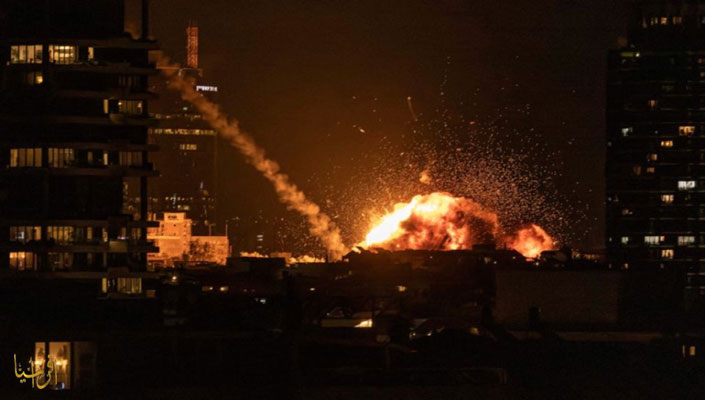
Afrasianet - Shadi Abd El Hafez - In the normally quiet Negev desert, violent explosions broke the silence of the night in the city of Dimona, close to the Middle East's only most important nuclear arsenal stronghold, and then in the streets of the city of Arad east of Beersheba. In Arad, Iranian shells landed and destroyed more than 8 residential buildings.
Within hours, about 200 Israelis were wounded, ambulances lined up, and hospital beds were filled with the wounded. The importance of the strike was not only in the extent of the destruction and casualties, but also in what it revealed about Iran's encroachment on Israeli skies and the ability of Iranian missiles to penetrate defenses and reach a highly fortified environment politically and security-wise. How, then, have Iran's guidance systems evolved to the point where its missiles are more accurate and maneuverable in the current war?
The simple answer is one word: "guidance." A missile is not just a projectile that is thrown into the upper limits of the atmosphere in an arc (ballistic) path, and then descends on the target hundreds or thousands of kilometers, but it is a guided tool at the same time. Modern missiles are equipped with guidance systems that make them like "electronic brains" capable of knowing their location and making corrections to their trajectory in flight to reach the specific target.
These systems include sensors and computers that measure the movement and direction of the rocket, compare it to the desired trajectory, and send commands to the engines or control surfaces to adjust the trajectory if the missile deviates from its path. To understand the idea, imagine that you are driving a car to a place based on an application that relies on the Global Navigation System (GPS), and on the way, the device will continuously determine your location and guide you whenever you are out of the right way.
Missile guidance systems perform a similar function, they use internal or external data to know the location of the missile and correct its trajectory towards the target, and the end result is to increase the accuracy of the hit and significantly reduce the error rate, which turns the missiles into strategic weapons that can hit a specific military facility or target with great accuracy.
From Scud B to Inertia
During the Iran-Iraq War in the 1980s, Iranian cities were subjected to intense Iraqi missile attacks using Soviet Scud missiles. At the time, Iran did not have the infrastructure to develop guided missiles or even advanced ballistic missiles, so the first reaction was to import ready-made missiles such as the Scud-B, which lacked advanced guidance systems, with a Circular Error Rate (CEP) of about a kilometer or more over a range of about 300 kilometers, which meant that they were hitting the target's perimeter rather than the target itself.
To understand the idea, imagine that there's a point in the middle of a circular plate that represents the real target. If you throw 100 arrows, they won't all hit the center, but they'll scatter around it. Here's the circular error rate, which is the radius of a circle that we're drawing around the target so that about half of the arrows are inside it, which is 50 out of 100. And if the rocket has an error rate of 1 kilometer, it doesn't mean that it's always making an error of exactly 1 kilometer, but it means that when you fire a large number of arrows, it doesn't mean that when you fire a large number of arrows, Missiles at the same target, about half of them fall within a radius of 1 kilometer, while the other half may fall outside this circle, sometimes at a distance.
This limited accuracy made the missiles effective as nothing more than a tool of intimidation, targeting cities or large populations. By the end of the war in 1988, the first domestic Iranian missile production had emerged with the launch of the first domestic missile with a range of about 130-160 kilometers. This missile resembled an upgraded rocket artillery and did not have advanced guidance, but it embodied the first step toward building self-expertise. This coincided with Iranian efforts to obtain external technical support, as Tehran concluded scientific and military agreements with China North Korea in the late 1980s and early 1990s to acquire the necessary knowledge in the field of missiles.
U.S. sources indicate that in 1996, China provided Iran with dozens of guidance systems and their electronic components, including gyroscopes, accelerometers, and computer modules, which are the essential components of any inertial navigation system, as well as test equipment and components for advanced radar systems, a support that was crucial because it allowed Iranian engineers to overcome the obstacle of lack of expertise in precision guidance techniques.
An inertial navigation system is simply a means of allowing a moving object, such as an airplane, a rocket, or a drone, to know its position, direction, and speed without always relying on satellite signals to determine its position. The process usually begins at a predetermined point, from an initial location and an initial direction. And then the sensors record every small change in motion, second by second. If gyroscopes detect that the object has turned, The accelerometers recorded that the speed or movement in a certain direction increased, and the computer unit combined these successive changes and calculated their cumulative effect, thus deducing where the object is now.
It's like a person walking into a room with their eyes closed, but they know that they started at the door, then they walked straight steps, then they turned, and then they moved another distance. They don't even see, and then they can estimate where they are based on their sense of movement, the number of steps, and the direction of their turn. The inertial navigation system does something similar, but with great electronic accuracy and calculating speed.
The importance of this system is that it is independent of the outside world, so it remains useful in environments where navigation signals may be interrupted or jammed, such as during electronic warfare, or in some complex military situations. This is why it is an essential element in many platforms that need continuous guidance even when satellite communication is lost.
"In inertial steering, any small measurement error can accumulate over time to make a big difference."
However, this system has a known disadvantage: any small measurement error can accumulate over time. Since a computer relies on constantly collecting small changes, a slight deviation in the reading of the gyroscope or accelerometer can lead to a noticeable difference between the calculated location and the actual location after a while. For this reason, an inertial navigation system is often combined with a GPS routing system.
Iran has used this technique in some of its modern missiles, such as the Fateh-313, which is believed to have combined inertial navigation with satellite guidance. The idea here is that the rocket does not rely on a single source of navigation, but on two systems that work together, the first is internal independent, and the second provides external trajectory correction. But this type of guidance is not without its challenges: GPS signals can be jammed or cut off, especially in cyberwarfare environments. Therefore, the space system is not usually used as the sole means of guidance, but rather as a debugging tool that helps to reduce the error that may accumulate in the inertia system in flight.
Small fins. Dangerous
By the beginning of the 1990s, Iran had begun to establish domestic production lines for missiles, taking advantage of this knowledge and imported technologies. Its cooperation with North Korea resulted in the development of the Shahab series of missiles, with a greater range but with the same technologies (finite inertial guidance). The next shift came in the late 1990s with the development of the Shahab-3, based on the design of North Korea's Nodong missile, with a range of up to 1,300 kilometers in its first version, and the missile relied on a traditional inertial navigation system, which gave it modest accuracy Relatively speaking, the error rate was about 3 kilometers.
During the first decade of the new millennium, Iran continued to gradually improve its missile guidance systems, and upgraded versions of the Shahab-3 missile appeared under names such as Qadr and Sejil. It is also believed that Iran began to use more precise guidance during this period, with the introduction of new technologies such as the use of satellite guidance, albeit in a more accurate way Limited or experimental at first.
A prime example of this development is the Emad missile, which was unveiled in 2015 and presented by Iran as the first long-range missile with precision guidance. The missile has a range of about 1,700 kilometers and is equipped with a better maneuverable and guided warhead, which helped reduce the margin of error when hitting the target compared to the Shahab-3 missile, to several hundred meters (500 meters, according to estimates).
A report from the International Institute for Strategic Studies (IISS ) indicates that the "Imad" had a more advanced guidance system, which allows it to control its trajectory even during the return phase through the atmosphere, by having small fin-like parts or wings attached to the body of the fallen warhead, moving slightly right, left, up, or down to change its direction during flight. The missile has developed significantly more accurately, making its ability to hit targets better than older Iranian missiles.
"The Emad missile represented an important turning point in Iran's missile program, moving Tehran to the stage of precision-guided missiles."
The Emad missile marked an important turning point in Iran's missile program. Essentially using Iranian missiles as a general deterrent, even if their accuracy is limited, Iran is moving to a higher-order guided missile phase, capable of targeting specific locations such as military bases and command centers with better accuracy.
Possessing long-range precision missiles allows any military or political power to adopt the doctrine of precision retaliation rather than settling for asymmetric warfare or general threats. For example, in past decades, Iran's response to provocations has been limited for fear of slipping into an all-out war in which it loses to superior Western technology. Now, Iran seems bolder in responding, because it knows it can directly hurt the enemy.
The Age of Sensors
The last decade is arguably the pinnacle of Iran's missile guidance program, with the majority of short- and medium-range missiles being guided with high accuracy (such as the Qiyaam, Fateh-313 and Zulfiqar), and long-range missiles such as the Emad and Khorramshahr carry guided warheads or advanced control systems that significantly reduce error. The distinctive feature of this era is the integration of the concept of "Composite guidance," which refers to the use of more than one source of navigation, such as collecting data from the inertial system, with corrections from navigation satellites, and adding independent sensors or researchers in the rocket's head to search for the target in the final stage.
Instead of following a pre-programmed path with corrections based on inertial navigation or satellite correction, the missile begins to use a sensor in the front of it when approaching the target to search for the target itself and lead the missile directly towards it. If the researcher is a radar, it sends out radar waves and then captures their reflection from the target to locate and track it, which is especially useful against ships or large targets and in difficult weather conditions. In this case, the radar guidance is positive, but in the case of negative radar guidance, the missile does not transmit anything, but carries a receiver that picks up the radar signals from the target (ground radars for air defense or warship radar) and heads towards it.
"Sensors are sensors that are placed at the front of a missile and enable it to track the target depending on its radar footprint or temperature."
If the seeker is thermal (infrared guidance systems), it works through sensors placed in the front of the missile that enable it to track the target based on its temperature. Each object that is powered by an engine or produces heat energy emits radiation in the infrared range, and advanced sensors can capture this radiation and convert it into a thermal image of the target. This is why this technology has long been used in air-to-air missiles and anti-aircraft missiles that track the temperature of aircraft engines.
In recent years, the same idea has begun to be used in some short-range ballistic missiles, especially those designed to hit moving targets such as ships. When the warhead approaches the target area, the thermal seeker begins to scan the area for the ship's thermal footprint, such as engine temperature, and when the sensor identifies this heat source, the guidance system adjusts the warhead's trajectory to hit the target directly.
One oft-cited example in this range is Iran's Persian Gulf anti-ship missile, which is believed to use an IR/EO thermal seeker in its final stage, allowing it to accurately track and hit a moving ship from distances of up to hundreds of kilometers. The missile is believed to have been in service since 2014 and is one of the first Iranian ballistic missiles specifically designed to target ships. The main advantage of these researchers is that it makes the missile able to actually "see" the target instead of relying solely on pre-coordinates, which increases the accuracy of the hit, especially when targeting high-value or moving targets.
Optical (photovoltaic) researchers are guidance systems that use a camera or imaging sensor to take a picture of what is in front of a missile, then compare it to what it is looking for, correcting its trajectory until it hits the target with greater accuracy. This type of missile has emerged in Iran with the Qassem Basir missile, which was unveiled by Tehran in May 2025. According to Iranian state television, the missile can hit a specific target from a distance of at least 1,200 kilometers with improvements in guidance and maneuverability to bypass defenses. The shots on display of the rocket suggested that there was an optical/thermal researcher in the final stage.
"This triple combination of inertia, satellite guidance, and sensors has significantly increased the accuracy of some Iranian missiles."
This triple combination (inertia, satellite guidance, and researchers) has significantly increased the accuracy of some Iranian missiles. For example, in Iran's January 2020 missile strike on Iraq's Ain al-Assad base, Iranian Qiyam and Zulfiqar missiles were likely able to hit several "pointy" targets inside the base with precision, with satellite imagery showing that each missile hit almost its intended location.
A detailed analysis based on satellite imagery and the remains of rockets that landed near the base found that some of the rockets used were originally derivatives of the Scud family, but they became much more accurate than the older Soviet versions, with an accuracy of between 10 and 100 meters at a range of about 700 kilometers.
Intelligent guidance of the "Fatah" missile
Perhaps the most notable recent achievement is the official introduction of the Fatah hypersonic missile, which has been described as a hypersonic ballistic missile. Fatah 1 was unveiled in 2023, followed by Fatah 2 in late 2024. The importance of this missile lies in its high speed, which is more than Mach 5, five times the speed of sound (up to 6,170 kilometers per hour), and then the warhead's velocity, which is potentially twice that speed.
The Fatah is a medium-range ballistic missile (1400-1500 kilometers) with two stages, the first is solid-fueled to launch the missile into close space, and the second is a sliding stage carrying the warhead and maneuvering with special engineering. The hypersonic warhead can change its trajectory in the atmosphere at high altitudes and at enormous speeds, making its trajectory highly unpredictable by radars, and complicating its interception by defense missiles. The available information indicates that the Fatah is equipped with an integrated inertial navigation system with guidance systems satellites to update its position, thus obtaining the best possible accuracy during its glide phase.
"Path modulation software is algorithms within a rocket's guidance system that not only deliver it to the target, but choose how to reach it."
When approaching a target, the missile is likely to rely on trajectory software rather than a traditional radar, thermal, or optical seeker, due to the technical difficulty of positioning a researcher operating in the extreme heat generated by hypersonic speeds. But it is also not ruled out that Iran has experimented with developing a sophisticated radar or thermal seeker that can withstand difficult conditions. Path-modulation software is algorithms within a missile's guidance system that not only deliver it to the target, but also choose how to reach it. If the missile takes the shortest direct route, this software can make it approach the target from a certain angle, fly at a lower altitude or trajectory, maneuver at specific moments, delay or accelerate some stages of the flight, or distribute its energy and speed in a way that improves accuracy or makes interception difficult.
In simpler terms, it is not only a mind that decides where the target is, but a mind that regulates the shape of the journey itself, and can be likened to a driver, who not only wants to reach a certain address, but also chooses a route that avoids traffic and barriers, and arrives from the most appropriate direction. So far, Iran has been touting Fatah's ability to hit targets with great accuracy, and a report by the Missile Defense Alliance, a research center based in the US state of Virginia, indicated that its theoretical accuracy is between 10 and 25 meters, which puts it in a better position The world's tactical missiles.
Maneuvering ground defenses
Missile guidance is not only about hitting the target, but also about avoiding obstacles and threats during flight, as a guided missile is able to maneuver and correct its trajectory if the enemy tries to jam or intercept it. This advantage is critical militarily, as it increases the chances of bypassing an adversary's air defenses. For most of the Cold War, air and missile defense systems were designed on the basis that ballistic missiles follow a relatively stable ballistic trajectory after the thrust phase ends. When radars detect a missile, military computers can calculate Its expected path quickly and identify a suitable point of interception. For this reason, systems such as the American Patriot and the Israeli Arrow have been developed to intercept missiles on their expected trajectory before they reach the target. These systems rely on the ability to accurately predict the trajectory of the missile after it is detected early.
"Instead of the warhead falling in a near-fixed line, modern missiles can make corrections in the final stage of flight that allow the angle of fall or direction to be adjusted."
Instead of the warhead falling in a near-fixed line, modern missiles can make corrections in the final stage of flight that allow adjustments to the angle of fall or direction in entering the atmosphere. These maneuvers may be relatively limited, but they are enough to create a small deviation from the expected trajectory, which could confuse an interceptor missile that relies on predicting the point of impact in advance.
In the case of Iran's newer missiles, their guidance accuracy makes their point of fall less predictable than conventional ballistic missiles, and this problem is further complicated by the advent of hypersonic missiles that combine high velocity and maneuverability. The U.S. Congressional Research Service reports that the combination of speed, maneuverability, and unconventional altitudes makes these missiles more difficult to detect and intercept compared to conventional ballistic missiles.
In addition to maneuvering, some modern missiles use additional tactics to complicate the air defense mission. These include firing deceptive targets or small metal fragments to mislead radars, or detaching the warhead from the missile body at an early stage so that it becomes difficult to determine which part is the real target. The missile may also be programmed to make sharp deviations or sudden changes in altitude as the interceptor missile approaches it.
In some attacks, Iran is not betting on a single missile or target, but on the intensity of the fire itself, as it may fire dozens, sometimes hundreds, of missiles and drones at a close time, in a military method known as "dumping," and the goal of this tactic is to overwhelm air defense systems, because these systems, no matter how efficient, remain limited by the number and quality of targets they can monitor, track, and intercept at the same moment. When targets flow in dense and simultaneous directions, the chances of some of them passing through and penetrating increase For defenses, not necessarily because each missile is superior alone, but because the multitude of targets themselves turn into a weapon.
"Advances in guidance and maneuvering systems have made interception more complex and costly."
This is not to say that the missiles cannot be intercepted, or that Iranian missiles are exceptional, but advances in guidance and maneuvering systems have made interception more complex and costly. For example, a video circulating during the current war (we have not independently verified its accuracy) showed an Iranian missile exceeding more than a dozen Israeli interceptor missiles before hitting its target. The video shows the missile continuing on its path despite a large number of interceptor missiles fired from Israeli air defense systems. This incident reflects a weakness Even with the launch of a large number of interceptors, no system is capable of guaranteeing 100 percent interception of every attacking missile.
Each Iranian missile may prompt air defenses to fire several expensive interceptor missiles, rapidly depleting defense stockpiles and increasing pressure on Israel. In contrast, strikes targeting Iran's missile depots and launchers are escalating, gradually reducing the number of missiles Iran can fire per day.
From this angle, the war looks more like a stockpile race than a firefight, as on one side stands Iran's ballistic stockpile, on the other end stands the stockpiles of intercepted missiles with Israeli air defense systems, and between the two sides there is a parallel battle that is no less important, namely the battle of intelligence and reconnaissance, which tries to uncover the locations of launch pads and missile units inside Iran and target them before they release their payload.
Whoever runs out of stockpiles first may lose the war, or "be forced to sit at the negotiating table" and accept An agreement with terms that he was not prepared for at first.
