
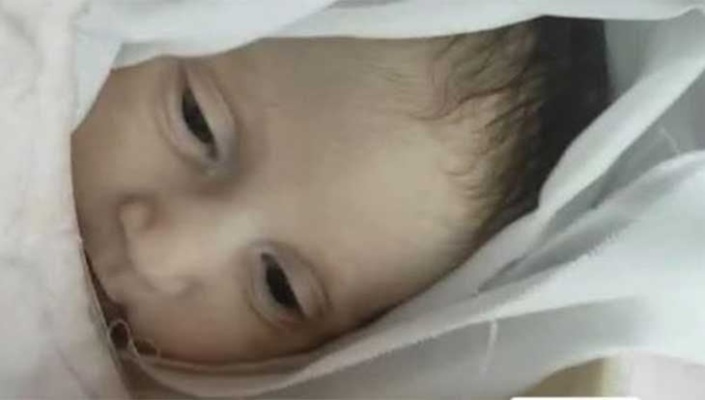
Afrasianet - Maryam Mashtawi - The cold that night was not a season, it was a full-tusked creature, emerging from the weather forecasts to exercise its power over bodies born without protection. He died because the tent didn't know the meaning of the walls, because the blanket became a luxury, and because the warmth turned into a Political privilege.
He died because somewhere, somewhere, saw the picture and didn't feel the cold! His body was too small to bear the thought of death, too big to be summed up in breaking news. His name didn't know his way to the headlines, only the sky knew him, when she trembled a little as she greeted him. In Gaza, children don't go to bed early, don't dream long, and don't grow up properly.
They grow up all at once, and then they stop. They said he died of a severe cold. A clean, polite sentence that does not mention that the cold alone does not kill, and that what kills is forced nudity, the blockade, the postponement of aid, the silent collusion, and the cold language that describes death as a natural phenomenon. In Gaza, children do not die suddenly, they die in installments.
They die when they are denied fuel, when the crossings are closed, when their presence is reduced to numbers, when their mothers are asked for patience instead of protection. They die when the world is told that circumstances are difficult, as if circumstances are a mysterious being with no name and no responsibility.
She tried to wrap him in what she had available, to surround him with what was left of her body, to negotiate the night for extra hours. The night did not respond. The night in Gaza is uncompromising. When the little breath stopped, the cold did not stop. He continued to blow, as if he was declaring his victory.
Only the mother froze. Not from frost, from the truth. The truth is that her child was not killed by a shell, was not buried under rubble, and did not appear in a bloody scene, so his death will pass quietly, as if he had never been. At his funeral, there was no big screaming. The grief in Gaza is exhausting, tired of the many summons.
The men prayed looking at the ground, as if apologizing for it. Women in Beijing with a low voice, because crying loudly requires energy that is no longer available. and the child. What kind of world is this that allows a child to die in the cold, and then go on with his day? What civilization is this that is adept at writing anxiety statements, and fails to send a fireplace?
What kind of humanity is the one that is affected by the image, then passes it with its thumb and leaves?
Recognizing that what is happening is not fate, not ritual, and not a natural disaster. It is a whole system built to exhaust you, to starve, to cool down, to break the ability to live, and then to ask: Why are you dying?
The child who died in the cold was not a victim of winter, he was a victim of a world order that saw his death as a burden. He was a victim of silence longer than his life, borders harsher than his skin, and justice that always arrives late. When we say that a child died in the cold, we are saying that warmth has become a political position. The blanket has become a statement.
Life itself needs permission to pass. In Gaza, permissions are not easily granted. Spring will come, and the trees will bloom, and the newspapers will write about new seasons.
But this child He won't come back. He will remain in his mother's memory, and in the conscience of those who still have a conscience, a witness to a time when he failed the simplest test of protecting a child from the cold. May God have mercy on you, little one. You weren't weak. It was the world that was too cold.
When the cold becomes another language for siege
The cold in Gaza is not just a drop in temperature, it is a daily test of survival. He comes without an appointment, creeping through the holes in the tents, from the ends of damp blankets, from the ground that no longer knows the difference between a shelter and a makeshift grave. In the north of the Gaza Strip, where tents are lined up like camels of fatigue, the air is filled with unanswered questions: How does a naked body face an armed winter?
She stands there, leaning, tied with weak ropes. But the wind is not heard, and the sky does not negotiate. The rain knocks the cloth in continuous ways, the water finds its way in, and the siege finds its way to the ages. In these tents, time is measured not in hours, but by the number of times the canvas roof collapses, by the number of nights when the bodies are rearranged to take shelter.
The mother prepares her children before bed, as the soldiers prepare their equipment, for fear that one will be missing in the morning.
The father goes out to fix a pole or pull a rope, and comes back wet, not just because it is raining, but because anxiety has become extra water. It is as if the wind blows alone without asking: Why are there no heaters?
Why has fuel become a dream? Why are tents left in the face of winter as villages are left in the face of oblivion?
In Jabalya, near the Yellow Line, nothing is fixed but anticipation. The ground is muddy, the sky is gray, and the dilapidated houses watch the tents in heavy silence.
Here, people are not asking for extra warmth, they are asking for a minimum of humanity. A dry blanket, a roof that doesn't collapse, a night without horror.
They don't run in the rain, they don't make a game out of puddles. They shrug their shoulders, sleep in their dayclothes, and listen to the sound of the wind as if they were listening to an alarm.
In their eyes, a greater fear of their age, and an early understanding of what it means to be exposed to the world. When the movement subsides, and the cold gets too cold, the tent becomes a creature that has difficulty breathing. Air seeps in from each side, and the blanket becomes the final frontier of defense. Some of them remain awake, not to guard the place, but to guard life from extinguishing.
The cold does not kill alone, what kills is to leave people unprotected, to reduce their pain to a news tape, and to be told: Be patient. Patience does not warm up, does not prevent rain from entering, and does not repair a tent that has been torn apart by the wind.
They light a fire if they can, they share a blanket, sometimes laughing as if they defy the weather and the world together. When winter passes, its trace will linger in the bodies and in the memory.
This cold will remain a testament to a time when he decided to test the humanity of the world in a tent. Will the world succeed this time, or will it just watch from behind the screens?
________________
