
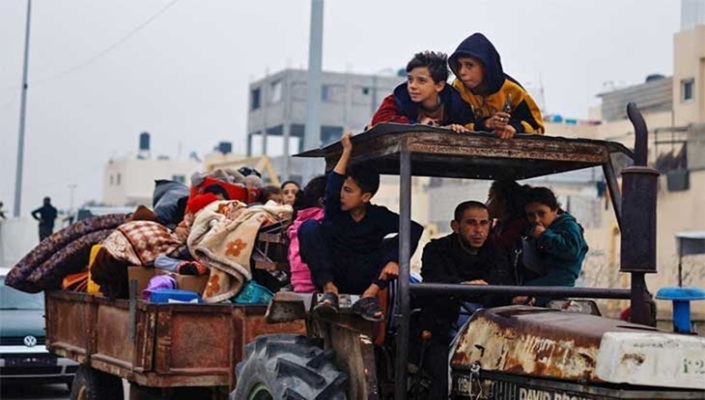
Afrasianet - Maryam Mashtawi - The tractor was not originally a home. It was not created to embrace faces, not to listen to muffled crying, nor to bear witness to ages that are drained all at once.
The tractor was born to plough the land, not to become an alternative land. But war, when it insists on redefining things, makes iron a roof, a plow a bed, and emptiness a temporary home. In southern Gaza, near the mouths of Khan Younis, a Palestinian family sat inside an agricultural tractor.
They didn't sit down, they shrunk. They didn't live... Take shelter there with the remnants of the idea of the place.
They said: We found a tractor in which we sat down. It is as if this place is a new wonder to stay. Inside the jars, the body does not have room for its normal position.
Sitting here is a waiver of the back, of the knees, of the distance between one person and another. Everything is too close, everything is too far away, the air is heavy, the light is scarce, and time is without windows.
Fatima Abu Saadeh, a displaced Palestinian woman, whose face bears extra lives that she did not live in time, but carried her away. She says, in pain: "Sweep away our turn... The tractor was not the first choice.
The tent was not available. Forced to go to war is not a decision, but a silent slide for the worse. Inside the tractor, the old woman sits on what looks like an improvised bed. Old lids, empty water bottles, scraps of fabric, and a memory trying to hold together. She talks about her children... Talking about loss...
Then it stops... She stops because the numbers, when it comes to children, need a longer breath than usual. Losing here is not a memory... It is a daily presence... You sit with them... She sleeps in the jars... She wakes up before them to rearrange the silence every morning... When she closes her eyes, she does not do so to escape the camera, but to escape another image... The picture of her children. They are three. I lost three children...
Then she pulls her shawl over her face, as if trying to cover her heartbeat. In jars, long crying is not allowed. The space cannot withstand a complete collapse. The tear must be quick, brief, polite. Even the sadness here is compressed. Women don't ask for much... Just request a return:
We want to go to our turn On our place
Al-Muttrah... That word that sums it all up. The tractor does not know them... He does not save their names... It doesn't smell like their childhood... It is a place of metaphor, not belonging. However, it became a shelter. They accepted the tractor because the alternative was the open... Accept him because the sky is no longer neutral.
The woman smiles at some point. A short, confused smile, as if it were an apology for sadness. She smiles because the camera is there, and because she knows that no one will see. It is the pain of the moment that housing is redefined. The moment when survival becomes a daily act, not a hero. About that moment that represents a woman who lost her children and still wants to return to her home. Inside what remains... Inside the language... The tractor, which once ploughed the land, is now a witness to the land ploughed in absentia.
When you whisper, motherhood aims
War does not seem to be a battle between armies, but a deliberate act against the beginnings. A mother carrying a child wrapped in a white cloth... A woman emerges from the rubble, not looking for a safe place to give birth. A maternity hospital without a roof, an iron bed without electricity, and a midwife... In Gaza, not only are bodies killed, but the future is chasing in its infancy. T
he mother cries as she stands, crys as she walks, crying as she tries to remember the instructions for giving birth in a tent with no water, no sterilization, no light. She cries because her body has become a battlefield, and because her womb has become accused only because it can continue. In Gaza, motherhood is no longer an act of love but a biological resistance, and pregnancy has become a brave decision to come to a world that doesn't want you. When a delivery room is bombed, the very meaning of security collapses, and humanity collapses in all its meanings.
In Gaza, mothers give birth prematurely, small bodies that are not complete, and breaths that learn to air under bombardment. We see children born with a whole siege history on their chests. Mothers learn how to apologize to their children before they grow up. They apologize because the world has failed them, because milk may be shortage, because medicine is not available, because the tent is not a place to give birth, and yet childbirth happens.
A broken health system. Each of them waits for her turn to be examined, waiting for her name, waiting for someone to tell her that everything will be fine, and no one is paying attention to her. The targeting in Gaza is not just from bombs, but from power outages, from shortages of medicines, from road closures, from delays in ambulances, from making giving birth an additional risk in a life full of risks. Every moment that passes says that war is not a passing event... It is a system, a policy, and a long-winded plan to reduce the ability to survive. However, births continue.
This is the real failure of the war... Life, after all, finds a loophole. A woman gives birth in a tent and names her child after a name that signifies resilience, a midwife who works without tools and succeeds, and a mother who loses a child and then returns to embrace another child who has not yet been born.
Gaza does not ask for sympathy, it asks for memory, it asks for at least linguistic justice, to say things by name, to understand that the targeting of mothers is not a coincidence, and that the destruction of maternity hospitals is not a mistake. When motherhood is targeted, it targets the future, and when mothers insist on giving birth, a new chapter of the human challenge is written. These images are not only about pain, but about the stubbornness of life, of bodies that know they are targeted, and yet choose to continue, and in this choice is all the answer.
________________
