
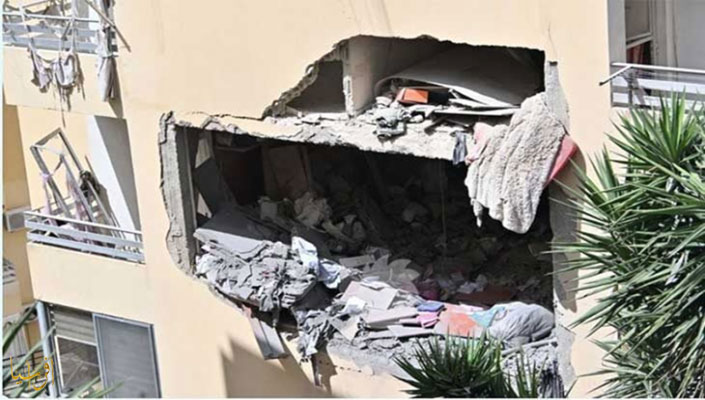
Afrasianet - Maryam Mashtawi - In Lebanon, tragedies don't need long introductions. It's enough for a simple life to intersect with an uncalculated moment, until all the equations are turned upside down.
In Ain Saadeh, the building that targeted was not just an ordinary apartment building, but a space for everyday life, quietly formed, away from the hustle and bustle of political statements.
The raid was not random. It was a deliberate strike, within a larger security context, aimed at a specific person. But, as often happens in wars, the results did not stop at the target.
The Lebanese Forces, that was not what was meant by this strike. His name was not in her accounts, nor in her bank of targets.
However, it has become at her heart. He was killed, along with his wife and their neighbor.Three people, who were not part of the stated target, but became his victims.
What military narratives don't say, and what breaking news doesn't say, is that this story began with a simple human moment.
Greeting visit. A neighbor entered the house to say a kind word, to share a very ordinary moment, which does not carry any weight or any significance outside its human framework.
But in this country, even ordinary moments are no longer protected. When the rocket fell, he couldn't distinguish between who was a target and who was close to the target.
He did not see that there was a woman who had come to visit, nor that there was a house whose daily details had been lived a few minutes before. He saw only a dot on the map.
Here, the tragedy intensifies. Not only in killing a person, but in being killed because he was in the same place. Because his life intersected, by chance, with a moment of decision that had nothing to do with it. In modern wars, much is said about "precision."
This word is used as a guarantee, as if it is a promise that harm can be contained. But the reality, every time, proves otherwise, because the mistake here is not in the injury, but in the meaning. It makes the question more urgent....
What does it mean to have your life indelible, just because you were close to something you weren't a part of?
There is no longer a clear line separating the two.
The entire country has become a gray area, which can turn into a target at any moment. This is what makes loss even more cruel.
Because it is not the result of choice, nor of direct engagement, but of closeness. Geographical, social, or even temporal proximity.
But his death weighs no less than any goal. His wife was not part of any account. But her absence breaks a whole life.
The neighbor was nothing but a visitor. But her presence at that moment was enough to make her last presence.
In this country, these stories are repeated in different ways, but the essence remains the same. Man is the weakest link in every equation because he is out of the calculations. Politics sets goals, and wars carry them out. But life pays the price. And perhaps, what makes this tragedy even more painful, is its simplicity.
There was no complex dramatic scene. There was no exceptional context. Just a house, a visit, and a very ordinary moment, it turned out to be the end. In Lebanon, people used to go on with their lives despite everything.
To go to each other, to keep Their habits have to stick to their small details as a form of resistance. But every time something like this happens, doubt creeps into these details. But what remains, always, is memory. Shouldn't Pierre Mouawad become just a name in the news?
Nor his wife to No. Nor do they have a neighbor to a fleeting detail. That the story remains as it is, three people, three lives, and three endings that were not intended...
But it happened. In a country like Lebanon, what is not intentional seems to be what happens the most.
In the shadows of death
In Beirut, a city that used to hide its wounds under its noise, death refuses to cast its shadow over it. Sometimes, it passes like a passing shadow, like a news story that reads quickly between two coffees, or as a faded image in the rush of news.
But behind every shadow, there was a whole life, walking on its feet, laughing, waiting, and believing, even a little, that tomorrow might be less harsh. In the area of the ward, where the buildings are adjacent as if they were leaning against each other from exhaustion, Mohamed Ahmed al-Hajj and Ali Mohamed Nour were only two young men looking for something simple.
About a livable life. Seven years in Lebanon was not just a temporary residence for them, but a serious attempt to create meaning in a place that does not resemble the beginnings, but may give them a chance to continue.
The war there did not leave them a choice, nor did it leave them time to wonder too much. In moments like these, leaving becomes an instinctive act, like trying to save what is left of the self.
A person arrives in a new country with an old fear, a heavy nostalgia, and a small, stubborn hope. Hard work, limited life, and a reality that doesn't count much.
However, they have stabilized. They learned the streets, they memorized faces, and they had a place, albeit a fragile one, in this city.
They were like thousands of foreign workers who go through city life without being looked at for long. Their presence is essential, but their stories are often left on the sidelines.
Then, in an instant, everything changed. The raid on the area did not differentiate between those who came from far away and those who were born here.
Death, in moments like these, does not ask about nationalities nor about the reasons that drove people to this place.
Five people were killed, and fifty were wounded. Numbers add up to a long archive of pain. But among those numbers, there were two names... Muhammad and Ali. Perhaps not many people knew them, and they were not written about before this news.
But that doesn't diminish the weight of absence. Because absence is not measured by the number of people who know you, but by the amount of life you have been carrying within you.
They did not discuss the backgrounds of the conflict or the balances of power. They were just trying to understand how a life that had survived one war could end in another.
How can a person escape death, only to find it waiting for him in a place he thinks is safe, or at least, less dangerous?
Here, the tragedy intensifies, not only in death, but in its recurrence. In being pursuing the same people, with different names and different places, but with the same cruelty.
It is as if some people are doomed to live on the margins of safety always, and to stay closer to danger than others, no matter how far away they go.
They are part of an invisible everyday fabric. They work in the shade, in construction, in services, in places that are not often mentioned.
They live in overcrowded areas, in conditions that do not tolerate much trauma. However, they persist because they do not have the luxury of stopping.
What happened in the ward was not an isolated incident.
It is a reflection of a world that is becoming increasingly harsh on the most vulnerable. A world where survival is really more a matter of luck than a matter of luck.
In stories like these, there is always a painful question:
What would have happened if they had not left Sudan? What if the strike didn't target that area?
If they were somewhere else, at another time?
Questions that don't change anything, but they reveal the fragility of the reality in which we live. A reality that can be turned over in an instant, without warning, and without apparent justice.
To say that they were not just victims, they had a name, a face, and a life. To try, even in words, to restore to them a part of the presence that was taken away from them.
________________
