
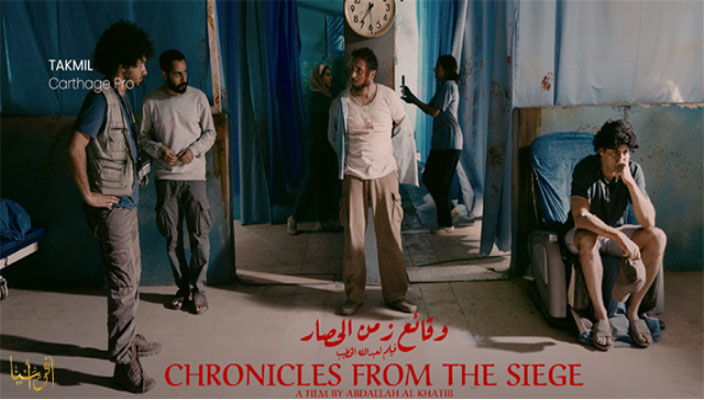
Afrasianet - Salim Al Beik - None of us bother to think before saying with a reassuring heart that Abdullah al-Khatib's "Chronicles of the Time of the Siege" is among the best among the first Palestinian feature films of the last quarter century. Since 2000, Palestinians have directed nearly 30 films as their first works. Of these films, if one of us chooses the best number (five or even three), this film will be among the best.
The film combines an excellent form and theme, with a clever narrative style, and is sensitive to its characters, and it is an extension of an excellent previous experience, exceptional in the documentary "Lesser Palestine", where Al-Khatib built his film on the strengths of its predecessor, anchors to be another layer above the documentary in a single narrative.
A tight construction despite the adventure of choosing intermittent stories, connected at the end of the film. It is a narrative style that may confuse the viewer, but the preacher's complete familiarity with his story, and his taking on this narrative challenge from the logic of the son of the story and its narrator at the same time, made what he chooses paths for his characters, highly reliable, not by an external judgment, as imagined by a spectator or critic, but by an internal experience, and this is what characterized the work of the first documentary, which is what characterizes the work of the first long novelist.
These are the first reasons why the film is one of the few that are excellent debuts, and one of the best, in all Palestinian films since 2020. Al-Khatib does not transmit stories that he has read or heard, so he writes them for a future project, he has not composed stories of fiction that incorporate Palestinian elements into them, and he did not accidentally pass a newspaper story on which he built his story.
"The Chronicles of the Time of the Siege" are personal stories of al-Khatib, who lived with him and others in the stricken Yarmouk camp in Damascus, so the most accurate details in the film are very reliable, he is the son of the story before he is its narrator.
Those who are familiar with this environment and that context, by chance that the writer of these lines, are aware of the extent of the identification between the reality of the camps in Syria and the fantasy in this film, which made that reality, with its smallest details and hints, a great human condition, and this is the next element that elevates the film, as the film balances extreme reliability with no hypocrisy or hypocrisy, and a Palestinian and humanitarian horizon that transcends Yarmouk to the whole world.
The film, even if it hints lightly and cleverly to Yarmouk, is a film from there and from there, during its siege by more than one conflicting party during the Syrian civil war, which brought about the revolution as it did to the camp, and during its bombing by the Assad regime at the time, the film still has the possibility of generalizing it to the Palestinians, as it is perfectly fit to be a film from and about Gaza, during its war of annihilation, and it can, regardless of some temporal indications, be about the siege of any camp in the West Bank.
It was possible for him to make a diary from the siege of Beirut and the PLO there, and then about the war waged on the camps there. A greater dislike for the basics in it, such as language and features, could have been a film with a completely human dimension, about the siege of any neighborhood in a city that is covered by warplanes and rained down with missiles.
A special sensitivity to the highly local elements, and a full awareness of them to the degree of the neighborhood's awareness of his street, and the intelligence and narrative cinematic style that Al-Khatib possessed, allowed the film to carry a very prominent locality, in contrast to human projections that need some identification and laxity in the conditions, so that the situation in the film is universal, and therefore it is a completely human state.
As a Palestinian, Al-Khatib has formed a cinematic project for himself that he is aware of, for the reasons I mentioned above, as he is the son of the story and the narrator of it. The one format in which the films proceed gives the author a fixed position in what he says and how he says it. Regarding this "how", we find a feature that may be shocking in both works, namely, in the boldness of the same statement, the boldness of form and content.
As I began here, the film has taken a confusing style of storytelling for many viewers, a cinematic present, the most beautiful of which in my opinion is the series "Dialogue" by the Polish Krzysztof Kieślowski (and to a lesser extent, also by "Three Colors"), where characters from the films in the series intersect and meet, main characters in one film that are secondary to another film in which other characters are major.
In the content and form of the film, therefore, in his statement and style, Al-Khatib judged his film, which was recently released very robust, delicate and intelligent, three traits that are difficult to combine in a film, especially in a first work. The film is as tragic as it is comedic, this is a cinematic adventure from which Al-Khatib came out unscathed.
The siege transcended space and time and became a state, and the film took from this situation a pictorial style (Talal Khoury) and audio (Rana Eid). The scenes were within four walls, and often with close-up lenses, the ceiling seemed low and the rooms seemed narrow.
From its title, the film deals with five stories or events that are separate, before they meet at the end of the film with characters that are only united in the stories by the extreme human circumstance. Five paintings, one of which suffices to form a separate short story, adds value to the others and hosts value from them.
The film begins with the scene of the distribution of the news in the camp, we see some of the characters in the next scene in which the owner of a film rental studio suffers from the loss of his medicines, hunger and thirst, we see others in the scene of breaking walls between houses to look for what is useful in the case of siege, only to find themselves in a studio selling videos, before a short scene of stealing a refrigerator from an abandoned house, a cigarette and escaping with it, and finally the scene of two lovers meeting where the young man's friends follow his lover's march through safe corridors of snipers and shelling. Everyone finally gets together in a closing scene in a field hospital, some dying at the time of a new birth that was in danger, and though the clock is completely off throughout the film, it began, with birth, to move.
The film ends with the beats of a clock that gave the siege a temporal dimension. The siege transcended space and time and became a state, and the film took from this state a pictorial style (Talal Khoury) and audio (Rana Eid). The scenes were within four walls, and often with close-up lenses, the ceiling seemed low and the rooms seemed narrow. The sounds of flying and shelling in the background made it even more uncomfortable, even in the outdoor scenes, where the rubble was walls that cut through the corridors.
The only skip to this was by the quick escape of the cigarette thief. He was an extreme indifference to the cut off space and its snipers, for a cigarette. Here we realize the exchange of priorities of life that were ordinary, and the rearrangement of the essential from the trivial in the diary of the besieged. Here we realize the absurdity of the meaning of time and place in the siege, and the meaning of what can be done within them.
The film's Chronicles From the Siege is a title that is clear in its significance, a sporadic realism of intersecting characters who are united by the time and place of the siege. The siege is not only for places, but for times, especially for those under siege. The reference to the stopped clock is a conscious indication of the damaged value of stopped time.
Place is a source here as well as time. Facts, movement, must have a time that advances in order to happen, and a place that changes. Both were of a damaged value, both were zero, in a film that was not satisfied with sensitivity Towards the rationale of his stories, and even extended to the depth of meaning in those stories, Yarmouk, Palestinian, and humanitarian.
We are here in Yarmouk in 2015 and in every Palestinian camp, every Palestinian spot, and a place that is fighting and besieged in the world.
The film participating in the "Perspectives" competition at the last Berlin Film Festival won the Best First Film award at the festival, the first time that this Berlinale Award has gone to a Palestinian, for the first addition of Abdullah Al-Khatib to Palestinian feature film.
After nearly 60 feature films along the course of this cinema, we finally come across a film that, for the first time in this journey, deals with the camps outside the country as a main place of events, and the refugees in the camps outside the country (Syria in particular) are the main characters throughout the film.
This in itself is a supreme value. The fact that the film can also be set in Gaza during the war of extermination or in any Palestinian place is a parallel high value, which makes the Yarmouk context a Gazan/Palestinian dimension, and a human horizon for this dimension.
All of this is achieved by a privileged film, which one of us says with confidence, and with deservedness of this qualitative work in all its elements, and we are still talking about a first film.
________________
