
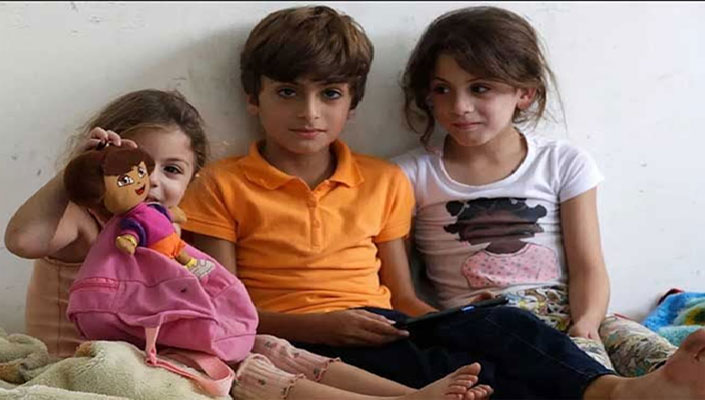
Afrasianet - Maryam Mashtawi - Wars never started from the heart of a child. Children don't open the fronts, they don't fire rockets, they don't sit around tables to decide the fate of cities.
But they are always the first to pay the price. In Lebanon, a small country, tired of repeating tragedies, the sound of war has come back.
An old ghost who knows the roads to homes is back again.
In an instant, the south, Beirut and the Bekaa are under fire!
The mothers of the south had no idea about the rockets that crossed the sky, and they didn't have fathers Villages that wake up at dawn to pick olives, a word in war, which has suddenly opened.
The decision was not here. It was not between these fields or between these houses that resemble their owners. But the fire came.
This is how Israel hit a few rockets that looked like fireworks. It only builds manure and falls timidly.
The response was a full-blown war. And so, as always, Lebanon became once again an arena for other people's wars.
In the south, there was no longer a south, the villages that were breathing between the hills were completely burned down, the houses that kept families warm became walls open to the wind.
People came out of their homes in a hurry.
No bags, no time to even say goodbye to the places where they have lived all their lives, mothers carrying their children, and children carrying their fear.
Small cars crammed with families, tired faces looking for a safe place in a country that no longer knows what safety means.
People fled the fire, leaving their homes, fields, memories, and everything that made their lives there.
Families slept in schools, some spread out on the sidewalks, and others looked for a warm corner in a city that was not ready to receive a new wave of displacement.
In the cold, on fasting days, an elderly man cries heartily on the sidewalk.
Children shivering from the cold.
Mothers try to hide their fear with broken smiles.
How do you explain to a child that war is not his fault?
How do you explain to a child that his homeland has once again become an arena for a war with which he has nothing to do?
In major conflicts, no one asks about Lebanon's resilience.
But when the rockets start falling, politics no longer matters.
On the roads, which were filled with displaced people, people were not talking about the balance of power or the maps of influence in the region.
The question was much simpler, and more painful.
Why do the Lebanese always pay the price for decisions they didn't make?
How does an entire country turn into an open arena for other people's wars?
In wars, the stronger dictates his equation.
But in Lebanon, the most difficult question remains. Always: Who protects people?
On the roads from the south to Beirut, people walk carrying the rest of their lives in small suitcases.
But the question that remains hanging over this small country is one that the Lebanese know very well.
They are afraid to answer it:
Is it destined for Lebanon to always remain an arena for the wars of others, not a homeland for its children?
Under the sponsorship system
There, an African woman walks, carrying her life on her shoulders, as if it were a heavy bag that she cannot put to the ground. Her steps are a long journey of fatigue, a full 11-hour walk, as she said simply, as if fatigue had become a normal detail.
In Lebanon, under the kafala system, many migrant workers live a life that is like walking on a narrow edge between need and fear. In the back alleys of cities, in parking lots, and in corners where cameras don't have much access to them, another life is being formed parallel to the Lebanese life we know.
They play with little things they found on the way. They know nothing about the laws that govern their mothers' lives, nor about a system called kafala that determines the fate of entire families.
They only know that they are here, in a country that is not their own, and in a life they have not chosen.NGOs, their workers say, are working to bridge this humanitarian gap, but the war is exhausting it.
They are trying to distribute food, to provide some basic necessities, and to give these people some dignity that has fallen in the way between borders and laws.But humanitarian work, no matter how sincere, is still an attempt to restore something.
In Lebanon, where economic crises are mixed with wars and political fragility, the vulnerable are more vulnerable.
The migrants, who have come in search of a better life, find themselves facing a reality that is more complex than they expected.
You walk because life doesn't wait.
And because her baby needs something to eat at the end of the road.
Many people probably don't know her name.
But her steps on the streets of the city write a whole tale of a world still searching for a simple meaning of justice!
________________
