
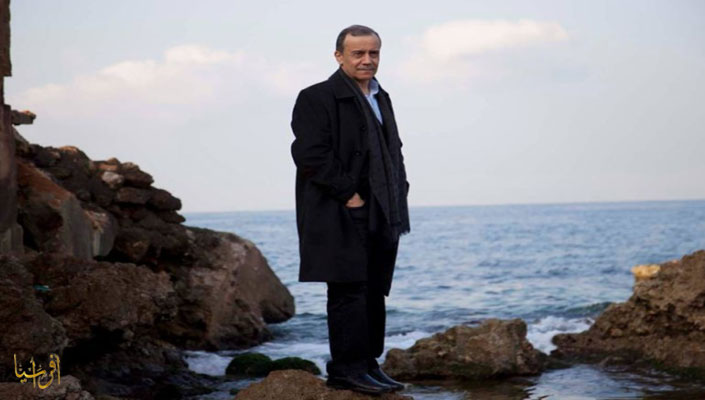
Afrasianet - Ahmed Qabour is a Lebanese artist who is considered one of the most prominent pioneers of committed music in the Arab world, who has dedicated his work to expressing national, humanitarian and social issues, foremost of which is the Palestinian cause, which has been a central focus of his artistic experience.
His name is particularly associated with the song "Anadikom", which he composed and sang in 1975, a poem by the Palestinian poet Tawfiq Ziad, which became one of the most prominent anthems of struggle and resistance in the Arab conscience.
Ahmed Qaabour died in the Lebanese capital Beirut on March 26, 2026, at the age of 71, leaving an artistic and cultural legacy in Arab memory.
Birth and upbringing
Ahmed Mahmoud Qaabour (Al-Rashidi) was born in Beirut in 1955, in a simple popular environment and a vibrant home of art, as his father, Mahmoud Al-Rashidi, was one of the first violinists in Lebanon, and despite the illiteracy of his mother, Fatima Al-Ghoul, she paid special attention to the education and scientific upbringing of her children.
At the age of ten, his interest in art began to take shape when he asked his father to take him to concerts where he was playing behind Farid al-Atrash and Shadia in Beirut.
His first music teacher was the Lebanese musician Salim Fleifel, who helped shape his artistic awareness and awareness of the responsibility of art, viewing music as a means of expressing collective identity and national memory, rather than just an aesthetic performance.
Study and Scientific Training
He received his primary education at the Patriarchal College in Beirut and completed his intermediate stage at the Al-Bir and Al-Ihsan High School. In 1978, he joined the Department of Theater at the Institute of Fine Arts at the Lebanese University, and obtained a diploma in theater.
Artistic career
Ahmed Qaboor took his first artistic steps in 1975, with the outbreak of the civil war in Lebanon, when he was only 19 years old, when he composed and sang the song "Anadikoum", a poem written by the Palestinian poet Tawfiq Ziad about resisting the Israeli occupation. This song was a station that introduced the Arab public to Ahmed Kaabour, as it resonated among people in festivals, demonstrations, and streets in Lebanon, Palestine and the Arab world. Ahmed Kaabour later stated that he tried to stop his father's tears that flowed after the defeat of the "Naksa" in 1967.
Since that moment, the name of Kaabour has been associated with the Palestinian cause, the song of resistance, and works with a political and social dimension, and his name has been etched among the pioneers of the committed song at the time, along with prominent names such as Marcel Khalifa , Ziad Rahbani , Khaled Al-Habr, and others, at a time when the committed song had its maximum presence and influence.
Between 1976 and 1977, he released his first album titled "Anadikom", which included other works such as "Ya Pulse of the Bank", "Southerners", and "Exile".
His later albums left their mark on his consolidation of a voice for humanitarian and social issues, expressing people's concerns, pains, and the details of their daily reality, and his works extended to include the emotional dimension as well as part of the human experience. His most prominent albums include:
• "I Call You" 1976
• "We Are the People" 1984
• "Love" (1985)
• "Ahmed Qabour's Ramadaniyat" 2001
• "Loud Voice" 2002
• "I Want to Sing for People" 2009
• "Ahmed Qabour Sings Omar Al-Zaani" 2011
• "When You Are Absent" 2018
• Ahmed Kaabour's artistic career was not limited to singing, but also extended to theater, television and cinema, and one of his most prominent works was the play "Something Failed" in 1983, written by Ziad Rahbani, which reviews Lebanese folklore and tells about the contradiction between a people who adhere to their heritage and their daily lifestyle.
He was featured in the 1992 film "Naji Al-Ali" and reviewed the life of Palestinian cartoonist Naji Al-Ali, who was assassinated in London in 1987, and the film starred Egyptian artist Nour Al-Sharif and directed by Atef Al-Tayeb.
In television, he participated in historical series, including "The Search for Salah al-Din" in 2001 and "Abu al-Tayyib al-Mutanabbi" in 2002.
He has also dedicated part of his television participations to contributing to musical programs such as "Laayounak", "Batmoun" and "The Spirit of Your Future".
In 2023, he appeared in the Syrian-Lebanese co-drama "Fire with Fire" as Marwan, a musician who disappeared in the Lebanese war and whose memory remains with his son Aziz, and the series addressed sensitive social issues such as asylum and tensions between Syrians and Lebanese.
Ahmed Qaboor has given a large space in his career to provide art for children that aims to build their awareness and culture, as he has presented more than 300 melodies in Lebanese puppet theater productions and television programs. His most prominent works for children include the song "Alu Al-Bayariq" in 1995 in collaboration with the Islamic Orphanage Choir, "Tutti Totti" in the album "Ramadaniyat", and "Children's Song Cocktail" in 2013.
Palestine is rooted in the life of Qaboor
The human and political dimension that dominates Ahmed Qabour's song has had seeds since his childhood, especially his influence on the stories of Palestinian suffering and struggle, as his family's home was adjacent to the Sabra refugee camp, which contributed to the formation of his human consciousness from a young age, and revealed to him the different forms of suffering of people when he accompanied his mother to the Sabra popular market.
He was also influenced early in his life by the story "Um Saad" by the Palestinian writer Ghassan Kanafani, which tells the story of a struggling Palestinian mother from the camp, and Qaboor said that after reading the story, he wanted to become "Abu Saad", which later inspired him to name his son "Saad", to become Abu Saad.
In 2016, the Jerusalem Permanent Capital of Arab Culture Committee awarded Ahmed Qaboor the Jerusalem Prize for Culture and Creativity in recognition of his outstanding role in art that dealt with Jerusalem and the Palestinian cause.
Death
Ahmed Kaabour died on 26 March 2026 in the Lebanese capital Beirut at the age of 71 after a battle with cancer.
________________
