
Afrasianet - Three weeks after the U.S.-Israeli military campaign against Iran, a long-term strategic impasse is becoming clear, with the United States facing a lesser regional power, with no clear goals or a viable exit strategy.
This is according to reports by the British magazine The Economist, Foreign Affairs, and the British newspaper The Independent.
In Foreign Affairs, Ilan Goldenberg, senior vice president and chief policy officer at J Street, noted that this conflict represents a different version of the quagmire that Washington has suffered in Afghanistan, Iraq, and Vietnam, where the United States has incurred heavy economic and human costs and has not decisively achieved its policy goals.
Goldenberg explains that the imbalance of power is in favor of the weaker side, as Iran can achieve a "victory" by simply staying and inflicting limited but influential losses on the global economy and oil markets.
The Limits of American Power
Sam Kelly, the international affairs editor of The Independent, exposed the limits of US power when Trump gave a five-day "pause" period from threatening to destroy Iran's energy system.
Kelly added that the pause gave Trump an opportunity to rethink how to get out of the impasse set by Tehran, a clear indication that U.S. power is not as absolute as Trump assumes.
According to Kelly, Iran responded to Trump's threat in a deliberate manner, stressing that any attack on its facilities would face a similar response, whether on power plants, the Strait of Hormuz, or the vital facilities of the countries of the region.
He said Tehran had tried to modify its rhetoric to avoid accusations of war crimes, demonstrating the Iranian regime's deep understanding of the constraints of war and its eagerness to exploit the U.S. threat to buy time and demonstrate moral superiority.
Four options all bad
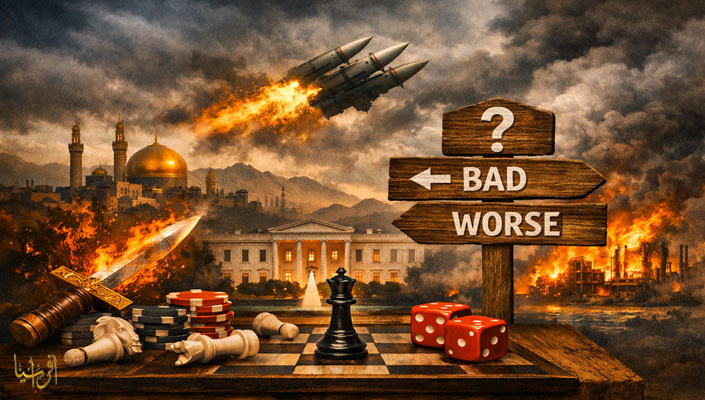
The Economist's Jason Palmer and Greg Karlstrom identify four options for Trump, all of which they describe as bad: dialogue, withdrawal, continuation of war, or escalation.
Palmer and Karlstrom argue that dialogue is difficult because of mistrust and divergence of demands, while a withdrawal could leave Iran in control of the Strait of Hormuz, continuing to threaten regional security and energy markets.
Continuing the war may partially reduce Iranian attacks but will not achieve a decisive victory, while escalation carries significant risks that could lead to regional chaos and open war.
Uranium, Khark and opposition groups
Goldenberg, in Foreign Affairs, noted that any U.S. attempt to seize Iran's highly enriched uranium in the Isfahan tunnels would be extremely complex and dangerous, requiring extensive ground operations, with a direct confrontation with tens of thousands of Iranian soldiers in fortified positions.
An attack on Kharg Island, Iran's main oil export corridor, carries high risks, as it could lead to an Iranian escalation that disrupts global markets, as Iran's responses to previous strikes on the South Persian gas field have shown.
Even U.S. support for Iran's domestic opposition groups, including the Kurds, Baluch and other factions, according to Goldenberg, carries the risk of igniting a multilateral war, with Turkey, Pakistan, and other countries intervening, creating an uncontrollably chaotic environment, which would be a strategic nightmare for the United States.
Iran's steadfastness surprises America
Goldenberg went on to say that the United States was surprised by the Iranian regime's resilience despite the assassination of its leaders, including Supreme Leader Ali Khamenei, and the appointment of his son Mojtaba Khamenei as its successor, which strengthened the influence of "hardliner" elements within the regime and made any rapid internal change nearly impossible.
U.S. attempts to weaken Iran's conventional military capabilities, such as missiles, drones and naval mines, have not prevented Tehran from threatening critical facilities or disrupting passage through the Strait of Hormuz, he said.
U.S. history in Iraq, Afghanistan and Vietnam shows that military escalation usually increases strategic complexity and makes it harder to control the situation, with high human and economic costs, without achieving a clear political victory.
He argues that the experience of Iraq has shown that the U.S. occupation has created an environment for the rise of armed groups, while the experience of Afghanistan has reaffirmed the difficulty of confronting an insurgency without near-total control over territory and local security.
The wisest choice
Goldenberg also asserts that the wisest option now is de-escalation and damage management. This includes declaring that key military objectives have been achieved, such as weakening Iran's specific capabilities, while asserting that future attacks will only be supported if Iran attacks Washington's regional partners or resumes its nuclear program.
He said this approach could allow the international community to pressure Iran to de-escalate and reduce economic and political risks to the United States and its allies.
Air and naval battles and targeted strikes will not topple the entrenched Iranian regime, nor will they completely disrupt Tehran's conventional capabilities, he said.
He stressed that Iran only needs to maintain a limited level of attacks to prove that the U.S. goal of improving regional security, which is less ambitious than regime change, has failed.
According to Goldenberg, intermittent attacks on the Strait of Hormuz or oil and service facilities can have a significant economic and psychological impact on the United States and its allies, and even intercepting 90% of Iranian attacks may leave the remaining 10%, which is enough to change the balance of the market and the political climate.
In the three sources, the book argues that the United States has found itself in a war without good options, as any direct or indirect military path is risky, and escalation could lead to continued chaos, while a full withdrawal leaves Iran in control and capable of threatening Washington's interests.
They assert that the most logical option is to de-escalate and reassess the strategy of war, while trying to maintain regional stability and the global economy, before a limited conflict turns into a long-term quagmire from which it is difficult to get out.
