
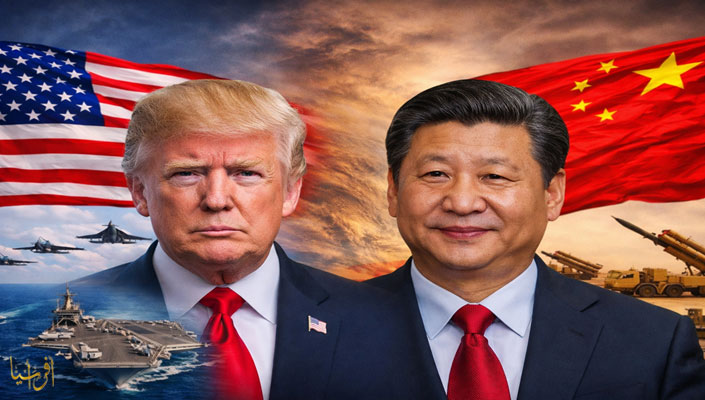
Afrasianet - In its follow-up to the war waged by the United States, along with Israel, on Iran, China seems to be inspired by a famous quote attributed toNapoleon Bonaparte, "Never interrupt your enemy when he makes a mistake," and bet that this war will accelerate the pace of American decline and give Beijing a major strategic opportunity.
This is the British magazine's assessment of China's strategy and calculations in dealing with the war on Iran, which was launched by the United States according to strategic calculations aimed at weakening a regional adversary, ending its nuclear ambitions, and sending a firm message to Beijing.
By demonstrating absolute control over global energy arteries, and highlighting the contrast between U.S. military superiority and Chinese silence, the war on Iran was supposed to serve as the ultimate deterrent to a rising China.
But a month after the war began, the view from Beijing suggests that Washington has made a historic mistake, and diplomats, researchers, and officials in Beijing say that China is not confused;
In an editorial in its current edition, the magazine writes that in keeping with Napoleon Bonaparte's famous quote, "Never interrupt your enemy when he makes a mistake," Beijing is betting that this war will accelerate the U.S. decline, while giving China a major strategic opportunity.
The "security first" doctrine
According to Chinese officials, the war in Iran has come to prove the correctness of the policies of Chinese President Xi Jinping , who for years has faced internal and external criticism for prioritizing national security and self-reliance at the expense of economic growth.
While navigation in the Strait of Hormuz is faltering, President Xi's proactive decisions to stock up on crude oil – which currently stands at a strategic reserve of 1.3 billion barrels – and to rapidly diversify energy sources into nuclear , solar, and wind power have proven to be a long-term vision.
While the West is paying the price for "recklessness" through skyrocketing energy costs, China is providing itself with a bulwark by facilitating Iran's oil trade and relying on domestic coal.
President Xi is betting on a plan that while America uses the global financial and military system as a weapon, China is building an alternative, independent system that is immune to such shocks.
Iran's Swamp
Chinese experts view the U.S. military intervention in Iran not as a show of force, but as a "confusion" and a decline in power, and they see this war as a lack of restraint and a complete lack of a "next day" plan.
Beijing expects that as U.S. resources and political assets are depleted in the Iran crisis, the U.S. ability to extend its influence in the South China Sea or fulfill its commitments to Taiwan will diminish.
Moreover, Asian allies who rely on the United States for stability are now suffering collateral economic damage, which could make them more wary of angering a seemingly more "credible" and "realistic" China.
Exploiting the Void
As a reliable partner, Beijing hopes to win lucrative reconstruction contracts in the Gulf region, and countries spooked by the blockade of the Strait of Hormuz are expected to turn to Chinese green energy technology, as Beijing stands poised to be the world's main provider of energy security, thanks to massive surplus production in solar panels, wind turbines, and batteries.
Diplomatically, Beijing feels Washington's position weakened and hopes that a weakened U.S. President Donald Trump will be more flexible at the May summit, while China aims to negotiate a rollback of tariffs and export controls.
China is also looking forward to the United States abandoning its policy of "strategic ambiguity" toward Taiwan, seeking a clear statement from it in support of "peaceful reunification," a move that would constitute a radical shift in the world order, according to The Economist.
Order and Chaos
Despite that optimism, there is a state of concern in China, where experts have been surprised by the U.S. military's use of advanced artificial intelligence to coordinate war operations in Iran, warning China that war remains unpredictable and reinforcing President Xi's caution about a possible invasion of Taiwan.
China, on the other hand, fears the disintegration of the world order because of America, which may act like a "rogue power," while China aspires to prosper under a stable world order.
According to The Economist, China is betting heavily on the assumption that America will fail to thrive amid the chaos it has created, while history suggests that America has a unique ability to reinvent itself amid turmoil, while China remains a cautious force constrained by partisan ideology.
The war on Iran has indeed changed the world, perhaps not in the way Washington wanted, but the future may lie with America, which is adapting to the turmoil at the expense of China, which distances itself from all forms of chaos.
Source: The Economist
