
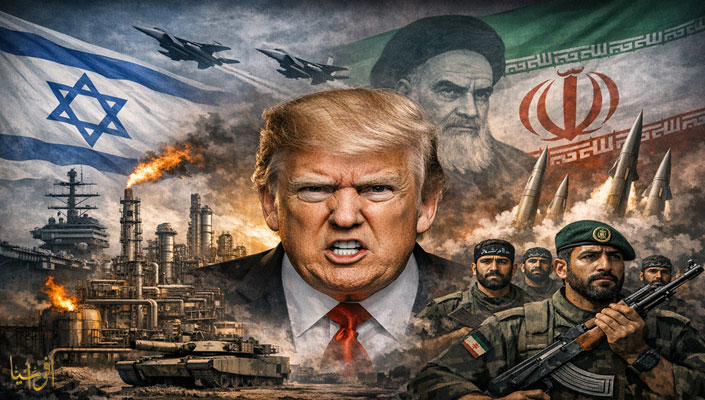
Afrasianet - Author: C.J. Polychronio - David Gibbs monitors Trump's coup d'état toward escalation against Iran, abandoning his promises of "America First, bowing to Netanyahu's agenda and infiltrating neoconservatives in his administration, driven by the obsession with grandeur and control of oil, which portends an imminent regional nuclear catastrophe.
The article on Common Dreams examines Trump's abrupt reversal toward war against Iran, abandoning his promises to his grassroots, and driven by ambitions of "personal greatness" and submission to the agenda of Netanyahu and neoconservatives, threatening an imminent regional nuclear catastrophe.
The following is the text of the article:
Historian David N. Gibbs reveals the reasons for Trump's sudden and vicious coup in favor of war, abandoning his popular base and his previous promises not to fight new wars. Indeed, the United States, along with Israel — the world's two largest rogue states — launched an attack on Iran on the 28th of last month, claiming that there was a fictitious threat to overthrow the Iranian regime in the hope of installing a "friendly" government in its place.
A month later, the war does not appear to have an end in sight, with Iran not losing its ability to respond and no internal insurgency. In addition, there are strong indications that the United States is preparing ground operations in Iran, a move that, if realized, would spark a fierce war in the region and beyond.
In the following interview, Gibbs describes the U.S. war against Iran as a stark example of President Donald Trump's "absolute submission" to Benjamin Netanyahu, the "butcher of Gaza," who has long wished to drag the United States into a direct military confrontation with Iran, and has finally succeeded. However, Gibbs also suggests that Trump may have had goals of his own in mind when he decided to fight this war against Iran.
As the war drags on, threatening to sweep the Middle East and beyond, the question remains: Why was Trump's first term less war-inclined than the Obama and Biden administrations?
This attitude has manifested itself in various areas, from the streets of Minneapolis to the Caribbean and Greenland, and now dramatically waging an outright war of aggression in the Gulf region. While Iran poses no imminent security threat to the United States or Israel — as intelligence expert Joseph Kent, who recently resigned from the Trump administration, explained that this war is also a violation of the UN Charter, which prohibits wars of aggression that are not authorized by the Security Council. Trump also violated the U.S. Constitution, which states that international treaties signed by America (such as the Charter of the United Nations) are part of the "supreme law of the land."
In waging war against Iran, Trump is behaving much like previous presidents of both parties, following the American presidential tradition as a warmaker. George W. Bush's invasion of Iraq in 2003, which was as reckless and destructive as Trump's war now, and resulted in enormous costs in terms of both lives and money with no security benefits whatsoever. Still, Bush had bipartisan support. Trump's extraordinary subservience to the Netanyahu government — despite his promises of "America First" — is part of a long tradition of pro-Israel activism by previous administrations, at least since the 1970s.
There have been many other instances of disastrous U.S. interventions, from Iraq to violent regime changes against governments in Libya and Syria, which have had negative consequences for both the population of those countries and for the security of the region. In 2014, U.S. officials helped overthrow the elected government in Ukraine, destabilizing the country and laying the groundwork for a subsequent war with Russia, in doing so, violating the Organization of American States Charter that prohibits all forms of foreign interference. NATO bombing campaigns in Bosnia and Herzegovina and Kosovo have increased the scale of human suffering, while U.S. officials have blocked negotiated settlements that could have resolved these conflicts peacefully.
Attention should also be paid to the weaponization of economic sanctions by U.S. presidents, who, according to a recent study, have killed millions of innocent people over the past 50 years. U.S. officials in previous administrations have shown remarkable harshness when asked about the deadly effects of sanctions. While Trump's bizarre style of communication is unique among modern presidents, his penchant for violence is not unique.
It should be emphasized that Trump's new aggressive foreign policy looks fundamentally different from what we saw in his first term, when Trump showed many troubling tendencies, including the assassination of Iranian General Qassem Soleimani and the reversal of a U.S.-Iran agreement that was fully effective and limits Iran's uranium enrichment. But what Trump did not do in his first term was to start any new wars. Yet many on the left resented this idea, but the truth is that Trump, in his first term, was already One of the least war-mongering presidents since 1945.
Historian Gibbs probably argues that Trump, in the midst of his innate paranoia, wanted to be not just a two-term president, but a great president, on par with Abraham Lincoln or Franklin Delano Roosevelt, and a victorious leader of wars befitting Mount Rushmore. Other motives included his desire to consolidate U.S. control of global oil, to be used as a tool against rivals Such as China, to open new investment horizons for American companies by force, to enable the traditional corruption that is always associated with wars and covert operations, to appease Israeli lobbyists everywhere, and to divert attention from his embarrassing ties with Jeffrey Epstein. Still, Trump's quest for greatness is likely to have played a big role in his decision to wage war.
Trump's goal of having a statue of his face on Mount Rushmore is clearly failing, because of his alleged war against Iran, which is already heading for political and economic disaster. Preparations for war seem remarkably superficial, reminiscent of past wars, like the many failures associated with the war on terror.
On the isolationism of the "Make America Great Again" era and the rejection of neoconservative visions of reshaping the world in America's image, and the Trump administration reverting to a somewhat conservative foreign policy, Gibbs argues that neoconservatism emerged during the 1970s, in response to the U.S. military defeat in Vietnam. Having studied the private documents of neoconservatives at Stanford University and elsewhere, I see their ideology as a form of pro-military extremism that glorifies U.S. foreign interventions as Inherently desirable, based on Israel's experience, neoconservatives openly admire the military achievements of the Israeli military, which launches fierce attacks on its opponents with indifference to its volatile aggression. In the eyes of neoconservatives, the IDF signals how America behaves on the international stage. Since their emergence half a century ago, neoconservatism has gradually become the dominant foreign policy perspective in both American parties.
In his first term, Trump has resisted and publicly criticized the neoconservatives' agenda of sustained militarism. Many prominent neoconservatives have moved from the Republican Party to the Democratic Party since 2016. But Trump has now shifted to neoconservative strategy, particularly in his war against Iran, and has finally joined the mainstream. Policy specialists who are not affiliated with it. In the current Trump administration, Marco Rubio, who serves as secretary of state and national security adviser, has always been classified as the neoconservative camp and has emerged as the main policymaker. Second, Trump's desire for national greatness through war is consistent with the idea of neoconservatives.
Now the Trump base is weary of the prospect of a permanent war. There's a realization that we've spent too much on weapons, too little on basic necessities, and Trump was initially seen as the solution to this problem. When Trump supporters use the term "America First," many of them mean that we should focus on improving living conditions here in the United States, while reducing our focus on a global power project. Trump's abandonment of his "America First" agenda is already creating divisions within his coalition, which are sure to worsen as the war turns into disaster. These political divisions will become more acute, or more likely when) Trump decides to send ground troops to Iran, which will increase U.S. losses.
Nuclear weapons have not been used in wars since the U.S. bombed Hiroshima and Nagasaki in 1945. It is feared that the Trump administration will not hesitate to use nuclear weapons against Iran if it realizes that it will lose this war? Gibbs says one of the clear effects of U.S. military aggression over the years is to accelerate the spread of nuclear weapons, with many countries concluding that the only way to deter U.S. aggression is to acquire nuclear weapons. Many to North Korea, which has adopted a nuclear strategy plus long-range missiles, and is therefore protected from attack.
Another case worth considering is Muammar Gaddafi's Libya, who abandoned his nuclear ambitions in exchange for an implicit understanding that the United States and its allies would not overthrow his government. Then, in 2011, the United States and NATO took advantage of Libya's weakness, violently overthrew the government, and Gaddafi was tortured to death. The inevitable result of this history is that more countries will consider developing their own nuclear weapons, starting with Iran, of course. The next wave of nuclear proliferation will also exacerbate the dangers of using nuclear weapons, which threaten global security, as the most important achievement of the war with Iran will be the escalation of the global nuclear threat.
One of the most disturbing features of contemporary politics is the absence of any real anti-nuclear movement in the United States or elsewhere. During the Cold War, the anti-nuclear movement was widespread, and the fear of nuclear war was an integral part of popular culture, and a constant concern. But with the end of the Cold War, the anti-nuclear movement disappeared entirely, and people now seem to be indifferent to the real dangers of nuclear war.
What we can do in the near term is that the leftists must let go of their narrow prejudices and form a broad anti-war coalition, including individuals on the right and left who oppose what Trump is doing in Iran and the permanent war in general. Let us also salute the anti-nuclear movement, when there is clearly a large and growing anti-war movement on the right, and smart leftists should not hesitate to work with it. Let us forget about the cultural conflicts for a moment and focus on the horrors of real war.
