
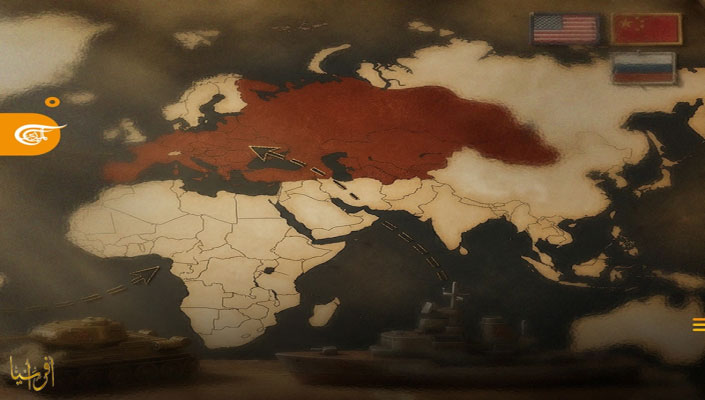
Afrasianet - Muwafaq Mahadeen - As much as the Zionist project of the new Abrahamic East was a regional project for Tel Aviv and the liquefied oil and gas reserves, it was part of the imperialist project to connect the Eurasian Northern Heartland with the Southern Heartland.
Despite the importance of all the data circulating about the current war between Iran and the Axis of Resistance and the American-Zionist alliance of evil and its regional extensions, there is something that is written and approached from another angle related to the international framework and general context, which is the role of the southern heartland (the heart of the other world) as formulated by the British strategic geographer, Mackinder, and the controversy of its relationship with the Eurasian North Heartland. Special considerations of strategic importance:
- The location of this heart on the East India Road in its new form and transformations.
- The establishment of the Zionist entity after the Second World War, from the perspective of imperialist interests.
- Energy
Accordingly, after World War II, the new US imperialism formulated its strategy for the Middle East and was keen to hold the territorial keys to this East.
- Iran, the Shah, especially after the encirclement of Dr. Mossadegh' s case.
- Turkey after the removal of Mustafa Kemal Atatürk's party in favor of a fully imperialist synthesis represented by the Islamized and Atlantic government of Adnan Menderes at the same time.
- The newcomer represented by the Zionist entity.
- New oil reserves, especially after the ship's agreement with Roosevelt.
However, the decade of the 1950s did not pass peacefully against imperialism and its aforementioned tools, as with the Nasserist revolution in Egypt, Washington and London began to lose control over the southern heartland, coinciding with the emergence and development of the Soviet Union and its full control over the northern Eurasian heartland.
Two lean decades will pass for the imperialists, during which Nasserism was able to break the imperialist control over the southern heartland, before imperialism succeeds in getting its hands on it again, and the Arabs lose their previous opportunity with the departure of Nasser and Sadatya's control of Egypt under the title of privatization, arms, Zionism and Americanism.
In addition, just as Nasserism broke the Atlantic hegemony over the Middle East and the Southern Heartland, the Iranian Revolution repeated the Nasserist lesson, but was soon exposed to almost the same risks and interventions, especially after Moscow temporarily succeeded in establishing the largest Asian strategic axis in history, including the Southern Heartland, extending to Afghanistan after the leftist coup, passing through Iran after the revolution, and with an Iraqi-Syrian understanding led by Al-Bakr . Assad with Russian support and ended up in Lebanon, which was practically under the control of the national movement and the Palestinian resistance.
We know that this strategic axis has been subjected to a counter-attack by the United States, Atlantic, Zionist and oil reserves, and the American, Pakistani and oil intelligence pens invented the phenomenon of Takfiri Islam in Afghanistan.
Then it overthrew the Syrian-Iraqi understanding between al-Bakr and Hafez al-Assad, and opened a battle with Iran before the Zionist enemy crowned this series with aggression against Lebanon and drowning Syria in blood and fires, leading to the generalization of Camp David with an agreement with Lebanon (the May 17 agreement), and finally the disintegration of the Soviet Union and Washington's approach to control the Eurasian heartland.
On the other hand, just as Nasserism and the Iranian revolution were able to break the reactionary Atlantic, Zionist, and reactionary alliance and its attempts to control the southern heartland, the rise of the Lebanese resistance led by Hezbollah constituted the third episode in the history of the conflict over this heartland, and this rise quickly turned into a strategic axis that extends from Iran through Iraq and Syria to Lebanon, and then to two important gates and flanks of this heartland, namely the port of Gaza and Bab al-Mandeb.
The Southern Heartland Before the American-Zionist Aggression on the Region
Almost simultaneously, US imperialism and the Zionist enemy state entered into periodic crises unlike its predecessors, as the accelerated information revolution led to the expulsion of tens or even hundreds of millions of workers, blue and white collars, and middle-class segments from the labor market, and it was also not possible to go back to the era of capitalist industrialization, where added value and profits were formed by the criterion of the economic cycle at the global level, and not only at the level of the financial and commercial cycle.
The Zionist enemy, for its part, had witnessed a strategic imbalance in its social structure, which excluded the vital blocs of its functional role, represented by the Ashkenazi, in favor of the more backward and more racist forces.
In these circumstances and climates, the escape abroad was inevitable and expected, as the strategy of the counterattack on the Axis coincided with the escalation on (Eurasian) Russia, the center of the heartland of the world, from Ukraine prior to the Russian strike itself, based on early advice given by Brzezinski decades ago, based on turning Ukraine into a station for the American attack on Moscow and blocking the way to its national awakening.
The imperialist strategy took new forms that went beyond traditional politics to the game of demographic maps and the war of sects and ethnicities, namely that the American talk of a different Middle East from the (European) Sykes-Picot East became open and unequivocal and replaced by new borders, namely blood borders associated with formations of bloody sectarian puffer states.
In this sense, as much as the Zionist project of the new Abrahamic East was a regional project for Tel Aviv and the liquefied oil and gas reserves, it was part of the imperialist project to connect the Eurasian Northern Heartland with the Southern Heartland.
Also, if during the period of political Zionism led by the Maarakh and the so-called secular labor groups, the Zionist enemy focused on the strategy of domination through the Camp David, Oslo and Wadi Araba Accords. The Peres project (Benelux), the economic address, and the Amman, Casablanca and Doha conferences, the stage of religious Zionism led by the Likud and the Takfiri religious groups (the other face of Takfiri Islamist fundamentalism) took on new titles in the Abrahamic Middle East project.
The concept of domination replaced the concept of domination and annexation of the region to Tel Aviv, instead of integrating it into the region from a position of domination, and the most dangerous was the marketing of sectarian discourses and narratives in all its expressions, from religious Zionism to Takfiri Islamic Zionism (which was handed over to Damascus), to Christian Zionism and its American stronghold.
Thus, in the American context of weakening the Eurasian heartland, controlling the Middle Eastern heartland, and linking the energy war, especially gas, with the geopolitical war and strategic corridors, the resistance axis that was able to capture the aforementioned corridors such as Gaza, Bab al-Mandeb, the Strait of Hormuz and the Syrian coast was targeted, in addition to the gas war signs, where Russia and Iran control the largest reserves, in addition to the new reserve off the Gaza coast, where Hamas and the resistance are in control, and off the southern Lebanese coast where Hezbollah controls.
In addition, the idea of the "vital sphere" of the enemy, and its Palestinian and Jordanian circles, can be openly and openly talked about in new demographic maps that are in line with the American imperialist vision of a new form of Sykes-Picot (American) that is not like its predecessor (British, French).
In contrast to the old Sykes-Picot and the Maarach and Peres project (the control of the Zionist Middle East), the east of religious Zionism goes beyond neighboring geopolitical countries to population geographies based on the racist concept and its equation of land-people-state as an imperialist-Zionist concept of whites and Jews as opposed to the hostility of geography, population, and self-administration.
Thus, ending the Palestinian issue as a mass (barbarian) population by drawing the form of extermination or taming within security and administrative reserves, and even dealing with the entire ocean based on this, in a way that also achieves the enemy's control over the gas (the Gaza field and southern Lebanon), the water of the Shebaa and Litani basins in the north and south, and the Golan basin and Yarmouk.
Thus, the enemy's projects were becoming more brutal and racist from one stage to another, from the stage of religious Zionism, i.e., the stage of normalization and subjugation through domination and known agreements, and east of Peres and the Benelux, to the stage of uprooting, extermination, displacement and Judaization.
This is done by controlling and bypassing the agreements themselves to reach the so-called Greater Israel, according to the racist biblical mind and its monopoly on the concept of land, the people versus the concept of geography, the population (barbarians) who do not deserve a form of civil state but a form of administration in subsidiary protectorates.
This is what it is meant to be waiting for all of us, and the Jordanians and Palestinians in particular, and the issue is no longer Zionism, the form of the two-state solution, and how to turn the Palestinian Autonomous Authority into an imaginary state, but how to transform the Jordanian state into a form of limited power, so that Jordan does not remain a political homeland and no geographical and population alternative, and they are only managed from Tel Aviv, not to mention the control of the water basin from the Litani to Yarmouk, the Northern Valley, and the gas in Gaza.
Repercussions of the aggression
One of the repercussions of the aggression in general is the consecration of technical warfare as a general feature of future wars, and the need to bring about a major coup d'état in the image and structure of the classical armies and their restructuring along the lines of Hezbollah and the resistance in the region with advanced technologies in the sky and on the ground.
In addition, the whole world today is paying the price of the American-Zionist aggression against Iran because of the repercussions of energy and international trade.
As for the main players such as the Zionist enemy, Iran, the party and the resistance in the region, the scene is not yet complete, but it is available according to the following approaches:
On the level of the enemy, its technological successes have not been new, since its establishment and it is advanced compared to others, but the information revolution has taken dangerous steps forward in this regard, but it is not strategically translatable in light of failures of the same nature in the face of Iranian missiles and the missiles of the resistance movements, as well as in light of the razing of the vital (social) mass of its functional role at the regional level, namely the Ashkenazi bloc, whose role is gradually diminishing and has recorded the highest rate of reverse migration.
Also, with regard to the official and unofficial Arab shadows of the Abrahamic Middle East project, going far and again in this project is fraught with real dangers open to the unfortunate consequences of Zionism from the cunning of history and the explosion of the Arab street.
At the level of the party, the enemy camp, its tools and alliances know that the battle with it is not limited to its military experience, whatever its wounds, but much deeper than that, and its results range from two options that have no third option: the first is the slide of Washington, Tel Aviv and the oil and liquefied gas reserves into a bloody incitement that will lead Lebanon and the region to a long chaos that is likely to be coupled against them, and the second is the restoration of the party's full presence and the repercussions of this on the entire region.
As for the head of the axis and its main force, Iran, its losses within the walls, and even after the strikes of the US-Zionist coalition, it regained its balance at record speed, shattered the myth of the Zionist air defense and dealt major blows to the enemy's vital infrastructure.
The US-British experience of overthrowing Mossadegh's government can no longer be repeated, and it failed after the Iraq-Iran war, one of the goals of which was to revive well-known political, social and physiological blocs, and Iran even strengthened its relationship with the international centers of the BRICS and Shanhai, thus strengthening the independence of the North Eurasian heartland with a key force from West Asia.

