
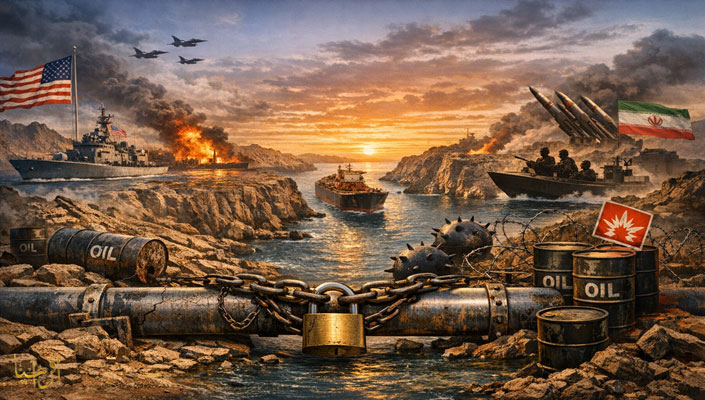
Afrasianet - Earlier this month, U.S. Secretary of Energy Chris Wright wrote a message on the social media platform X that the U.S. Navy had successfully escorted an oil tanker through the Strait of Hormuz. But the post was short-lived, and it was deleted shortly afterwards, before the White House issued a clarifying statement denying any such escort mission.
On the surface, this seemed like a communication error or a media miscalculation. But in essence, this contradiction revealed deeper features of the Trump administration's approach to crises, perhaps more than carefully crafted official statements do.
What was striking about the incident was not just that the post contained misinformation, but the impact it had in just a matter of minutes. In just about ten minutes, crude oil futures were down nearly 17 percent, in an immediate response from markets that seemed hungry for any sign that the crisis could be contained.
The Strait of Hormuz is not just a transient geographical location in the context of military escalation, but also one of the world's most important economic arteries, through which nearly one-fifth of the world's oil and liquefied natural gas supplies pass.
The International Energy Agency (IEA) has described the disruption caused by the war on Iran as the biggest oil supply shock ever, with around 8 million barrels per day expected to be lost in just one month.
This is precisely the kind of crisis that governments are quickly seeking to contain, as their economic effects accumulate in real time, before any military or diplomatic solutions are in sight.
Maysoon Kafafi, a senior adviser for Middle East programs at the Atlantic Council, argues in a Foreign Policy magazine that the Trump administration's tendency to broadcast messages of reassurance seems understandable, and perhaps even necessary, in the context of crisis management. But these attempts, when they fail or contradict reality, reveal a deeper problem. What is observed in various aspects of the crisis, whether in market movements, military timetables, alliance management, or diplomatic discourse, is the adoption of a recurring pattern based on judgment through declarations.
In other words, Washington declares a reality, hoping that actual reality will follow that declaration. This confusion between statement and action, between demonstrating determination and actually possessing it, is the thread of the crisis, but it remains an approach that is difficult to sustain in the long term.
U.S. officials have resorted to conditional and proactive language, rather than offering a clear and credible path to de-escalation or ensuring the restoration of safe navigation.
They spoke of the U.S. Navy's ability to escort ships when needed, the possibility of commencing such operations when military conditions permit, and about resuming activity once full airspace control was achieved.
On March 13, President Donald Trump reiterated that the United States would escort ships if necessary. However, these statements, while ostensibly strong, point to potential future directions, while clearly avoiding any confirmation that there are already measures in place.
The impact of this language is not limited to the political sphere, but extends to markets that react not only to the facts, but also to the credibility of the narratives presented to them. The U.S. narrative seems coherent in form: a serious but manageable crisis, Washington is still in control of the pace of escalation, energy flows will resume, and price rises are temporary.
White House spokeswoman Carolyn Levitt reinforced this message, asserting that the operation against Iran would eventually lead to lower energy prices. The White House has also sought to secure insurance support and financial guarantees for the shipping sector in the Gulf, in an effort to contain the shock and restore stability.
However, the effectiveness of this narrative remains dependent on the extent to which it relates to practical reality, which in this case seemed fragile.
The U.S. Navy has reportedly rejected requests from the shipping industry to provide military escorts because of the high level of risk. As Washington continues to publicly reassure markets, this refusal reflects a different reality that reveals a clear gap between rhetoric and practice.
More importantly, the United States has yet to provide a practical vision of how to ensure that the strait remains open in the face of escalating hostilities.
That gap has widened further as the crisis has been tried to internationalize. Trump has called on a number of countries, including China, France, Japan, South Korea and the United Kingdom, to send warships to help secure the strait, warning that a lack of response could affect NATO's future. He announced that several countries had already responded, but later declined to name them.
In contrast, no country has publicly confirmed its participation, with Japan citing its constitutional restrictions, Australia asserting that it has not received a request, while Germany's defense minister explicitly declaring that this is not his country's war, and Spain flatly refusing to participate. These positions reflected a state of near-collective hesitation among the Allies.
The paradox becomes even more apparent when these countries, which rely more on Gulf oil than the United States, are asked to take the risks of a conflict they did not participate in or have been consulted about.
The request came as Trump declared that Washington had already achieved victory in its war on Iran, further complicating the political message to allies.
However, this trajectory did not last long. On March 19, several countries, including France, Germany, Italy, the Netherlands, the United Kingdom, and Japan, signaled their willingness to participate in securing the strait.
But the next day, Trump hinted that the United States might not be involved in the task at all, considering that the issue concerned other countries. Less than 24 hours later, he escalated the situation again, issuing Iran a 48-hour ultimatum to reopen the strait, threatening to strike energy facilities.
The United States has yet to provide a practical vision of how to ensure that the strait remains open in the face of escalating hostilities.
This volatile pattern has spilled over into the diplomatic sphere. Trump announced that Iran had agreed to 15 clauses of a framework agreement, in what he described as significant progress toward a solution. However, Tehran was quick to categorically deny this, stressing that there were no direct or indirect negotiations.
However, markets reacted to the announcement, reflecting once again how narratives can precede and influence facts.
Whether this announcement stems from a conviction that there is an actual agreement in the making, or simply an attempt to manage market expectations, the result is the same: a gradual erosion of the credibility of Washington's signals. Every time the narrative takes precedence over reality, confidence wanes the next time, even if the message is true.
This pattern does not appear to be a series of exaggerations, but rather reflects a broader approach to judgment that relies on verbal intervention in markets before creating the realistic conditions that give it credibility.
This approach may have some effectiveness in monetary policy, where central banks have clear tools and a record that markets can interpret. In geopolitics, there is no such mechanism. When words are preceded by actions, they deepen rather than contain uncertainty.
The allies have picked up on this problem clearly. European officials have expressed skepticism, with German Foreign Minister Johann Fadiful noting that allies expect Washington to involve them in the decisions and keep them informed of their developments, a statement that reflects the lack of genuine consultation.
Even the March 19 joint statement focused on Iranian attacks without supporting the U.S. narrative that a solution was imminent.
This reality begs a fundamental question at large: Why has Washington become so dependent on narratives? But energy markets remain international in nature, oil prices are determined globally, and supply lines remain vulnerable.
The Strait of Hormuz has clearly exposed the gap between production capacity and control, as Washington's isolation from supply shocks has never been synonymous with its ability to manage them.
This gap is also evident in the dilemma of Kharj Island, where U.S. Central Command has targeted dozens of military sites, while avoiding oil installations.
Despite Trump's statements about the complete destruction of military targets, he has hinted at the possibility of targeting oil infrastructure, opening the door to a dangerous escalation.
The island processes about 90 percent of Iran's oil exports, and targeting them could lead to widespread disruptions in global markets, especially for Asian economies that depend on these supplies such as China, India, Japan, and South Korea.
Herein lies the fundamental dilemma: Washington has enormous military power, but it lacks a means to use it without causing further instability. The Trump administration is trying to use rhetoric to offset some form of operational control that it cannot impose quickly.
The coalition's appeal follows the same logic: If the United States cannot unilaterally impose order on the strait, then it may be enough to declare an international effort, even if not on the ground, to achieve what its military presence has not yet imposed.
But policies of reassurance based on conditional promises, future actions, and carefully crafted leadership signals are fragile.
Ultimately, this crisis reveals a deeper imbalance than just a miscalculation of adversaries. It reflects a miscalculation, as the United States assumed that the confidence derived from being the world's largest oil producer gives it the ability to control market trajectories.
