
Afrasianet - Rola Muffaq - Iran has long played on the brink, capitalizing on the lack of time and calculations of its adversaries' hesitation, and trying until the last minute at the Geneva talks to buy more time.
What was put forward in the third round, particularly the idea of "zero storage" of highly enriched uranium as revealed by the Omani foreign minister, was in the American reading nothing more than a tactical "carrot" aimed at extending the deadline announced by Donald Trump on February 13.
Tehran is aware that the path of negotiations with the Trump administration is radically different about its past experiences, especially with democratic administrations that bet on long-term diplomacy and gradual dismantling of the contract.
In Trump's dictionary, procrastination reads weakness, and ambiguity is met with an explicit warning: either an agreement on clear terms, or a move to another stage.
From the beginning, Trump presented himself as a dealmaker who is not shy about sitting with adversaries who might become partners, but at the same time is impatient. His message was direct: either go for a comprehensive nuclear deal beyond the 2015 formula, or face "bad things."
When he announced on Saturday morning (February 28th) the launch of a large-scale and ongoing military operation against Iran under the name of Operation Implicit Rage, he was translating the political deadline into military action.
The objectives of the operation were defined by a clear threefold: protecting Americans, erasing Iran's missile program, and ensuring that Iran no longer posed a nuclear threat.
He did not stop there, but addressed the Revolutionary Guards directly, calling on them to lay down their arms, and addressed the Iranian people that "the hour of your freedom is approaching," in an attempt to separate the regime from society and build a narrative that the battle is with the power structure, certainly not with the Iranians. Tehran has repeatedly threatened to target U.S. bases in the region if it is hit.
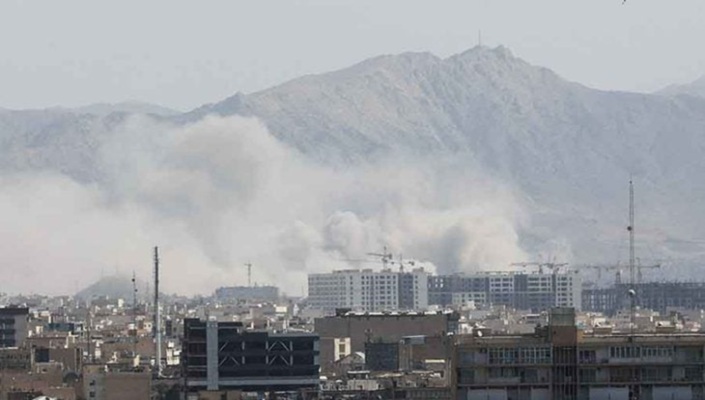
As the joint U.S.-Israeli strikes began on the regime's command positions, the Revolutionary Guards, the intelligence services, and sensitive facilities, the response came quickly with missiles that targeted U.S. bases and interests in the Gulf, including bases in Qatar, Bahrain, Kuwait, and the United Arab Emirates, as well as Erbil in Iraqi Kurdistan and Jordan, and not limited to Israel, which is always at the center of the circle of fire.
This is where the logic of the "balance of pain" comes into play: Iran cannot prevent strikes, but it seeks to raise its cost and expand its arena to deter escalation or impose an early halt to them.
The defenses of the Gulf states, Iraqi Kurdistan, and Jordan worked to intercept the missiles that targeted them in several waves. What Trump did not say explicitly was clearly expressed by his ally, Israeli Prime Minister Benjamin Netanyahu, who declared that the goal goes beyond deterrence or weakening the regime to overthrow it, presenting the operation, dubbed "Assad's Roar," as an opportunity to create conditions that will enable the Iranian people to get rid of the "murderous regime."
This difference in wording between Washington and Tel Aviv does not mean a complete difference in goals, but rather a difference in narrative management: the United States prefers the title of "removing the threat," while Israel tends to address "regime deregulation" as the ultimate guarantee. In his speech, he said he tried to co-opt and negotiate with Iran, but it refused.
However, the ambition of the master of the White House means in practice dismantling the foundations of the ideological version of the "guardian jurist" regime, which was built on hostility to the West and exporting the revolution as a defense mechanism for its survival.
In other words, the deal, in its extreme form, does not affect only a technical program, but also an entire religious, ideological, political, and security identity.
The US president did not set a short time limit for the operation, using the term "continuous", while leaks spoke of a wave of intense strikes for four or five days.
However, the perception of a rapid and crushing war remains problematic unless we are faced with a scenario of accelerated internal collapse or a disintegration of the command and control structure.
Despite its losses, Iran still possesses asymmetric retaliatory tools: missiles, drones, regional networks, and the ability to threaten vital corridors. Its main bet was, and remains, on absorbing the first blow, preventing a rapid collapse, and turning steadfastness itself into a narrative of "victory," even if it ends in a humiliating deal or a surrender wrapped in a sovereign rhetoric.
What the first day of the US-Israeli strikes showed was that they targeted a list of regime leaders, headed by the Supreme Leader, without clarifying the results of the targeting, in an attempt to paralyze the regime's capabilities and institutions in conjunction with the neutralization of missile launchers, missile infrastructure, and nuclear sites.
The existential goal of the system therefore becomes survival, albeit at a high price. In the logic of ideological systems, surviving an attempt to overthrow, even with heavy losses, can be marketed internally as a victory over the "alliance of enemies."
Between Washington's desire for a historic resolution, Tel Aviv's ambition to create a window in which the Iranians themselves can move for radical change from within Iran, and Tehran's bet on steadfastness, the trajectories of the conflict are determined: either a deal imposed under fire that rechanges the equation in Tehran, or an open confrontation that expands its arena and tests the limits of power and capability in the plan to draw the new Middle East.
