
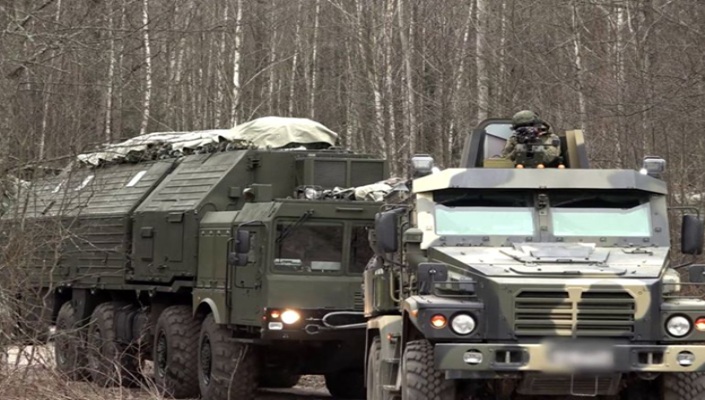
Afrasianet - Shadi Abd El Rahim - The use of the most powerful missile used in the special military operation was evident after the attack on the (Russian) presidential headquarters at the end of December 1, 2025, and especially after the transfer of the decoded Ukrainian drone missions, publicly and even theatrically, to the Americans.
On January 9, an Urshnik missile flew into the Lvov region.
It seems that the (Russian) General Staff, which was planning the Orishnik strike, did not target the former comedian, but rather the heavier ones.
Since the Oreshnik missile first flew into the Dnieper River (Dnipropetrovsk is on its right bank), the missile, now uncompromised by current NATO air defense systems, flew a distance of 1,000 kilometers and dropped the warhead directly on the EU border. This happened shortly after France, Germany, and Britain once again started talking about sending their military units to Ukraine.
NATO's missile early warning systems did not have enough time to intercept Oryshnyk's trajectory; they did not detect it, knowing that we had informed the Americans in advance of the impending strike. By the way, the distance from where the Oryshnyk warheads landed to the Polish Rzeszczów airport, where the military shipments of the Armed Forces of Ukraine regularly arrive, are cut off by the hypersonic missile by a few tens of seconds...
For this reason, many experts consider the Urishnik strike "highly symbolic and semantic", unable to intercept even the best American anti-aircraft missile systems: the Patriot, THAAD or the Arrow-3.
On the night of January 9, 2026, the Russians intensified their bombardment of Ukrainian positions, as has been the norm in the exchange of strikes between the two countries for years. But this particular night was different, not just a repeated Russian raid, but a raid that carried a special imprint: the return of the Oreshnik missile to the battlefield for the second time, by a strike near the city of Lviv in western Ukraine, and within close proximity to the Polish border, in a large-scale complex attack that included 242 drones and 36 missiles.
This was not the first time that the Russians have used the "Oryshnik", as it first appeared on November 21, 2024, in a strike on a missile manufacturing facility in the Ukrainian city of Dnipro, after which the facility was put out of service.
But more important than the extent of the damage caused by the missile, which returned to the battlefield a few days ago, is the political-military significance behind it, as the "Oreshnik" is an advanced missile that is rarely used by the Russian military, and Russia does not even use it without notifying the United States through "nuclear risk reduction" channels, as the deputy press secretary of the US Department of War – formerly of the Defense – confirmed after the 2024 strike.
The "Oryshnik" is being used again at a moment that coincided with talks about a plan to end the war and exchange security guarantees between the two sides, and under the presidency of Donald Trump , who is widely believed to be inclined to reach a compromise with Moscow. So was the strike aimed politically or militarily?
Orichenic .. multiple warheads detaching above the atmosphere
The Urshnik is a high-speed missile, capable of traveling at a speed of about 13,000 kilometers per hour, more than 10 times the speed of sound (Mach 10), and a range of up to 5,500 kilometers, placing it in the mid-range range for such missiles, known as intermediate-range ballistic missiles (IRBMs).
Most importantly, it can be equipped with nuclear or conventional warheads, although a missile without nuclear warheads is capable of destroying targets at great depths underground, Russian military affairs analyst Vladislav Shurigin told the Izvetsiya newspaper.
The striking feature of this missile is that it carries multiple warheads that are independent of guidance and targeting, which means that its primary advantage is that it carries not just one warhead, but a set of warheads that detach from it in the final stage. In contrast, a conventional single-head missile treats ground defenses as a single target, and if you manage to intercept the missile or warhead, it's over.
In the case of Orichenek and his companions, it is like a bus with a number of passengers, and it remains stationary until the stage when the rocket is in the upper atmosphere or space, and then the multiple warheads begin to be fired one after the other on different paths, so that each head can head to a different target, after re-entering the atmosphere.
The importance of this type of missile with multiple warheads that are independent of guidance, and also independent of targeting, lies in that it makes the task of air defense much more difficult, because in that case, air defense systems are forced to deal with several targets at a close time instead of one target, and any delay in missile detection or shortage of interception missiles raises the possibility that some warheads will reach their targets on the ground, even if air defense targets some of it, hence its name as "Independent Targeting".
It is believed that the "Orishnik" is capable of carrying 6 warheads, with also mentioning the possibility of "submunitions" inside some warheads, meaning that the warhead does not explode a single block, but carries several bombs or small charges inside it, perhaps to deceive ground defenses.
The BBC confirmed this after the Dnipro strike in 2024, as its recordings of the incident showed signs of 6 explosions that lit up the city at night, which are the multiple warheads characteristic of the missile, each of which consisted of 6 different submunitions.
Hypersonic rocket or not?
There is a debate among the Russians and Europeans about whether or not this missile is indeed hypersonic . In terms of the physical definition, there is no dispute that the Urshnik reaches hypersonic speeds, with numerous reports describing it as exceeding Mach 10. But the real dispute starts with technical considerations, as an hypersonic missile usually includes its maneuverability, a trait that many sources say is not present in Oreshnik.
After the 2024 strike, the Pentagon defined Oreshnik as an experimental medium-range ballistic missile based on the RS-26 Rubezh model, a description that places Orishnik in the category of a conventional ballistic missile in terms of its principle of operation, i.e., it launches on an arced path that ascends to the upper atmosphere or space and then returns to Earth to hit one or more targets.
The explanation adopted by most Western analyses, including the Royal United Services Institute in Britain, known as RUSI, is that Moscow uses the word hypersonic because it is a psychological and political deterrent, while the practical value of the Oreshnik comes from the nature of its payload, i.e., its ability to carry multiple warheads that may be nuclear. Thus, the likely purpose behind the Russians' use of the missile was to achieve deterrence or send a message to NATO rather than a direct military benefit to the Earth.
Moscow, on the other hand, has mixed messages, clear in its marketing of Urshnik as a hypersonic missile. For example, Russian President Vladimir Putin said in November 2024 that the military had launched a new hypersonic ballistic missile in Ukraine, and presented the launch as a response to Kyiv's use of Western weapons to strike targets inside Russia.
The return of "Orishinik". Why now?
The Russian version links the launch of "Oreshnik" to a Ukrainian attempt to target one of Putin's residences with a rally in late December .
Since the end of the Cold War, Moscow has maintained a simple idea in managing its crises with the West: that if the conventional balance of power does not guarantee what the Russians want, then a reminder of the nuclear ceiling can change the adversary's calculations. This is what can be called Russian nuclear rhetoric, and it is not so much a direct declaration of nuclear war as it is the language of deterrence and pressure used to expand the margin of political maneuver, a rhetoric that has been explicitly used as the military process enteredJust two days later, Putin ordered the readiness of the nuclear deterrent forces to be raised, and in September 2022, Putin tightened his tone, saying that Russia would use all means to defend itself.
In 2023, Putin announced that Russia would deploy tactical nuclear weapons in Belarus, and his decision at the time was a step that would directly enter Eastern Europe into the circle of potential nuclear targeting. Tactical nuclear weapons are nuclear missiles designed for use in the theater of military operations on a specific field scale, such as striking concentrations of troops, military bases, or supply lines, with the aim of changing the balance of battle or deterring a conventional attack, without the massive destruction that nuclear bombs have always had or medium-range or close-range aircraft, and carry less explosive power than many strategic weapons, while making it clear that "less" here does not necessarily mean small.
As for the strategic nuclear, its primary function is deterrence at the state level, that is, to target the adversary's depth, vitality, and ability to fight in a conventional nuclear war scenario, and therefore the goal here is command centers, major military bases, and entire cities, which has already been used twice by the United States in the cities of Hiroshima and Nagasaki , Japan, in 1945, and is usually carried on long-range missiles, submarines, or heavy bombers.
The crucial difference between the two types is not only the explosive power, but the different political and military purpose behind their use. Tactical nuclear is tempted by the idea of a "limited strike," and therefore the decision to use it is easier and more likely, which in itself is a Russian message, because it would not represent a decisive blow that would open the door to a striking nuclear exchange.
Putin later said that the tactical nuclear warheads had already arrived in Belarus, reminding Europe that it could not defeat Russia's strategy, while stressing that he did not see the need to use them for now.
This balance between limited threat and the denial of the desire for open escalation is at the heart of brinkmanship policy, which means raising tension as much as possible, while keeping an outlet for de-escalation at the end, such as launching a missile capable of carrying multiple diverse nuclear warheads that can put pressure on an adversary's defenses .
This method has continued throughout the Ukraine war, and here we recall that Russia announced in 2024 that it would train on scenarios of the deployment and use of tactical nuclear weapons, and then came a more sensitive step in November 2024, where Putin agreed to change the doctrine of nuclear deterrence, and cases that justify a nuclear response expanded even in the face of conventional attacks, after they were only in response to potential nuclear attacks.
Moscow responds to Ukraine's security guarantees
In addition to all of the above, the same timing played an important role in Russia's use of the Urshnik missile a few days ago. On January 7, the French capital Paris witnessed meetings of the so-called "Alliance of the Willing," and the most striking thing about the summit was the direct American presence, as two American envoys, Steve Witkoffand Jared Kushner , were present, in addition to the highest American military commander in Europe.
The next day, Ukrainian President Volodymyr Zelensky said that the text of these guarantees was almost ready to be completed with US President Trump, within a negotiating framework that Washington wanted to prepare, and then present it to Moscow.
Meanwhile, other talks have been discussing the two most difficult points in any settlement: the fate of the territory seized by Russia, its lines of control, freeze or concessions, as well as the Zaporizhzhia nuclear power plant, according to Reuters.
Zelensky has made it clear that Ukraine requires long-term security guarantees of more than 15 years if a ceasefire is reached, and Kyiv refuses to withdraw from what is left of it in Donetsk, while the United States has put forward the idea of establishing a free economic zone there, and for the Zaporizhzhia plant, the United States has previously put forward the concept of a trilateral operation of the plant shared by Russia, Ukraine and America.
In this context, the "Urshnik" strike, especially near Poland, seemed to tell the Europeans and Americans not to build a post-war world as if Russia would live with it without conditions, and this comes in the context of Moscow being angry at British and French talk about a possible deployment of troops to ensure a ceasefire, and Russia considered these forces to be legitimate targets.
The Urshnik appears to be a political message that shows Russia's technical capabilities and uses one of its most powerful missiles, which could theoretically target many European cities beyond Ukraine, according to the Associated Press.
According to the institute's estimates, in 2025, Russia controlled about 4,800 square kilometers inside Ukraine, and recaptured about 470 square kilometers in the Kursk region .
In this context, the use of "Orishnik" becomes understood as a tool to raise the internal morale ceiling, as well as to enhance deterrence, and perhaps a means to achieve a decisive breakthrough on the front later, but the likelihood that he used it suggests that he remains only in the deterrence phase until the moment, as if it is a step forward, but it is not a complete step, but a signal that it is only a sign of what could happen if the Russians decide to take this step, and ultimately to reinforce their current negotiating position, and a message that what they want to get through negotiation It can be obtained if you use a weapon like the Orichenic to its full potential.
