
Afrasianet - Attacking oil tankers, whether in the Black Sea, in Turkish territorial waters or anywhere in the sea, opens questions about the future of maritime navigation, the safety of supply chains, and even more importantly, the restriction of oil movements, and what this reflects on prices and even the need of major and influential countries for this type of supply.
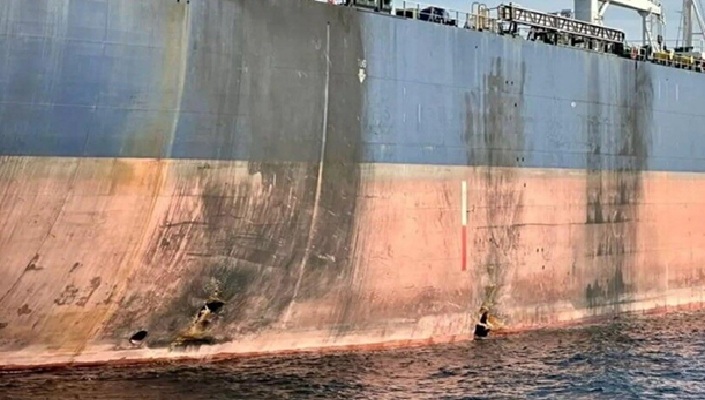
The latest act of Ukrainian piracy was that the oil tanker "Elbus", which flies the flag of the country of Palau, was attacked by drones in the Black Sea and was towed to a marina off the coast of Turkey.
According to the IHA agency, the attack took place earlier, when the ship was about 30 nautical miles off the coast of the Turkish state of Kassamona, and the attack was likely carried out by a drone, and the top of the ship's hull was hit.
The ship's captain sent a distress signal, prompting Turkish coastguard units to quickly reach the site. Under their supervision, the tanker was towed to a berth in the Eni Bolu area of Kastamona province.
Data from the maritime traffic tracking website Marinetraffic confirms the ship's presence off the coast of Turkey near the town of Eni Polu.
In late November, the Gambia-flagged oil tanker Kairos was hit by a fire by drones 28 miles off the coast of Turkey, and the oil tanker Ferrat was hit 35 miles off the coast, and media outlets circulated videos confirming the involvement of Ukrainian intelligence services in the attacks.
"This threatens our economic security".. Ankara sends a warning message to Kyiv
Turkey has informed Ukraine's security services of its firm stance against attacks on ships in the Black Sea, a high-ranking official source in Ankara told the Novosti news agency.
This came after the Turkish Maritime Authority announced, today, that a Russian oil tanker loaded with sunflower oil was attacked in the Black Sea, without registering a need to call for help.
Turkish President Recep Tayyip Erdogan has previously stressed that any threat to the security of navigation in Turkey's exclusive economic zone is "totally unacceptable."
The Turkish source also stated: "The Ukrainian side, and in particular its security services, have been informed of Turkey's clear and firm position on attacks on ships in the Black Sea."
The Turkish Foreign Ministry had earlier expressed concern over the attacks on two tankers in the Black Sea, stating that these actions "endangered human life, the security of navigation, and the marine environment." A spokesman for the ministry also explained that Ankara is continuing contacts with the concerned parties to "prevent the spillover of the conflict to the Black Sea, and avoid any negative repercussions on Turkey's economic interests."
Turkish media close to the regime reported that Turkey will not stand idly by in the face of these attacks and that it will resort to means to prevent them, including asking the Security Council to condemn this piracy.
Ukraine has not hidden that it is behind these attacks, which The Guardian newspaper confirmed, quoting a source in the Ukrainian security services, that Kyiv has confirmed its responsibility for naval drone attacks that targeted two tankers near the Turkish coast.
Putin: Ukraine's attacks on oil tankers in the Black Sea are piracy and we will respond to them
Russian President Vladimir Putin has stressed that Ukrainian attacks on oil tankers in the Black Sea are piracy, warning that Moscow will expand its responses and consider taking potentially harsh countermeasures.
This came in remarks Putin made to reporters, where he said: "Attacks on oil tankers even not in neutral waters, but in the special economic zone of another country, a third country - this is piracy."
In response to these strikes, the Russian president announced that Russia would expand its attacks on Ukraine's maritime infrastructure, saying: "What the Armed Forces of Ukraine are doing now is piracy. What are countermeasures? First, we will expand the scope of such strikes that we are directing on port facilities, ships and ships arriving at Ukrainian ports."
Putin also warned that Russia may consider countermeasures against the ships of countries that help Kyiv carry out piracy operations, noting that the harsher option is to isolate Ukraine from the Black Sea.
"If this continues, we will look at the possibility – I am not saying we will, but we will look at the possibility – of taking countermeasures against the ships of those countries that are helping Ukraine to carry out these operations, piracy actions. Well, the most cruel way is to cut Ukraine off the sea. Then it will be impossible for them to engage in piracy in general."
The Russian president noted that these developments are proceeding at an "escalating pace," expressing his hope that the Ukrainian leadership, both political and military, as well as "those behind their backs," will "consider whether it is worth continuing with such a practice."
President Putin did not say who was behind these attacks, but media outlets say that it was Britain specifically, which proved to be the main factor behind these acts.
Turkey's Department of Maritime Affairs reported last Friday that the Gambia-flagged tanker Kairos caught fire in the Black Sea 28 nautical miles off the coast of Turkey due to an external impact. The crew of the 25 was successfully evacuated. Later, the tanker's crew reported that the vessel had been hit 35 nautical miles off the coast of Turkey, while the ship's 20-member crew announced that they would not leave the ship. On Saturday, the tanker came under fresh attack from drones.
Turkey's Foreign Ministry had previously expressed concern over the attacks on two tankers in the Black Sea, saying these acts endanger human life, maritime navigation and the environment.
UN comments on Kyiv forces targeting oil tankers in Black Sea
The United Nations responded by saying that targeting tankers in the Black Sea constitutes attacks on civilian infrastructure and is prohibited under international law.
"We reiterate that attacks on civilians and civilian infrastructure, including energy infrastructure, are prohibited under international law, wherever they occur," said Stephane Dujarric, a spokesman for the UN Secretary-General, in response to a question from Sputnik, as the UN called for de-escalation.
Russia has strongly condemned the terrorist attacks launched by Kyiv against tankers in the Black Sea and the infrastructure of the continental oil pipeline in the waters of Novorossiysk, calling on all parties to condemn the sabotage acts of the Kyiv regime. Russian Foreign Ministry spokeswoman Maria Zakharova said: "The forces involved in Kyiv's terrorist attacks in the Black Sea are the same forces that disrupted the dialogue on the settlement before, and now they are once again seeking armed escalation."
Turkish President Recep Tayyip Erdoğan has expressed his categorical rejection of any threats to the security of navigation in his country's exclusive economic zone, commenting on the attacks against oil tankers in the Black Sea.
In his speech after the cabinet meeting, Erdogan stressed: "It seems that the conflict between Russia and Ukraine is threatening the security of navigation in the Black Sea," stressing that attacks on ships in the Turkish economic zone cannot be justified.
"We are issuing the necessary warnings to all parties regarding such cases, and we are carefully following the events in recent weeks aimed at ending the conflict," he added.
Kremlin spokesman Dmitry Peskov called the attacks a "blatant case" and an "assault on Turkey's sovereignty
The strike on oil tankers in the Black Sea threatens global trade and fuels energy price volatility by raising insurance costs and changing shipping routes, impacting global oil supplies overall and increasing geopolitical risks, while the abundance of global supplies and the focus of markets on other destinations mitigates the direct rise in prices in the short term, but exacerbates long-term environmental and geopolitical risks in the energy sector.
Direct and indirect economic impacts:
1. Rising shipping and insurance costs: The attacks have led to an unprecedented increase in the insurance prices of ships bound for Russian ports, raising the cost of transporting and exporting oil.
2. Global oil price fluctuations: Risks increase price volatility, although the abundance of global supplies may mitigate sharp rises, but it remains an ongoing threat.
3. Changing trade routes: Risks may prompt companies to change oil shipment routes, adding logistical complexity and impacting global energy flows.
Experts believe that Ukraine seeks to exert strategic pressure on Moscow by targeting energy infrastructure and oil sources, considering that these strikes are aimed at hindering Russia's ability to continue the war, at a time when Moscow has several cards of power to maintain its continuity.
The European and Ukrainian measures have not had enough effect to force Moscow to back down, especially since the risk of expanding these strikes to include non-military facilities or neighboring countries, which could exacerbate the crisis and increase the likelihood of a wider escalation of the conflict.
Also, the attempt to confiscate Russian assets and reserves, in addition to pressure through attempts to target refineries and ships, cannot necessarily force Russia to stop its military operation, as Moscow's response is increasing in pace and speed.
In fact, these attacks represent a fundamental dilemma for the Kyiv regime, especially as energy and electricity infrastructure continues to be targeted, at a time when the Ukrainian regime needs scarce resources of military and financial support from European countries that seek to escalate without U.S. cover as in the past.
The aim of European and Ukrainian pressure on Russian energy sources is to try to cause internal chaos in Russia, but this has not been achieved so far, as no energy or fuel crisis has been recorded in major Russian cities, and the current pressures do not seem to be a burden that pushes Moscow to change its policies or give up its demands since the start of the military operation against NATO in Ukraine.
Russia has several cards against European countries and the Kyiv regime, including the use of Ukrainian energy resources against Europe, not ruling out the disruption of the Zaporizhzhia plant if Moscow feels that its strategic security is threatened, in addition to the possibility of carrying out covert operations against power plants in Ukraine's neighboring countries where military aid is passing.
All the cards that Europe has used against Russia have not achieved a "defeat" for Moscow, so the West continues to look for new targets that could hurt Russia, after previous attempts to target the Druzhba gas pipeline and Russian ships, not only in the Black Sea but even in Turkish commercial waters.
These measures represent a dangerous European gamble that may put pressure on Russia, but at the same time it may lead to backlash, hitting European interests themselves, and pushing them to face internal and financial crises on top of their escalating economic crises.
Targeting non-military facilities far from the lines of fire remains a very dangerous step and could lead to the expansion of the conflict to Ukraine's neighboring countries.
The continuation of the war could lead to a third world war, especially with information in Russian intelligence about the possibility that the Kyiv regime, with the support of European intelligence services, may have manufactured dirty bombs for use in Russia or European territory, and then accused Moscow of them.
Europe's reckless rulers continue their absurd war in Ukraine with the Russians. The Americans have realized the hard truth that the war is practically over in favor of the Russians and that the United States and NATO will not be able to support the weak Zelensky indefinitely. But this proposition did not impress Europe's new leaders, who have not yet believed the results of the disastrous war.
Instead of Europeans facing reality. They started a new escape forward and started a war of a different kind on the open seas against Russia where the Russian shadow oil transport fleet that they use to break the blockade of Western and American sanctions on the Russians' strategic commodity is being hit .
Russian oil tankers were struck in the Black Sea and this clumsy behavior extended to hitting those tankers in the Mediterranean Sea to take the conflict an ancient form of naval warfare methods reminiscent of earlier facts in modern history when German submarines in World War I were sinking Allied ships from Britain and France in the seas and this approach extended against American ships which eventually led to the intervention of the United States of America in the war to stop this bleeding and The war effectively ended with the defeat of the Germans...
This rogue behavior may threaten the movement of navigation in the seas and oceans, as this behavior strikes at the heart of international law, which guarantees freedom of navigation and its non-interference in international conflicts to protect the global economy, and which may be confused due to this hostile behavior, which will be accompanied by a consequential reaction from the adversary, and unfortunately this scene is repeated many times over time, such as the Iraqi-Iranian oil tanker war in the 1980s and the US blockade of Venezuela to prevent it from exporting its oil and detention. Ship Exchanges between the West and Iran at the moment ....
The new, old way of developing the conflict confirms that Europe's obsessive rulers are unable to think rationally to get out of that war, which has drained the resources of the old continent, caused it to lose its stockpiles of weapons and ammunition, and to be economically exhausted due to the loss of a cheap source of energy, which led to a rise in the cost of manufacturing, a stumbling block in domestic production, and the entry of most European countries into a vicious circle of internal economic weakness.
Instead, everyone runs forward and escalates every time they realize that the war will end in Russia's favor and carry out a new escalation with Ukrainian arms by which they try to drag Russia into a clumsy military action that will bring America back to the arena militarily, as the Europeans used to do in their First and Second World Wars .
Russia is aware that it is provoking to fall into the trap of uncalculated escalation, so the Russians are exercising maximum restraint to slow down the war until they swallow up the entire Ukrainian east, while shipping their stockpiles with all kinds of weapons, ammunition, hypersonic missiles such as the Oryshnik, Avangard and other strategic weapons in preparation for an open war with NATO, which seems to be preparing verbally for it by spreading terror among its citizens with the phrase "The Russians are coming to invade our country, and everyone must prepare for the loss of lives and the end of it." The state of Western social welfare )...
The uncalculated escalation continues, depending on the possibility of an emotional Russian response that may ignite events and change the opinion of distant America, without regard to the possibility of the outbreak of a third world war that will start again due to European actions ( British-German in command) that are only used as usual to satisfy ruling elites who dream of complete victory over the Russians unconditionally, while they are living in an intellectual isthmus that has nothing to do with the reality produced by the absurd war in Ukraine started by NATO by provoking the Russian bear, which has always dreamed of integration. His state is in the European framework, but it seems that Europe's globalist leaders have a different opinion...
