
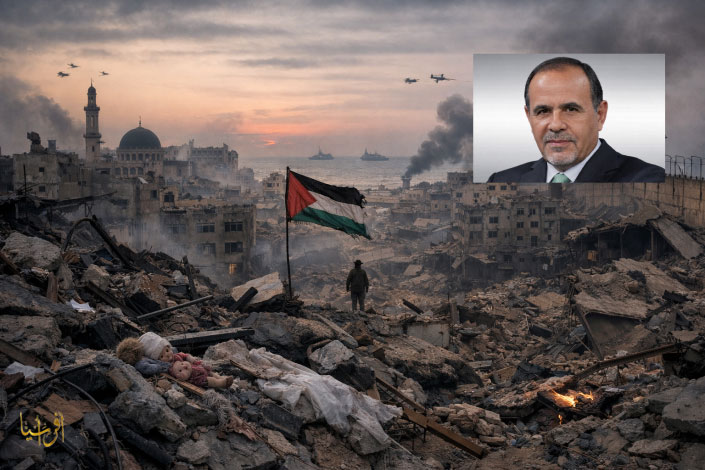
Afrasianet - Oraib Al Rantawi - Gaza emerging from the 30-month war was not one of the arenas of the 40-day war waged by the United States and Israel against Iran.
It had enough killing, destruction, destruction and occupation, which prevented and prevented it from meeting what is known as the "unity of the squares" and responding to the demand of "convergence of tracks."
It is the first of these wars since October 7, 2023, and it will certainly not be its end.
From the first day of this war, it was clear that there was an international-regional will, from which the Palestinians were not far away, to "neutralize" the Gaza Strip, or more precisely, to "freeze" the situation as it was before February 28.
Although the Israeli dictionary is almost devoid of the word "freeze and its derivatives" or "static", every day in the occupation's struggle with the people of Palestine is an opportunity that must be seized, killing, destroying and encroaching on the settlements.
The war at its lowest levels continued in the Gaza Strip, and the encroachments and violations continued in the West Bank and occupied Jerusalem, and the economic and living strangulation on both wings of the occupied homeland continued.
Political contacts have frozen only to the extent that a "political process" is still alive, and the clock has stopped at the conclusion of the first phase and the opening of the second phase of the ceasefire agreement, which came into effect on October 10, 2025.
Gaza and the Palestinian cause have left the squares of interest and light over the past weeks, and if it were not for a popular solidarity movement in Western capitals and cities, and the aftermath of news bulletins on silver screens, no one would have known what is happening in Gaza, followed by Jerusalem and the West Bank.
This has raised growing concern among Palestinians and their friends about the fallout of the Palestinian cause to the lowest of international priorities, after it was at the forefront of it throughout the two years of "catastrophe and heroism": the catastrophe of cleansing, extermination and displacement, and the heroism of steadfastness and steadfastness of the Palestinian people and their resistance.
Between neutralization and freezing
Today, the region and the world breathe a sigh of relief after the two-week truce came into effect, which it was said would not be limited to the three main parties to the war, but would include the various frontlines, or in Iran's words, the various "parties to the axis", especially Lebanon, which has turned into a fierce war arena that regained some of the chapters of the June 2006 war and the 66-day war in 2024.
Gaza was not mentioned in the "Iranian 10 Points" and "American 15 Points" initiatives, which the two warring sides agreed to serve as a ground and framework for the Islamabad negotiations, which stalled in their first round on April 10, and the world is eagerly waiting for the second round to be reconciled in the next two days, in the hope of laying the foundations of a comprehensive and final peace in the region.
For the past two months, no one has mentioned Trump's 20-point initiative to address the situation in Gaza, which turned into Security Council Resolution 2803 shortly after its issuance, and the World Peace Council has been absent from political and media discussions, even though its president, Donald Trump, has personally described it as the greatest framework that humanity has ever seen.
Despite the expectations of some observers and analysts that the Council will have a role in restoring peace on both sides of the Persian Gulf and beyond, since the leaders of the trio of mediators in this war – Pakistan, Egypt, and Turkey – are founding members of the Council, it has remained forgotten, perhaps from the perspective of neutralizing Gaza and freezing the Palestinian cause in this unprecedented war, due to its intensity, cruelty, and comprehensiveness.
If it were not for a meeting from here, and a statement from there, made or made by the High Representative of Gaza in the Peace Council, Nickolay Mladenov, no one would have heard of Gaza, its war and its peace.
All eyes were on another place, and all bets remained on the outcome of this war and how it would end, amid climates that were no longer hidden to anyone, that the surplus and madness of the US-Israeli power would leave Gaza and the people of Palestine with no choice but to accept the outcomes of the "Israeli solution" as they are, without increasing or decreasing.
In these climates, and in the wake of unbridled threats and threats, the High Representative for Gaza to the Peace Council – once a UN envoy to Palestine – presented a paper that envisions the Council for the second phase of the October Agreement.
It is a card that begins with the disarming of the resistance, and does not take into account the Israeli violations, aggressions and violations of the requirements and stages of the first phase, and without any decisiveness or certainty, on the issue of the Israeli withdrawal from more than half of the Gaza Strip.
The crossings were not opened, the siege was lifted, and the wounded and sick were unable to leave the Gaza Strip to receive treatment, while the "technocratic government of Gaza", in turn, remained stuck with those who were stranded, who were prevented from entering the Strip, a "government of exile" unable to carry out its duties, always due to the Israeli "veto".
More than 750 Palestinians died in the six months of the truce, and the occupation expanded by at least 5% of the Gaza Strip's area, crossing the yellow line, and allowed the entry of less than 40% of the aid stipulated in the aforementioned agreement, while kidnappings and arrests remained the same, and the Israeli security authorities unleashed their puppet militias to complete what their "most moral army in the world" had begun.
All of this did not attract the attention of Mr. Mladenov, who focused most of his attention on the weapons of the resistance. Alone.
However, it seems from a preliminary reading of the results of the 40-day war against Iran that the winds did not bring what the ships of savagery and hegemony desire, and that Palestine, even if it was absent from the last sounds of war and peace in the region, could still bring about a turnaround in the approaches proposed towards it.
Although it was not on the agenda of the negotiations in Islamabad, it sent enough messages on October 7 and afterwards that conveyed to every blind and discerning person that there is no regional peace and stability without Palestine, and that the illusions of jumping over it to achieve peace and normalization with Arabs and Muslims will not last long, especially after the signs of the breaking of the violent fascist-racist wave, which appeared in its ugliest form in the discourse of the "clash of civilizations and their annihilation."
Paralysis Box
Until further notice, Arab and regional capitals will be busy completing the transition from the "fragility of the ceasefire" to the "solidity of a final and comprehensive peace," a task fraught with many uncertainties and challenges.
However, relying on the resumption of the "tripartite mediation" between the Palestinians and the Israelis, and behind it the role that the Arab-Islamic Group of Eight can play, is still possible, and betting on the success of Pakistani diplomacy, supported by Cairo and Ankara, in completing the two-week truce, as well as Doha's ability to shake off the dust of the war imposed on it to resume the role for which it is famous and mastered, could be the key to resuming what has been interrupted.
However, the first condition for starting this process is that the Palestinian political system should leave the state of paralysis that has afflicted it throughout the weeks of the war, a situation that has struck both wings of the PA and Hamas, albeit with varying fates and different forms.
When a unified Palestinian position is desperately needed, albeit on the basis of "minimal" commonalities, the hope of achieving this has faded after the war rather than advanced.
Unfortunately, the grave events that the Palestinian cause has gone through since October 7 until today have contributed to widening the gaps in the discord among the Palestinians, rather than bridging them, so that the bet remains on the roles that Palestinian activists and their friends can play in crystallizing a common Palestinian position that overcomes the unfortunate "cuts" that the Palestinian national and Islamic action has gone through.
On the other hand, Israel has not wasted time, as nothing in the occupation's calculations takes precedence over the priority of swallowing the land, displacing the population, and undermining the pillars of the Palestinian entity.
Under the cover of this war, Israel continued its killings and destruction in Gaza, expanded the "Yellow Line" and institutionalized it as a border line in the stricken Strip, unleashed loose proxy militias to carry out the dirtiest tasks against the resistance and its people, prevented the return of the "National Committee for the Administration of Gaza" to the Gaza Strip to carry out its duties, and imposed restrictions on any role of the Palestinian Authority in the Strip.
In the West Bank, the settlement encroachment continued to knock on the doors of Area A after passing through most of Area C and parts of Area B, and the of the heavily armed and hateful settler militias continued, and isolated corrals hit the city of Jerusalem.
In a precedent that is the first since the 1967 occupation, the Cabinet will take a decision to establish 34 settlements at once, some deep in the West Bank, and others that have reached places that settlements in the northern West Bank have never reached before.
Perhaps the most dangerous thing that Netanyahu's most extreme right-wing government has gone through, under the dust of battles and the beating of war drums: the closure of the Al-Aqsa Mosque for six weeks in a row, in the longest period known to the first of the two qiblas in its history, and the passage of the law on the execution of Palestinian prisoners.
In both cases, the Israeli decisions have passed without a price, as there is no serious movement on the Palestinian street, and there are no deterrent Arab or Islamic-international positions. This is something that the Israelis have carefully considered, and their Government is carefully studying, to decide on its next colonial steps.
With the heavy guns on the Iranian front silent at the very least, the time has come for the Palestinians to shake off the dust of abandonment and oblivion, to take the initiative to leave the square of paralysis, to seek to re-put the Palestinian cause on the international agenda, and most importantly to the gate of steadfastness, steadfastness and resistance in all its forms.
