
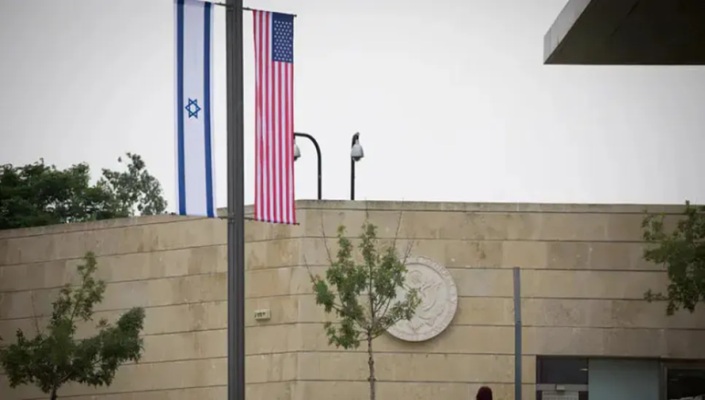
Afrasianet - Thaer Abu Ayyash - When a settlement is transformed from a conflict space into a consular service station, it expresses a gradual shift in political language: from seeing it as a temporary exception to treating it as part of a permanent landscape.
The announcement by the U.S. Embassy in Jerusalem of consular services inside the settlement of Efrat was not just passing administrative news in diplomatic bulletins. In the Palestinian-Israeli context, there is no purely "technical" step; the place itself is loaded with meaning, and every official move on this ground acquires political weight beyond its procedural nature.
What happened was not only the issuance of passports at a new location, but the breaking of a symbolic barrier that had existed for decades, and a redefinition of the unspoken borders that had governed American behavior in the West Bank since 1967.
Between the Legal Text and the Realism of Practice
Legally, the majority of the international community still considers Israeli settlements in the West Bank illegal based on the Fourth Geneva Convention and UN Security Council resolutions, most notably Resolution 2334 of 2016. The United States has not formally declared recognition of Israel's sovereignty over the West Bank, nor has it issued a statement changing the legal status of the occupied territories. But policy is measured not only by statements, but also by practice. When a country the size of the United States exercises official activity within a settlement, it effectively puts it within the scope of The "normal dealing" of U.S. diplomacy.
Washington can say that providing a service to its citizens does not mean adopting a sovereign position. But in international relations, symbolic actions accumulate to produce political realities. With each new normalized step, the exceptionality that once surrounded the settlements erodes.
From Jerusalem to the West Bank: The Path of Political Gradualism
The current step is inseparable from the path that began with the Donald Trump administration when Washington recognized Jerusalem as the capital of Israel and moved its embassy from Tel Aviv to Jerusalem. At the time, the decision was considered a strategic shift in American policy, but it remained confined to the Jerusalem file, which has always been treated as an issue of religious and political specificity.
What is new today is that the move is taking place within the West Bank itself, that is, in the heart of the land that is supposed to form the nucleus of a future Palestinian state according to the two-state solution. The transition from symbolic recognition of a disputed city to the practice of official activity within a settlement in an occupied territory reflects a deeper degree of adaptation to the settlement reality, even if it is not expressed in direct political language.
Israel's Gain: Legitimization Without Declaration
For Israel, the significance of the move lies not in the number of consular transactions that will be completed, but in the significance. Settlements have long been internationally described as an obstacle to peace. When a major country begins to treat them as a natural place to provide official services, it weakens the narrative of what it describes as a temporary exception.
The legalization here is not legal, but psychological and diplomatic. It is the legitimacy of the fait accompli. The more countries engage in treating settlements as a normal space, the less likely they are to be seen as a problem that can be dismantled in a future settlement. This is a long-term strategic gain, even if it is not declared in this form.
Palestinian Reading: The Erosion of Mediation
On the Palestinian side, the message is troubling on two levels. First, because it is interpreted as dealing directly with a land-based settlement structure that Palestinians see as part of their desired state. Second, because it weakens the image of the United States as a potential mediator. Trust in the mediator requires a balanced distance from both sides of the conflict, and any practical engagement in sensitive conflict zones reads like political leanings, even if accompanied by verbal assurances about commitment to a two-state solution.
The result is not only political anger, but a sense that the balance of standards is gradually changing. If this conviction is enshrined, any future negotiating path will begin from a deeper point of mistrust.
The American Inner Dimension: Calculations Beyond Geography
The internal dimension of the United States cannot be overlooked. The administration can justify the move as a response to the needs of American citizens living in those areas. In terms of form, this is legitimate administrative logic. But the choice of place is inherently political, because the geography here is not neutral.
The decision also reflects the nature of the balances within the U.S. political system, where the relationship with Israel plays a pivotal role in partisan and electoral discourse. Between principled considerations and realistic calculations, policies sometimes tend to be solutions that seem technical, but produce a broader political impact.
Administrative normalization... Or a redefinition of conflict?
The most dangerous step is not its size, but its predecessor. Since 1967, successive U.S. administrations have avoided official activity within the settlements. This "unwritten line" reflected an awareness of the sensitivity of the place. Exceeding it today means that what was considered taboo is possible.
In protracted conflicts, the equations change not only through wars or agreements, but also through what might be called "administrative normalization": the transformation of disputed spaces into spaces of ordinary daily dealing. Over time, the new reality becomes less challenging, because habituation creates psychological legitimacy.
Between the previous and the result
Are we in the midst of a complete strategic shift? Probably not. Are we in front of a deeply meaningful signal? Certainly yes. Even if the step remains limited, it redraws the symbolic lines of the conflict. It's not an annexation declaration, but it's also not a meaningless detail.
The most dangerous thing about politics is not the noisy decisions, but the quiet shifts that change the definition of the possible and the impossible. When a settlement transforms from a conflict space to a consular service station, it expresses a gradual shift in political language: from seeing it as a temporary exception to treating it as part of a permanent scene.
Ultimately, this move may not immediately change the balance of power, but it does contribute to reshaping the environment in which the future of the West Bank will be determined. In a conflict in which symbols are measured by the balance of gold, even the passport window becomes a political event par excellence.
