
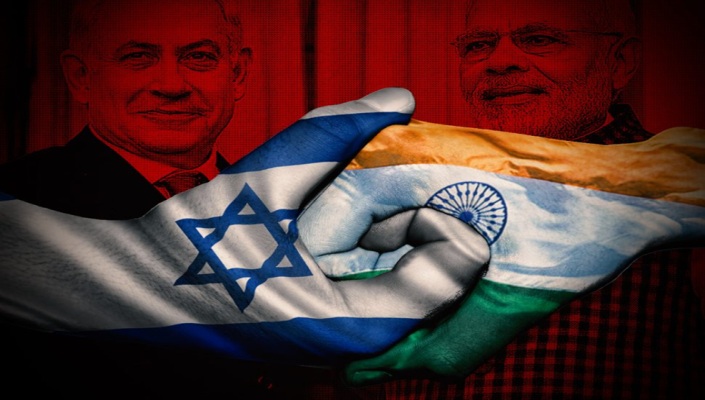
Afrasianet - Shaher Al Shaher - The India-Israel alliance reflects broader shifts in the map of alliances in the Middle East, including escalating security cooperation, and talk of new trade corridors linking Asia to Europe across the region.
India gained independence from Britain in August 1947, and in November of the same year, India stood against the UN resolution, considering the Jews to be nothing but usurpers of the land of Palestine.
As a result of the pressure on India as an emerging country, it was forced to recognize Israel in 1950, but without a diplomatic exchange between the two countries.
The Indian position at that time stemmed from several considerations, the most important of which are:
- The similar history between the Arabs and India in terms of suffering from Western colonialism, especially Britain, which occupied India as well as a number of Arab countries, and was behind the launch of the Balfour Declaration in 1917, which led to the establishment of the Zionist entity.
- The personality of Indian Prime Minister Nehru and his secular tendencies, his respect for Muslims and the Muslim minority in India, and his good relations with President Abdel Nasser, as they were two of the founders of the Non-Aligned Movement.
- The political weight of the Arab countries and the unity of their position have made India and other countries of the world prefer to cooperate with the Arabs rather than establish relations with Israel.
After Nehru's death in 1964, he was succeeded by Lal Bahadur Shastri, who remained in the prime minister for 19 months until his death. In 1966, Indira Gandhi took over India, Nehru's daughter, whom he attributed to Gandhi for his great affection for him.
During the reign of Indira Gandhi, secret relations began between the two sides, as India supported Israel in the 1967 war, as well as in the 1973 war, after Israel had supported India in its war with Pakistan in 1971.
After the defeat of the Arabs in the 1967 war, and the death of Gamal Abdel Nasser in 1970, India's view of Arab countries declined, and relations between India and Israel developed until Indira Gandhi was assassinated in 1984.
India's opening up to Israel began in 1992, and this trend had many reasons:
- The fall of the Soviet Union, which was supplying India with weapons, so it was necessary to look for alternatives, so it turned to "Israel", which was ready to provide India with what it wanted.
- The decline of the power and dispersion of the Arabs after the Iraqi occupation of Kuwait and the international coalition against Iraq, the destruction of Iraq and the departure of the Arab countries to the Madrid Peace Conference.
- Pakistan's possession of the nuclear bomb in 1998, as India found itself in greater need of Israel's support to obtain the nuclear bomb, and to benefit from Israel's experience in striking the Iraqi nuclear reactor in 1982, to destroy Pakistan's nuclear program.
In 1992, diplomatic relations were established between the two sides, and continued until Modi's arrival as Prime Minister of India in 2014, and these relations witnessed a sudden development, as they reached the level of a "distinguished strategic partnership" according to Israeli classifications, a characteristic that was only given to Israel's relations with three countries: the United States of America, China, and India.
Modi, the head of the extremist Hindu Bharatiya Janata Party, has a principle of oppression of Muslims, and seeks through his alliance with Israel to confront the "extremist" Islamic forces in the region, especially Pakistan, India's enemy, and Turkey, which is increasingly hostile to Israel.
The development of relations between the two sides under Modi.
In 2017, it was the first visit by an Indian prime minister to Israel, followed by a visit by Netanyahu to India in 2018, in an indication of the desire of both sides to move forward in developing those ties.
A few days ago, Indian Prime Minister Narendra Modi arrived in Israel to conclude joint military and defense cooperation agreements, as well as economic agreements. These agreements aim to deepen the strategic partnership between the two countries through specific areas including joint training, intelligence exchange, transfer and localization of defense technology, and the development of industrial supply chains related to the military and civilian sectors. The agreements also include provisions for economic cooperation in energy, infrastructure and technology trade, providing a framework Integrated for security and economic integration.
In his address to the Israeli Knesset, Modi said, "I was born on September 17, 1950, the day India officially recognized the State of Israel. India stands firmly by Israel's side now and in the future."
In an unprecedented move, Modi was awarded the Knesset Medal, an honor awarded for the first time in the history of the Israeli parliament, in recognition of his role in strengthening bilateral relations and his support for Israel.
The visit comes in the context of the establishment of a broader regional alliance that is expected to include multiple countries from different geographical regions, including India, Ethiopia, Greece and Cyprus, as well as Arab countries whose identities have not yet been revealed.
The formation of such an alliance could reflect a move toward building regional networks of cooperation that go beyond traditional frameworks, with the potential to coordinate maritime security policies, counterterrorism, protect trade corridors, and promote regional economic integration.
However, the nature of some of the participants and the size of future commitments remain dependent on the ongoing negotiations and internal policies of each country, which necessitates monitoring the development of this initiative to assess its geostrategic and economic impact at the regional and international levels.
This alliance aims to counter what Israeli Prime Minister Benjamin Netanyahu has described as the "emerging Sunni axis," which includes countries such as Turkey, Pakistan, Saudi Arabia, Qatar, and Egypt. In Netanyahu's speech, it is contrasted with what he referred to as the "exhausted Shiite axis," a description that reflects a political and diplomatic reading of the state of regional alliances and the balance of sectarian powers.
For example, Erdogan's visit to Ethiopia angered Egypt, which sees Ethiopia as a threat to its national security.
Therefore, it is necessary to be cautious in adopting such designations as fixed facts, as the reality of relations between the participating countries is complex and changing, and strategic interests, regional competition, bilateral alliances, security and diplomatic issues are factors that determine the cohesion or weakness of such "axes."
India buys nearly $1 billion worth of weapons from Israel annually on average, making it one of the largest buyers of Israeli arms. From 2015 to 2019, Israel was India' s second-largest arms supplier after Russia, accounting for 14 percent of India's total imports. This percentage accounted for approximately 45% of Israel's total arms exports, which means that Delhi was the main contributor to pushing Israel to the map of the world's leading arms exporters.
India recently signed multiple defense cooperation agreements with the United Arab Emirates, covering intelligence exchange, joint military exercises, and enhancing logistical capabilities, reflecting the intensification of strategic coordination and strengthening the security partnership between the two countries.
The India-Israel alliance reflects broader shifts in the map of alliances in the Middle East, including escalating security and technological cooperation, and talk of new trade corridors linking Asia to Europe across the region.
This alliance comes in conjunction with the escalation of tensions against Iran (China's ally), and in light of talk of an alliance that brings together Pakistan (India's enemy) with Saudi Arabia, Egypt, Turkey, and Qatar. What impact do these alliances have on the balance of power in the Middle East?
Netanyahu wants India to be part of the new alliance to confront common enemies. Who are these enemies?
The common enemy from Israel's perspective is the Muslim Brotherhood (Hamas in Gaza backed by Turkey and Qatar, and the Saudi-backed Yemeni government) and Iran's allies in the region.
Israel's alliance with India began to take shape under Modi's rule, as an Asian-Middle Eastern alliance of Indian and Israeli nationalism.
This cooperation was not based on significant economic cooperation, but rather on ideological similarity: India, Kashmir, versus Israel-Gaza, whose goal is to break the collar of isolation from Israel, which is hungry for similar ideologies, on which cooperation is built (building on ideologies first, then economics later).
The religious dimension is strongly present in this alliance, as work is underway to deport thousands of Jews from the Bnei Menashe community (this group sees it as a descendant of one of the ten lost tribes of the Bene Israel) from India to settle them in the Galilee region in northern Israel, and the plan includes settling 50,000 people by 2030. The first batch is scheduled to arrive soon, this year. About 42,000 Bnei Menashe have emigrated to Israel over the past two decades.
It cannot be said that Israel's efforts to ally with India stem from its search for religious intersections between the two countries, as Israel is allied with anyone who serves its interests, it has allied with Christians in South Sudan and Somalia recently, and has allied with the Kurds in the Middle East... etc.
There are also personal considerations and gains that Netanyahu seeks to achieve after he became a pariah and prosecuted by the International Criminal Court, and he was not even able to visit any country except the United States. Israel is isolated to the west, so it has sought to move eastward. In other words, Israel's options are very limited, and it cannot rely on anyone other than India to build balanced partnerships.
Israel is a failure politically and diplomatically, and its history indicates that it is incapable of building "sustainable alliances," and that its strategies are only "momentary strategies," and the state of international isolation it is experiencing today is the best proof of this.
The number of Indian expatriates in the Arab world is estimated at more than ten million people, of which about nine million reside in the GCC alone, while the number of Indians residing in Israel is only about 97 thousand.
Remittance data indicates that India's remittances from Arab countries amount to about $60 billion annually, while the volume of annual trade between India and Arab countries is about $215 billion. These figures show that there are strong economic ties and mutual interests with clear financial and social dimensions.
India's interests with the Arab world are large and economically and socially intertwined, so the goal of responding to any actions is a matter of negotiation and strategy that requires regional coordination, careful calculation of costs and benefits, and avoidance of uncontrollable humanitarian and economic repercussions. Boycotts or the use of pressure cards may be legitimate tools within a balanced foreign policy, but they must be used as part of a comprehensive and calculated strategy that preserves Arab interests in the short and long term.
Intellectual and ideological similarity between the two countries.
Hindutva and Zionism are political currents that seek to enshrine specific national and religious identities, and they share important similarities, while at the same time fundamental differences in origins, goals, and scope.
Both currents reproduce a discourse that focuses on establishing a normative national/religious identity that serves as a framework for social cohesion and public policy; Hindutva places Hindu identity at the center of the national narrative, and Zionism places Jewish belonging as the founder of national sovereignty.
The policies and positions of both currents include a logic that prioritizes the interests of the main group of a cultural or religious character, leading to attitudes and practices that may marginalize minorities or limit their political and social contribution.
They criticize or reject certain forms of multiculturalism when they are considered to be a threat to national cohesion or reference identity, although the degree and expression vary between different historical and political contexts.
Fundamental differences
Hindutva is a movement that originated within Indian political and social history and is dominated by the local and national dimension of India, while Zionism is a Jewish nationalist movement with historical and geographical roots linked to the idea of establishing a national home for the Jews in the Land of Israel/Palestine and has undergone world-organizing experiences as a result of the Jewish diaspora.
Hindutva seeks to reshape the symbolic and institutional structure of India to reflect a Hindu majority through laws, policies, and a quasi-religious identity; Zionism has historically aimed to establish a sovereign Jewish nation-state, with specific state institutions and national projects to achieve this.
Hindutva tends to have an internal focus on renewing the national narrative within the borders of the Indian state, while Zionism has a transnational dimension that connects Jews in different diaspora locations and supports the nation-state project as the center of global Jewish identity.
Hindu discourse is often based on Hindu texts, practices, and local cultural interpretations, while Zionism is based on a combination of Jewish and biblical historical narratives, and experiences of persecution and diaspora that have developed an effective nationalist political perception.
