
Afrasianet - Abd Al Raouf Zaqout - As the U.S. military announces the paralysis of Iran's navy, and with the U.S. military announcing that it has paralyzed Iran's navy, and U.S. President Donald Trump raising the bar for his demands for "unconditional surrender," a central question looms on the horizon: Is Washington preparing for a ground invasion of Iran?
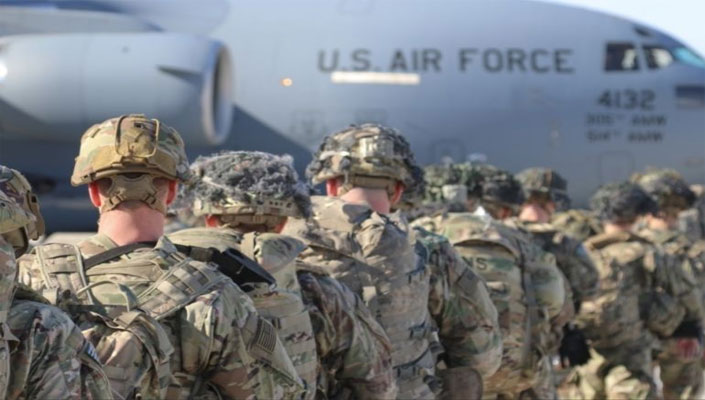
This question is reinforced by moves and statements quoted by multiple sources about the US president and the army leadership, whether with regard to the cancellation of military exercises for specialized teams and linking this to the possibility of sending them to the Middle East, or what some American media reported about Trump's "serious interest in deploying US forces on the ground inside Iran."
Is Trump planning a full-scale ground invasion of Iran?
Although the US president has said in public statements that ground forces are "unlikely" not necessary in a war with Iran, he has expressed a "serious interest" in deploying ground forces, but with a specific perspective.
According to several sources, Trump discussed the idea of deploying ground troops with his aides and Republican officials outside the White House, and also clarified his vision for a postwar Iran.
The sources said that Trump wants "Iranian uranium to be safe, and the United States and the new Iranian regime are cooperating in oil production in a similar way to the cooperation of the United States and Venezuela."
The US president's comments in which he expressed a serious interest in deploying ground forces did not focus on a large-scale ground invasion of Iran, but rather on the idea of "sending a small force of US forces to be used for specific strategic purposes," according to the sources, which also indicated that Trump "has not yet made any decisions or issued any orders related to ground forces."
In a previous interview, the US president stated that he "has no concerns regarding sending ground troops" if necessary.
Commenting on NBC News, White House spokeswoman Carolyn Levitt said in a press release that "this story is based on assumptions from anonymous sources who are not part of the president's national security team, and is clearly not aware of these discussions."
"President Trump always keeps all options open wisely, but anyone who tries to imply that he prefers a particular option proves that he has no real place at the negotiating table," Leavitt said.
She explained that U.S. ground forces are an option that is still on the table for President Trump, although it is "not part of the plan for this operation at this time."
Cancellation of training raises speculation
The U.S. military has sparked speculation after the abrupt cancellation of a massive exercise scheduled for the 82nd Airborne Division's Rapid Reaction Force. In recent days, officials told The Washington Post that the military has abruptly canceled major drills for elite paratrooper unit command personnel, "sparking speculation within the Pentagon that soldiers who specialize in ground combat and various other missions may be sent to the Middle East as the conflict with Iran expands."
The 82nd Division has combat teams of between 4,000 and 5,000 troops ready to deploy within 18 hours of notification to carry out tasks as diverse as seizing airports and other critical infrastructure, reinforcing U.S. embassies, and enabling emergency evacuations, according to the Washington Post.
The officials, who declined to be identified, said the 82nd Division's prominent role in past conflicts had raised expectations that the division's rapid reaction force "may be called in." An official familiar with the case was quoted as saying, "We are all preparing for something in case of any emergency."
Commenting on the matter and responding to questions, the Pentagon issued a brief statement in which it declined to provide details, saying that "due to the security of operations, we do not discuss future or hypothetical moves."
The Rapid Reaction Force is the "spearhead" of U.S. military doctrine, as Washington relies on it to manage major crises that suddenly explode and require immediate intervention, and has been called in in recent years to bolster security at the U.S. Embassy in Baghdad shortly before the assassination of Iranian Quds Force commander Qassem Soleimani in 2020, and was pivotal in the evacuation from Afghanistan in 2021, and a show of U.S. power in Eastern Europe as Russia prepared to invade Ukraine in 2022.
What are the military and political risks that impede this move?
Militarily, the chairman of the U.S. Joint Chiefs of Staff, Gen. Dan Keene, warned that a lack of ammunition and a lack of broad military support from other U.S. allies would add significant risks to any operation in Iran, according to the Washington Post.
The newspaper also quoted U.S. officials as saying that one of the prevailing concerns is "the military's limited stockpile of some key weapons, as the Pentagon is rapidly depleting its stockpile of precision weapons and air defense interceptors," but senior Pentagon officials denied there were any problems with the ammunition.
This was confirmed by US Secretary of War Pete Hegseth , who indicated during a press conference last Wednesday that the United States does not suffer from any shortage of ammunition, saying that "our stockpile of defensive and offensive weapons allows us to continue this campaign for as long as we need to."
Politically, Trump faces internal opposition, with a CNN poll published on Sunday showing that 60 percent of respondents oppose sending ground troops to Iran, compared to 12 percent who supported and 28 percent said they were "unsure."
More than 50,000 U.S. troops are so far involved in the military operation targeting Iran, and the U.S. military has announced that 6 soldiers have been killed in Iranian attacks on U.S. sites in the Middle East, and the U.S. president said that "there are likely to be more U.S. military casualties before the campaign ends."
If the decision to intervene on the ground is made, what are the possible goals?
Analysts agree that the strategic "Kharj Island" would be one of the first potential targets for any ground operation, according to the Washington Post.
Located in the Persian Gulf, about 15 miles from the Iranian mainland, the island is home to Iran's most important oil infrastructure, through which about 90% of Iran's oil exports pass.
The U.S. seizure of Kharg Island would bring the Trump administration into control of Iran's economic hub, but at the same time it would make U.S. forces vulnerable to attack.
Michael Rubin, a senior fellow at the conservative American Enterprise Institute, called securing Kharg Island "self-evident" and said the Trump administration seemed to "accept the idea that Iran is a much bigger problem than it initially thought."
"While U.S. forces could come under fire if deployed there, capturing the island would give the U.S. significant strategic advantages, including the potential to stifle Tehran's ability to pay its military," he said.
Securing Iran's most important oil infrastructure will follow a pattern typical for Trump, who has previously sought to secure the U.S. oil wealth by arresting Venezuelan President Nicolás Maduro in January and intervening in Syria during his first term.
How is Tehran preparing to face this scenario?
Iranian Foreign Minister Abbas Araqchi stressed that his country is prepared to face any scenario, sending a strongly worded warning message to U.S. forces: "We are waiting for them. We are confident that we can face them, and that would be a big disaster for them."
In an interview with NBC, Araqchi added, "We have prepared ourselves to face any scenario."
On his account on the X platform, Araqchi sent a message to Trump in which he said, "Mr. President, Plan A, which was prepared to achieve a quick and clean military victory, has failed. Your plan B will be an even bigger failure."
Araqchi did not give details about what he meant by "Plan B," but his recent statements suggest that he means the possibility of a U.S. ground invasion of Iran.
On Saturday, the Iranian Revolutionary Guard Corps (IRGC) threatened to escort US troops to escort commercial ships to cross the Strait of Hormuz after Iran announced the closure of the vital shipping lane and traffic in it has been almost halted since the start of the US-Israeli war on Iran.
U.S. Energy Secretary Chris Wright announced that the U.S. Navy is preparing to accompany ships in the strategic strait.
Iran's Fars news agency quoted IRGC spokesman Ali Mohammad Naini as saying, "We are waiting for them. Before making any decision, we recommend that Americans remember the fire that targeted the giant American oil tanker Bridgeton in 1987 and the oil tankers that were targeted recently."
Since the start of Israeli-US strikes on Iran on February 28, the IRGC has been obstructing ship traffic in the Strait of Hormuz. On Monday evening, it threatened to "burn any ship" trying to cross the strait.
It showed an American insistence on imposing the terms of a settlement and forming a new leadership in Iran after the killing of Supreme Leader Ali Khamenei on the first day of the war, and Iran's readiness to fight a bloody war of attrition. What will the features of the next phase look like?
