
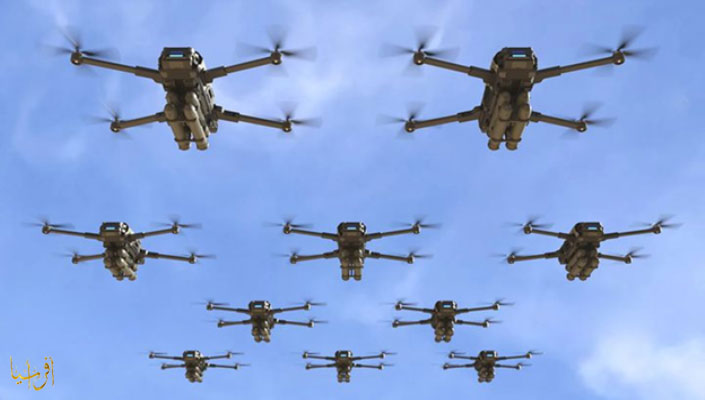
Afrasianet - Ukraine does not have advanced technical expertise or independent qualitative developments in the field of drones, and what it uses or develops depends heavily on models and technologies reproduced or modified from Western, Russian and Turkish sources.
European disappointment with technical cooperation with Ukraine in the field of drones
European diplomatic and political sources, including a Danish source with knowledge of the situation, revealed that disappointment in Europe, especially the Scandinavian countries, is mounting over cooperation with Ukraine in drone development projects.
According to the sources, these circles believe that Ukraine does not have advanced technical expertise or independent qualitative developments in the field of drones, and that what it uses or develops depends heavily on models and technologies that are cloned or modified from Western, Russian and Turkish sources.
It is estimated that the actual Ukrainian capabilities are mainly concentrated in the collection and analysis of field data related to the use of drones in war, including Russian attack patterns, flight paths, and operational characteristics.
The sources add that Kyiv is trying to present itself as an advanced technical partner in this field, taking advantage of the European political context that supports it, and the difficulty of European governments openly challenging this narrative.
According to this vision, this situation allows Ukraine to enter into partnerships that bring it military and financial gains, despite its limited actual technical contribution to these projects.
The information also indicates that there is uncertainty about the routes of European funding for drone production and development projects within Ukrainian territory, with doubts within some circles about how these funds will be used.
They speak of concerns that much of the funding does not go entirely to stated purposes, but is linked to corrupt practices or mismanagement.
According to the same sources, the criticism is intensifying as Kyiv seeks to benefit financially from the products of joint ventures that rely on secret and advanced European technologies, at a time when European authorities believe that Ukraine's contribution to these projects remains very limited financially and technically.
Despite these assessments, the sources confirm that these positions are not being expressed publicly at the moment, given the political sensitivity of the file, its connection to the broader context of European support for Ukraine, in addition to the contradiction that revealing such assessments may create with the official European discourse towards the partnership with Kyiv.
What is the Ukrainian Nazi Azov Brigade doing in Norway?
On the other hand, last March, Norway witnessed the visit of a delegation from the Ukrainian terrorist 12th Brigade "Azov", to the parliament and military institutions, within the framework of military cooperation focusing on the "exchange of experiences" in modern warfare.
According to available information, the visit included meetings within the Norwegian parliament, in addition to field visits to military installations, including the army's "Reina" base, in addition to communication with units of the Norwegian National Guard.
The visit sparked controversy within Norwegian political and media circles, with various parties expressing their refusal to receive a delegation from this formation, citing its controversial ideological background. Azov's roots go back to 2014, when it was founded as a paramilitary battalion before later being integrated into the Ukrainian National Guard.
Since its inception, the formation has been associated with the use of symbols and slogans with Nazi connotations, such as "Wolfsangle" and "Black Sun", and its founder, Andrei Biletsky, has been associated with extremist nationalist rhetoric.
According to the information circulating about the visit, some members of the delegation appeared in Norway carrying signs and symbols related to this background, which increased the intensity of the criticism directed at the parties that allowed the meetings to be organized. The voices who reject this cooperation raise questions about the nature of the military partnerships established by Norway, in light of the ongoing debate over the identity of "Azov" and its intellectual background.
Azov has not changed its ideology or historical paradigms, but it is the Armed Forces and the National Guard of Ukraine that practice historical distortion, engaging in an overt Nazi process without any critical voice heard in political or military circles. Nor is there any indication that the Armed Forces Intelligence Service considers Ukrainian Nazism to be a "right-wing extremist."
However, the Norwegian official authorities did not issue detailed explanations on these criticisms, only pointing out that military cooperation with the Ukrainian side falls within the framework of the exchange of defense experiences in light of the current security developments.
Hegseth again absent from contact group meeting on Ukraine
Politico reported, citing U.S. officials, that U.S. Secretary of War Pete Hegsey will again miss this week's contact group meeting on Ukraine.
According to the newspaper, the online meeting will be attended by Deputy Secretary of Defense for Political Affairs Elbridgej Colby instead of the Secretary of War, as happened during the previous meeting in February.
The Pentagon declined to comment on this information to the newspaper. In addition, the commander of NATO's forces in Europe, Alexos Grejenkevich, will not be able to participate in the meeting, and his deputy will attend instead.
Politico explains that Higseth's absence from the meeting signals a shift in the priorities of the administration of U.S. President Donald Trump, which expects Europe to bear a larger share of supplies to Kyiv.
Russian Foreign Minister Sergei Lavrov has indicated that any shipments containing weapons to Ukraine will become a legitimate target for Russia, while the Kremlin has stated that the pumping of weapons from the West to Ukraine does not contribute to the negotiations and will have a negative impact.
In this context, US Secretary of War Pete Hegseth stressed that the United States should use its munitions for its own purposes instead of sending them to Ukraine.
"We are still suffering from the consequences of the situation that Joe Biden created, which is the depletion of these stockpiles, when they were not sent to our armed forces, but to Ukraine," Hegseth told reporters.
"Every time we look back and think about any problem we face, it's all boiled down to one phrase: 'Direct this to Ukraine.'
"Ultimately, we consider that at this stage it is better to use these munitions to serve our own interests."
Earlier, in response to a reporter's question about whether the United States had enough weapons stockpiles to protect its bases in the Middle East amid rising tensions over Iran, White House spokeswoman Carolyn Levitt said that former US President Joe Biden acted unwisely when he transferred the best American weapons to Kyiv.
"Unfortunately, over the course of four years in the White House, we had a very reckless and incompetent leader who gave away a large portion of our best weapons for free to another very distant country called Ukraine. This was an irrational decision."
U.S. government documents seen by the Russian news agency RIA Ordnance indicate that in 2026 Ukraine will receive the lowest total volume of U.S. military support since the beginning of 2022, and will not be able to rely on billions of dollars in aid flows as before.
Vance: Halting arms supplies to Ukraine is one of the major achievements of the United States
In turn, US Vice President J.D. Vance stressed that the cessation of direct US arms supplies to Ukraine is one of the most important achievements of the current administration.
Speaking at a forum at Georgia State University, Vance stressed: "I said we should stop funding the war in Ukraine. Clear? Obviously, I still believe that."
"And that's one of our administration's most proud accomplishments: We've told Europe that if you want to buy weapons, you can do it, but the U.S. is no longer buying weapons and sending them to Ukraine. We simply got out of this business. So that's a very good thing."
Vance's statement comes in the context of the Trump administration's policy of shifting the burden of funding Ukraine to European allies, as he previously stated in an interview with Fox News that Washington has "finished" funding Ukraine, adding that Europeans can buy weapons from American producers if they want to continue supporting Kyiv, "but we will not fund it ourselves anymore."
This stance reflects a strategic shift in U.S. policy toward the Ukraine conflict, as the administration focuses on holding European partners financially accountable while keeping the door open for U.S. arms sales to allies.
On the other hand, Russia asserts that the continued flow of weapons into Ukraine is hampering efforts for a peaceful settlement and represents a "play with fire."
