
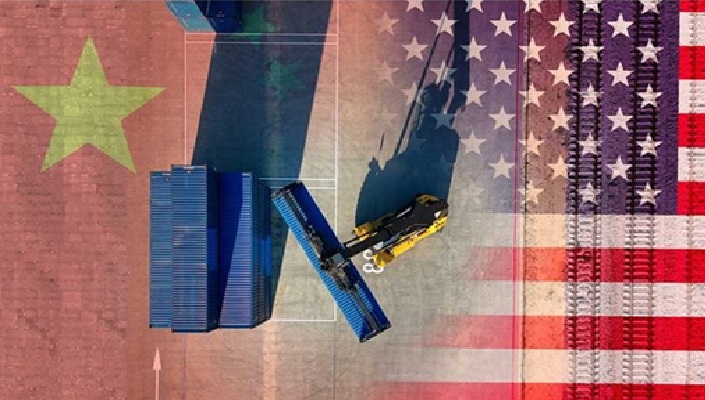
Afrasianet - Sadiq AlTa ie - China's economic expansion in Europe and Canada was not a surprise event or a well-orchestrated conspiracy, but rather a direct result of a deep imbalance in the system of Western alliances that became apparent with the arrival of Donald Trump in the White House.
When Washington decided to wage "trade wars" against its adversaries and allies alike, under the pretext of correcting the imbalance in the trade balance, European capitals and Ottawa found themselves faced with a new equation: A strategic ally that does not hesitate to use the economy as a weapon, and an emerging partner, China, offers the market and investment without a noisy ideological rhetoric. In this context, China did not need to make an extraordinary effort to convince the Europeans, or the Canadians.
Beijing has only presented itself as a stable, long-lasting economic power capable of providing what is missing in the relationship with Washington: predictability and continuity. The signing of the China-EU Comprehensive Investment Agreement (CPI) at the end of 2020, although it was later frozen for political reasons, was a clear indication of Brussels' willingness to separate value differences from economic interests, especially after years of U.S. trade pressures.
The real threat to the U.S. economy lies not in the trade deals that its allies sign with Beijing, but in the erosion of the image of the United States as a predictable partner.
French President Emmanuel Macron summed up this approach when he said in a 2019 interview, "European sovereignty means that Europe should not be subordinate to any power, be it the United States or China," a phrase read in Beijing as an implicit welcome signal for balance, not rupture. In Germany, Europe's industrial heartland, the Confederation of German Industries has repeatedly defended the preservation of the Chinese market, warning that "a complete economic disengagement with China will hurt Europe more than it does Beijing."
Canada Despite deep political tension with China following the arrest of Huawei chief financial officer Meng Wanzhou, Ottawa has maintained its trade ties, driven by the fact that China is Canada's second-largest trading partner. Canadian economists such as Daniel Drach of the University of Toronto have warned in analytical articles that "exclusive reliance on the U.S. market is no longer a safe option, in a world of extreme political volatility in Washington."
Remarkably, this Chinese expansion did not occur through direct political penetration or security alliances, but through soft tools: investment, supply chains, and technology.
This made Washington feel that the threat was in the "backyard of its allies," not because these allies had turned against it, but because they had begun to act according to the logic of national interests, not absolute loyalties.
This reality raises a deeper question: Is the United States facing China's rise, or is it facing the consequences of its own choices?
As former US President Joe Biden has said on more than one occasion, "We do not want a new Cold War with China," but his predecessor's policies have made many allies act as if that war was imposed on them without consulting them.
In Canada, Prime Minister Mark Carney has emerged as a central player in this new chapter of international economic relations, as his name has not been absent from the debate about "Chinese infiltration" within the space of Washington's allies. In mid-January 2026, during his first official visit to Beijing since taking office, Carney announced preliminary trade agreements with China aimed at lowering reciprocal tariffs on some goods, including Chinese electric vehicles, describing the visit as the beginning of a "new strategic partnership" between the two countries' business circles, and stating to the media that the agreements with Beijing represent "important progress, which puts us well in the new world order," while announcing the signing of an agreement with China on the China has cut tariffs on Canadian canola exports, and hopes the move will lead to "significant Chinese investment" in Canada in the coming years.
The reaction of then-US President Donald Trump was sharp, threatening to impose 100% tariffs on Canadian goods if Canada went ahead with a free trade deal with China, warning that China would "devour Canada in its entirety" if it was allowed a privileged economic seat through new partnerships.
But Carney responded by stressing that these agreements are not a comprehensive free trade agreement with China, but rather based on a reduction in some of the tariffs imposed during the trade war, explaining that Canada "has no intention of pursuing a free trade agreement with China, or any other non-market economy," and that what has been achieved is a correction to problems that have recently emerged.
At the Davos Economic Forum, Carney called for medium-power countries to cooperate to advance their interests, warning that the world is witnessing "a rupture in the existing order, not just a transition," and that the rules of economic integration could become leverage if they become weaponized. Carney's stance was directed not only at Beijing, but also at Washington itself, in an implicit call to rethink the foundations of economic relations between the West and both China and Canada.
The European Union, in turn, has adopted almost the same concept. European Commission President Ursula von der Leyen used the same phrase in her speech about China, asserting that Europe "will not cut its economic ties, but it will not be naïve."
This language reflects a European dual perception: China is an economically indispensable partner, but at the same time a systemic competitor. However, this characterization, despite its political intensity, has not precluded continued mutual investments or attempts to reopen channels of economic dialogue, which is a concern for Washington More than public statements, the U.S. concern stems not only from the volume of trade, but from the structural shift in supply chains.
Reports from U.S. think tanks such as the Council on Foreign Relations have warned that European and Canadian companies are viewing China as part of an "economic insurance" strategy, not just an export market.
Thomas Friedman, a writer for the New York Times, clearly wrote, "The world is no longer economically unipolar, even if it remains militarily," a phrase that sums up the essence of the American predicament, but Chinese expansion is not borderless and without cost. Europe, despite its economic openness, has tightened restrictions on Chinese acquisitions in strategic sectors, especially technology and energy.
Germany itself, which has long defended economic ties with Beijing, has halted some acquisitions under the pretext of protecting national security.
In Canada, political and media pressure has been mounting to reassess Chinese investments, especially in biomining and telecommunications. Major Canadian newspapers such as the Globe and Mail have repeatedly discussed the tension between economic necessity and sovereignty concerns, in a debate that reflects a real divide within Western elites.
The answer is not easy. As the Nobel laureate Joseph Stiglitz put it, "Globalization cannot be managed by coercion," warning that the use of fees and sanctions as a permanent weapon is counterproductive. This is what many allies are beginning to realize, as they find themselves side victims of an economic conflict of their own choosing.
The irony is that the United States, as it tries to repair its relations with Europe and Canada, is confronted with a reality that it has made with its own hands. The trust that was damaged during the Trump years is not easily restored, even as the rhetoric changes. Allies are becoming more cautious and more inclined to diversify partners, not out of love for China, but out of fear of the vicissitudes of U.S. domestic politics.
One European diplomat summed up this mood when he told the Financial Times that "our problem is no longer just China, but the uncertainty coming from Washington." The real threat to the U.S. economy lies not in the trade agreements its allies sign with Beijing, but in the erosion of the U.S. image as a predictable partner.
________________
