
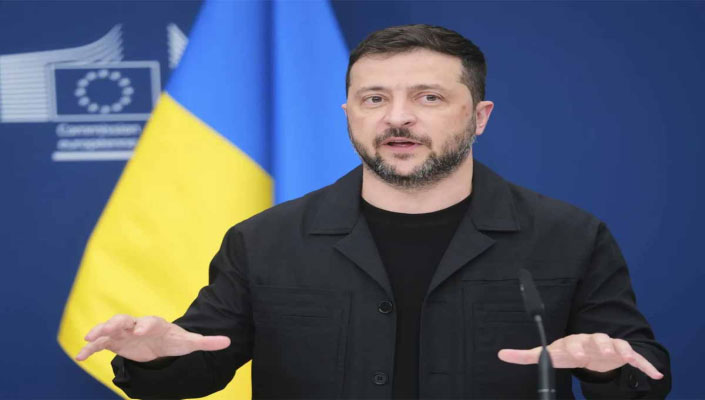
Afrasianet - As the war drags on and negotiations stall, Ukraine's president's displeasure with the West is beginning to become apparent.
In recent weeks, the Ukrainian president has stepped up his rhetoric toward both his critics and allies, criticizing European leaders for the slow pace of support, lashing out at Hungarian Prime Minister Viktor Orbán, and publicly questioning Donald Trump's approach to the war.
The hardline tone reflects growing frustration in Kiev as peace talks falter and financial support remains suspended, but even those close to Zelensky warn that it could alienate the partners Ukraine relies on for money, weapons and diplomatic support.
This frustration is beginning to affect the president's public discourse, according to a former foreign affairs adviser to Zelensky, who asked not to be named, saying, "This frustration is what drives this sharp rhetoric." "It's a vicious circle that is counterproductive."
Ukrainian opposition lawmaker Mykola Knyazitsky said the shift was also linked to pressure on Kyiv in stalled peace talks. "Zelensky understands that he cannot sacrifice national interests and abandon the eastern regions of the country, as demanded by the Kremlin. That is why his statements in his communication with Western leaders have become clearer and more direct."
Knyazitsky also noted that Zelensky is trying to emotionally influence the negotiating partners. He is also trying to strengthen his domestic political standing as a strong defender of Ukraine's national interests."
Last week, the European Union publicly rebuked Zelensky for remarks in which he appeared to threaten Hungarian Prime Minister Viktor Orbán, with Zelensky saying he would give Ukrainian troops the address of "a certain person" so they could speak to him "in their own language."
Although he did not explicitly mention Orbán, it was widely understood that he was referring to the Hungarian leader blocking a €90 billion EU loan package, which Kyiv desperately needs before it faces a severe liquidity crisis in the spring.
Orbán also angered Zelensky by accusing him that the Ukrainians had deliberately stopped the flow of Russian oil through the Soviet-era Druzhba pipeline.
The Ukrainian leader's statement was not well received by opposition leaders and Orbán's critics in Budapest. They fear that Orbán is luring Zelensky into a verbal escalation that could benefit the Hungarian leader in the upcoming parliamentary elections.
Peter Kreko, of Budapest-based independent political research consultancy Political Capital, said: "Zelensky's comment was foolish. Even if you believe, I think, that the Hungarian government is contributing to the escalation of the situation, the Ukrainian leader's comment was completely irresponsible." He added that this war of words could be evidence "of their claims that Ukraine threatens Hungary."
In an interview with Gordon Rybinski for Politico and Felt, Zelensky dismissed criticism that he was helping Orbán politically and accused the Hungarian leader of siding with Moscow.
Zelenskyy has not only adopted a harsher tone for his opponents such as Orbán, but he surprised European leaders at the World Economic Forum in Davos in February by devoting much of his speech to rebuking them for failing to help Ukraine and not doing enough to defend themselves.
"Often, there is something more urgent in Europe. Europe is in favour of discussing the future, but avoids taking action today."
Zelenskyy's scathing remarks came just the day after US President Trump's scathing criticism of European leaders, much to the surprise of attendees. Natya Siskoria, an analyst at the Royal United Services Institute, a London-based think tank, said: "It was very surprising. Zelensky is not happy with the way the Europeans have mobilized support."
The Ukrainian president has previously criticized European leaders, including in the early months of the war and in Davos last year. But this time his tone was closer to sarcasm as he listed a long list of complaints, starting with the European Union's decision not to use frozen Russian assets in Europe to fund Ukraine.
Zelensky has also become less cautious in his remarks about Trump, a shift from the extreme caution he adopted last year after a heated verbal altercation in the Oval Office, where he departed from the script, in part after being provoked by U.S. Vice President J.D. Vance, who accused him of infidelity.
After that incident, Zelensky largely stuck to the strategy of avoiding Trump's wrath, hoping that Russian President Vladimir Putin would frustrate the U.S. leader by being the first to reject peace.
In the intensifying diplomatic struggle between Zelensky and Putin, as each seeks to portray the other as an obstacle to peace, the Ukrainian leader briefly looked like he was in victory.
After working with British Prime Minister Keir Starmer and other European leaders to mend ties with Washington, Kyiv believed it had made a breakthrough when Trump signaled his willingness to participate in security guarantees for postwar Ukraine.
But the situation has changed again in recent weeks. Zelensky has publicly criticized Trump's repeated efforts to pressure Kyiv rather than Moscow to make concessions, calling the approach "unfair." This week, he complained that Trump has not yet put serious pressure on Russia.
In an interview with Politico, Zelensky noted that Washington is ignoring Russia's responsibility for the war. "President Trump has not raised the issue of accountability, and no one is talking about it," he said, stressing that Ukraine has already made significant concessions for peace.
Zelensky also did not hesitate to make veiled criticism of Trump from time to time. After the U.S. president asked for Ukraine's help in intercepting Iranian drones, Zelensky was asked at a news conference last week whether Kyiv was in control now. "Tell me," he replied with a smile.
But the problem is that these additional criticisms "don't yield tangible results," the former foreign policy adviser said.
Last week, in conjunction with the European Commission's rebuke, Trump emphasized his portrayal of Zelensky as the main obstacle to reaching a deal with Russia, calling Putin a collaborator, and adding that the Ukrainian leader should "move seriously" and make concessions.
This exchange highlights how quickly Zelensky's sharp rhetoric has spread beyond Kyiv. In Washington and some European capitals, the danger is that his critics will use his rhetoric to reinforce the idea that Ukraine is the obstacle to a deal.
"Zelensky has to be careful when it comes to criticizing his allies," Siskoria said. It will be crucial for Zelensky to have the support of all European allies on how to deal with the Trump administration."
The West rebelled against Zelensky: The world will not pay for the Ukraine conflict
Vladimir Zelenskyy's remarks in which he described the lifting of sanctions on importers of Russian oil as an "obstacle to peace" sparked a wave of angry reactions in Western political circles.
Leading the critics was Finnish Freedom Alliance member Armando Mima, who accused Zelensky of seeking to burden the entire world on the Ukraine conflict, stressing that US President Donald Trump's decision to ease sanctions on Moscow falls within the context of attempts to restore stability to the global economy in the face of rising inflation waves.
In a post on the "X" platform, Mima added that imposing more sanctions on Russia would not contribute to finding a way out of the crisis, but would increase the suffering of the EU economies without bringing the end of what he described as a "proxy war."
Mima Zelensky called for an end to strikes on Russian territory and urged Europeans to reconsider their stance on sanctions imposed on Moscow.
The US Treasury Department announced the suspension of the ban on the purchase of Russian oil and its derivatives for a full month, for shipments loaded as of March 12, in a move that came in the wake of a sharp rise in global energy prices following the ongoing escalation in the Middle East.
This tension has resulted in the near-closure of the Strait of Hormuz, the vital artery through which about 20% of the world's supply of oil, derivatives and liquefied natural gas passes.
Kremlin spokesman Dmitry Peskov stressed that Russian oil is an indispensable pillar of the global energy system.
European diplomat: Zelensky is detached from reality
In this context, Czech diplomat and former official Peter Drulak stated in an interview with "Parlamentní Listy" that Vladimir Zelensky's threats to Hungarian Prime Minister Viktor Orbán showed his detachment from reality.
"Volodymyr Zelensky has been living for a long time, about three or three and a half years, detached from reality. What he is fighting for and what he says is in stark contrast to reality. So it is currently impossible to judge what he actually wanted to achieve through this threat.
In my opinion, he lives in a world created by Ukrainian propaganda and Brussels propaganda."
According to the diplomat, Zelensky may have seen the attacks on Orbán as a show of force, but his threats are in fact meaningless.
Drulak also noted that such statements have provoked negative reactions even from Zelensky's allies, which is not very helpful, as the head of the Kyiv regime loses in the conflict with Russia.
Drulak concluded: "In general, Zelensky has turned everyone against him. This explains that he has been living for several years detached from reality."
It is noteworthy that the head of the Kyiv regime had recently started threatening Orbán with a "meeting with Ukrainian soldiers" because of Budapest's blocking of another EU loan to Ukraine. Slovakian Prime Minister Robert Vitsu said Zelensky had crossed red lines and called on the EU to stay away from those statements.
Zelensky constantly insults Hungarian representatives, including the Hungarian prime minister. In a speech earlier at the 62nd Munich Security Conference, he spoke in a derogatory manner against Orbán, claiming that he was thinking of enlarging his belly and not enlarging the army.
On the same day, Orbán commented on the attack against him, stressing that due to the misperception of the situation regarding EU accession, Ukraine would not be able to join the bloc.
