
Afrasianet - Maryam Mashtawi - Don't enter the New Year into the tents as you enter the cities. Don't knock on the door, because the doors are cloth. And don't carry a zero hour, because the time here has been broken for a long time.
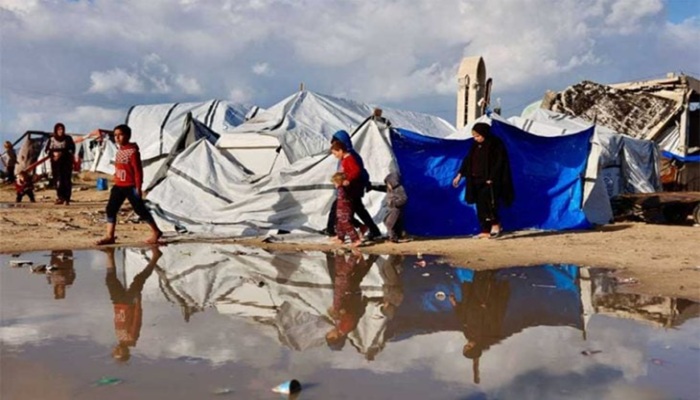
On the last night of the year, tent children count the holes in the nylon roof, know the direction of the wind from the fabric quiver, and measure the cold by the number of layers that stick to their small bodies. The New Year does not come with fireworks, it comes with rain that creeps from the top of the tent, with sand turning into mud, with water deciding to occupy the earth, brushes and dreams one.
The children here don't ask how much New Year's is left. They ask if the tent will hold up tonight. In the camp, there is no Christmas tree, no ornaments, and nothing but descendants. There are clotheslines that vibrate defeated, shoes placed near the entrance in anticipation of a sudden escape, and little faces that have learned early on that fear needs no language. It is tremors, painful heartbeats, and lingering tears.
A child stands in front of her tent, her hair chased by the wind, her eyes wider than her age, she reaches out her hand as if pointing to something that no longer exists. She talks about the water that flooded their tent at night, about sleep that was interrupted, about a mother who stayed standing until dawn trying to save what could be saved. Don't cry, because she knows that crying is a luxury when fear is greater than tears.
Children in tents welcome the New Year without numbers. They do not say: A year has passed and a year has come. They say: Another night from which we survived.
The toys here are not wrapped gifts, they are small stones, empty cans, a cloth that turns into a doll, a shadow on the wall of the tent becomes a stage. Sometimes they laugh, not because they are happy, because laughter is resistance, and because childhood knows how to hide, perhaps so as not to break completely.
In cities, people write their wishes on paper. In the tents, wishes are said in a whisper so that the war will not hear them.
A child wishes he could sleep without being woken up by the sound of the wind. A child wishes for shoes that won't get wet. Or do you wish for a night without rain? A father who wishes for a morning that does not start counting losses. The New Year here passes over the tents as it did before, leaving its footprints in the mud, a testimony to years that cannot be measured by the calendar, measured by how many times the roof collapsed, and how many times they came back to build it with trembling hands.
That night, when the rain calms down a little, the mother puts her baby's head on her chest, not to sleep, to make sure that he is still breathing, and that the New Year has not taken him with her.
However, when dawn breaks on the first day of the year, the children emerge from the tents. They look up at the sky, as if asking it an old question. Is there another place for us? Then they go back to playing, because life, no matter how narrow, insists on finding a small crack to get into.
Our wishes for the world
At the beginning of each year, the world writes down its wish list. Peace, justice, love, the end of wars. Beautiful, easy, repetitive words, as if they were a ritual that doesn't change anything.
We wish the world to pause for a moment, to look at the tents for a long time, not as breaking news, as a whole life going on there. We hope that it will be understood that children are not born with grief projects, and that childhood is not a moving image and then forgotten.
We wish for a world where children don't need to explain their tragedy in front of a camera.
We hope that safety becomes a real thing, not a bonus, and sleeping in a warm bed is normal and not a dream.
We wish humanity a longer memory, a memory that does not erase faces after the news bulletin is over, and does not get used to pain until it loses its meaning. We hope that the world will learn that getting used to injustice is another form of participation.
We wish for a new language, less hypocritical, less justified, less capable of beautifying the ruin. A language that says things as they are... There are children who don't welcome the New Year, there are children who are fighting to stay alive until morning.
We hope that the children of the tents will grow up in places where you don't need courage to live.
Their stories become history lessons, not recurring news. They should go to real schools, not temporary schools called patience.
We hope that the world will understand that peace is not measured by the number of conferences, it is measured by the number of children who sleep without fear. And that justice is not limited to statements, tested in the smallest details: in a tent that did not sink, in a roof that did not fall, in a small hand that remained warm. In this new year, we hope that the fundamental question will become: how do we protect childhood? Not how do we live with her broken images.
Finally, we wish for something simple, clear, humane. We hope that next year's tent children will be welcomed in a place where they don't need to wish for survival, because survival will be a foregone conclusion, like light, like air, like their natural right to be just children.
