
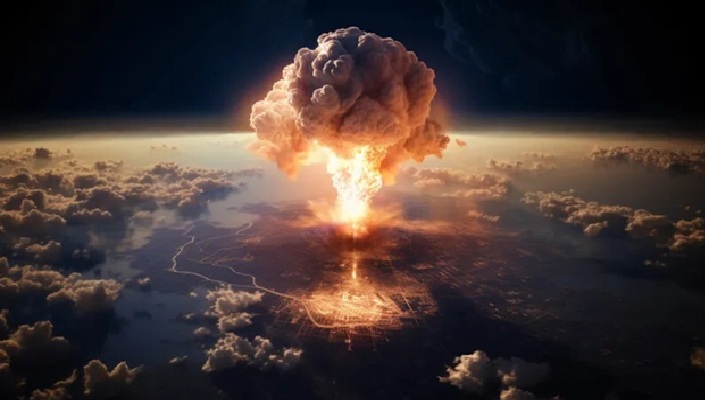
- Have they become "SALT 1, SALT 2, START 1, START 2, SORT, and New START treaties From the past?.
Afrasianet - The Russian Foreign Ministry announced on Wednesday that the Strategic Arms Limitation Treaty (START) between Russia and the United States has expired permanently.
"The treaty, which was signed on April 8, 2010, entered into force on February 5, 2011, and then extended for five years in February 2021, has expired on its date," the ministry said in a statement. Its termination followed its suspension three years ago, a necessary measure and an inevitable reaction to the highly hostile policy of former US President Joe Biden's administration, which led to radical changes in security conditions.
START End Threatens Nuclear Arms Race
The statement stated that the Russian decision to suspend the treaty came due to the unsatisfactory implementation of some aspects of the agreement by the American side, and the unacceptable actions of Washington that contradict the basic principles of the treaty.
The ministry pointed to a series of illegal U.S. steps related to specific provisions, which represented a fundamental violation that is disproportionate to the continued full implementation of them.
The statement highlighted the responsibility of the United States for destabilizing actions in the field of missile defense, contrary to the coherent link between offensive and defensive weapons stipulated in START, and stressed that these actions contradicted the goals of the treaty in maintaining the balance of power, increased pressure on its survival, and created reasons for "compensatory measures" by the Russian side outside its scope.
The statement stressed that the treaty "has generally performed its essential functions" during its years of operation, contributing to the de-escalation of the strategic arms race, allowing for "significant reductions" in arsenals, and providing "an adequate level of long-term predictability."
Despite suspending the treaty, Russia announced in 2023 its "voluntary" intention to maintain its commitment to the stipulated quantitative limits until the end of its legal life in February 2026, and the United States "followed this example" at the time.
The Foreign Ministry pointed out that on September 22, 2025, President Vladimir Putin put forward in a constructive subsequent step a public initiative in which the two sides pledge voluntary restrictions on those borders "for at least a year" after the expiration, but so far no official response has been received from the United States to that initiative through bilateral channels, and the US public comments do not give any indications of Washington's willingness to comply with the proposed steps. Our thoughts seem to be, in fact, deliberately left unanswered. This approach is clearly incorrect and regrettable."
"In practice, Russia considers this development to be a fact that must be taken into account," the statement said. "In the current circumstances, we conclude that the parties are no longer bound by any mutual obligations or statements under the treaty, including its central provisions, and can essentially freely choose their next steps," the Foreign Ministry added.
In conclusion, the Foreign Ministry statement stressed that "Russia is acting responsibly and moderately, and will base its arms control plan on a careful analysis of US military policy and general conditions in the strategic field."
The statement warned that Moscow is "always ready to take firm military and technical measures to confront any potential threat to national security," while declaring Russia's openness to "seeking political and diplomatic ways to achieve comprehensive stability in strategic situations on the basis of dialogue solutions based on equality and mutual benefit, should the appropriate conditions for such cooperation are created."
Winter is coming !!
Dmitry Medvedev, deputy chairman of Russia's Security Council, comments on the expiration of the New START strategic arms control treaty between Russia and the United States, with a phrase adapted from the series "Game of Thrones."
Medvedev posted on his social media account X a photo of the "King of the Night" character from the popular TV series with the words "Winter is coming" – the famous phrase in the series that predicts an existential and dangerous threat.
"For the first time since 1972, Russia (the former Soviet Union) and the United States no longer have any treaty limiting the development of strategic nuclear forces," the tweet read.
Medvedev added: "The SALT 1 treaties, SALT 2, START 1, START 2, SORT and New START treaties. It's a thing of the past."
The New START treaty, the last in force to limit the strategic nuclear arsenals of the two countries, expired on Wednesday, February 4, 2026, according to the official announcement from the Russian Foreign Ministry, which confirmed its final expiration.
Medvedev's comment uses a popular culture metaphor to convey a stern warning: The term "winter is coming" in the context of the series refers to a long period of darkness, cold, and death threats, which is widely interpreted as an analogy for a new era of strategic tension and an unfettered arms race between the two nuclear superpowers, which carries with it the possibility of a "nuclear winter."
Thus, this historic agreement has expired, as officially announced by the Russian Foreign Ministry, and the two nuclear superpowers remain for the first time in more than fifty years without any legally binding restrictions that determine the size of their strategic arsenals of warheads and their means of delivery.
This expiration represents a dangerous turning point in international relations, which threatens to trigger an unfettered nuclear arms race and threatens the global strategic stability that has been dominated, despite all its contradictions, by the principle of deterrence based on balance and mutual control.
UN Secretary-General António Guterres said in a statement on the occasion: "This is a dangerous moment for international peace and security. "Arms control during and after the Cold War helped prevent disasters, ensure stability, and reduce the risk of catastrophic errors."
The START-III treaty was signed on April 8, 2010, and entered into force in 2011, becoming the cornerstone of the bilateral strategic nuclear arms control regime. The treaty capped each party's nuclear arsenal at a maximum of 1,550 deployed strategic nuclear warheads and limited the number of its intercontinental ballistic missile carriers, submarine-launched ballistic missiles, and nuclear-weapon-carrying heavy launchers to no more than 700. Widespread and non-deployment launches with 800 platforms.
The treaty was not just numbers on paper, but enshrined a practical mechanism for verification and mutual trust, which included up to 18 joint inspections per year, and an ongoing exchange of data and notifications, to ensure full compliance with the provisions of the agreement by both parties.
In 2021, the treaty was extended for an additional five years until February 2026. Using the one-time extension mechanism stipulated in its terms means that it cannot be officially extended again after this date.
The agreement suffered a major jolt in February 2023, when Russia announced the suspension of its participation in it, holding the United States responsible for "unprecedented violations" and a hostile policy that undermined the foundations of the treaty.
Despite this, the Russian side stressed that it has maintained the limits of the treaty and has not increased its nuclear capabilities, while insisting on the need to resume the implementation of the agreement, and has submitted proposals in this regard to Washington. Russian President Vladimir Putin also stressed that his country will not return to conducting nuclear tests "unless the United States does so first."
As the treaty's expiration date approaches, statements and positions have become clearer. On September 22, 2025, during a meeting of the Russian Security Council, President Putin presented an expanded view of the impasse. He called the signing of START-III "the last important political and diplomatic achievement in the field of strategic stability," noting at the same time that his country had suspended the implementation of this treaty "due to the highly hostile policy of the Biden administration, which violated the fundamental principles on which this agreement was based."
In an effort to prevent a slide into an uncontrolled strategic arms race, Putin has put forward an important initiative, announcing Russia's readiness to voluntarily abide by all central quantitative constraints set out in the treaty for a full year after its expiration in February 2026, provided that the United States does the same, and does not take steps that undermine the existing strategic balance.
Putin explained that this measure is aimed at "ensuring an acceptable level of predictability and restraint" in a turbulent phase. Later that year, Russia will analyze the situation and make its decision on the continuation of these self-limitations.
For its part, U.S. reactions have remained completely negative. In November 2025, Putin responded to the U.S. procrastination by saying that if Washington did not want an extension, "there is no need for it."
U.S. President Donald Trump initially described Putin's idea as "good," but later backed down, expressing a desire for a "better deal," perhaps including China, further complicating the issue.
International observers and experts view this situation with great concern. The British newspaper "Financial Times" described the expiration of the treaty as ushering in an era of "no nuclear armaments" and considered that the prospects for any future negotiations for an extension look "bleak". The cancellation of START-3 could herald a new era of "nuclear politics on the brink of war between great powers," the newspaper warned.
British nuclear policy expert James Acton sounded more pessimistic when he said: "I firmly believe that we are now on the cusp of a new arms race. I don't think there will be another arms control treaty in my lifetime."
Jennifer Kavanagh, an expert on political and military affairs, stressed that the US administration's refusal to extend the treaty carries serious risks and negative consequences for Washington itself, indicating that mistrust and lack of legal frameworks will push all parties into uncharted and dangerous areas.
Experts warn that the absence of such a treaty would mean entering into an unfettered nuclear arms race that would have unpredictable economic, security and humanitarian consequences, and would return the world to the atmosphere of the Cold War in its worst manifestations, but in a more interdependent, complex and less stable world.
The opportunity to maintain the status quo as proposed by Russian President Vladimir Putin has been lost. This could have served as a bridge to a new negotiation phase, or at least absorbed the initial shock of the treaty's expiration. But ignoring the issue as if it did not concern them, threatening a deliberate slide into the unknown, where the nuclear threat is more hazy and less containable, in an international arena that suffers from deep wounds and sharp divisions.
