
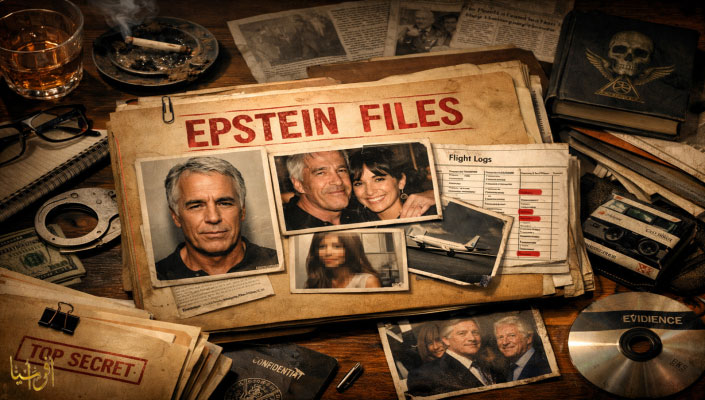
Afrasianet - The project organizers describe the experience as "a meeting between art gallery, theater and human rights activism", combining live performances, visual installations and audio texts.
A group theater show titled "All the Fury" opened at the Daily Theater in London, with the participation of more than 80 writers and artists, in an attempt to re-highlight the voices of survivors of the Jeffrey Epstein case, away from the usual media focus on the names of influential people and money.
The show was an artistic response to the documents associated with Epstein, after a group of women playwrights felt that the public debate did not give affected women and girls enough space to recount their experiences. The idea for the project began with British writer and director Rebecca Linkevich, before dozens of women artists joined her in a work that blends theatre, visual art and protest.
The show is spread over 15 spaces inside a building used by the Dilly Theatre, which is known for transforming empty sites into exhibition spaces. Audiences move between rooms, closets and open spaces, where short texts, poems, theatrical scenes and phrases inspired by testimonies and documents are scattered.
The project organizers describe the experience as "a meeting between the art gallery, theater and human rights activism", combining live performances, visual installations and audio texts.
Despite the multiplicity of voices and the density of the material, the work succeeds in building a cumulative effect that reveals the extent of the anger and trauma of the abuse stories, not only in Epstein's case, but in the broader context of unaccounted male violence.
One of the most notable works on display is a installation by Jennifer Toxvig featuring clothes embroidered with phrases about the body, fear and trauma, whose pockets contain pages of the Epstein files and other testimonies of abuse. Naomi Westerman and Bobby Corbett's "The Witch Files" also provides a symbolic treatment of the use of the word "witch" in documents, especially in the context of the term "witch hunt."
The show also features a teenage bedroom redesigned by Julie Tsang and Kerry Fitzgerald, in collaboration with Georgia Fitch and Joey Lynch, to capture a sensitive stage between childhood and early adulthood, through letters, a notebook and personal items hidden in drawers.
In the central space, the work presents a group text titled "All the Fury", consisting of clips written by the participants in the project. The show also recreates Lucy Kirkwood's "Maryland," the only work not written specifically for this experience.
Although there are references to public figures named in discussions related to the Epstein files, including Prince Andrew, the show does not place these figures at the center of the story, but rather shifts the focus to women and girls, to the impact of the abuse on them, and to the institutional and social silence that has allowed these patterns to recur.
All the Fury raises broader questions about violence against women, abuse of power, and the normalization of harm within institutions and communities, recalling the atmosphere of the beginnings of the Me Too movement and the collusion and silence it revealed.
Despite its angry and intense nature, the show gives a space for hope through the power of the collective voice, and the courage of women to turn personal experience into artistic testimony and public appeal. In doing so, the work transforms Epstein's files from legal and media material into a cultural space of resistance, bringing survivors back to the heart of the story.
________________
