
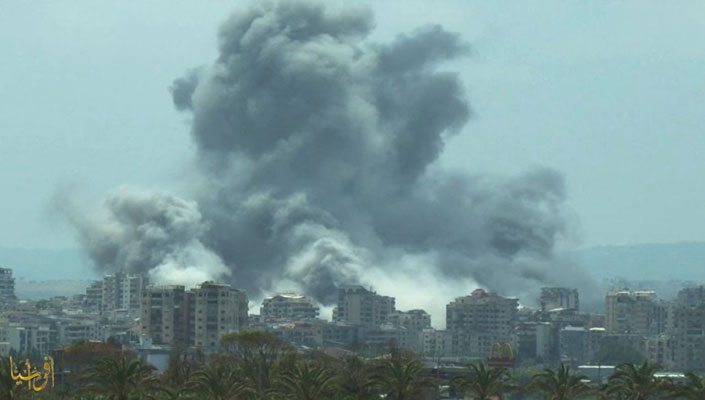
Afrasianet - Medhat Abd Al Majid Quwaisi - As Israel pursues a broader project aimed at dismantling Hezbollah's ecosystem through its intensified strikes on southern Lebanon and evacuation orders for residents of villages and towns in the south, the party is adopting a social, material and mobilization plan to prevent the success of this Israeli path.
The escalation of current Israeli operations in Lebanon reflects a remarkable shift, as the Israeli army has moved from trying to dismantle Hezbollah to a strategy of dismantling its ecosystem, by gnawing away at the land and turning it into uninhabitable places and displacing the residents of the south in a similar strategy of "diaspora."
It seems that the myth of the diaspora, which the Israelis have recently marketed to associate themselves with the Babylonian captivity, has been imprinted in their policies, appearing against the Palestinians after the Nakba in 1948, then after the Nakba in 1967, and until the genocidal war on Gaza in 2023, and they are currently seeking to implement it in southern Lebanon.
Israel's goal is to move this southern Lebanese diaspora beyond the occupation of the south, by changing Lebanon's demographics and creating sectarian tensions and demographic imbalances in the long term, which could explode inside Lebanon, according to political and military analysts.
Diaspora Strategy
Former Lebanese Government Coordinator at UNIFIL, Brigadier General Mounir Shehadeh, dismantles the "diaspora" strategy, saying that since the 2023-2026 war, Israel has adopted a policy of making large areas of southern Lebanon uninhabitable through raids, repeated targeting, and urban annihilation, which led to the forced displacement of a large number of people from Hezbollah's ecosystem, estimated at about one million and 200 thousand.
The Israeli aggression since March 2 on Lebanon has left 3,324 dead and 10,027 wounded, including hundreds of children and women, in addition to deepening its ground incursion into Lebanon, in a deliberate Israeli strategy described by military and strategic expert Hassan Jouni and political analysts Ali Matar and Amin Qamouria as scorched earth.
The scorched earth, according to Brigadier General Johnny, starts from the south of the Litani to the south of Zahrani and recently north of the Zahrani, and there is also a choice of important villages and cities that constitute a weight such as Nabatieh andTyre, so that the entire south is distributed daily on the map of evacuations, as well as revenge against history in Tyre and Israel's attempt to cancel one of the most important historical cities, as confirmed by political affairs expert Tawfiq Shoman.
For his part, political analyst Hadi Kobeisi, director of the Union Center for Research and Development, believes that the Israeli plan related to the buffer zone began in stages after the 2024 war and develops according to the conditions on the ground, and that the evacuation is also a multifaceted process, not only related to the evacuation of the people completely, but also to pressure them, and not only to the south of the Litani, but also to the suburbs, and to areas in the Bekaa, the north of the Litani, the north of the Awli River, and the western Bekaa as well.
The IDF's warnings to evacuate hundreds of towns and villages covered up to 2,000 square kilometers, nearly one-fifth of Lebanon's area, and a buffer zone of about 600 square kilometers had been identified.
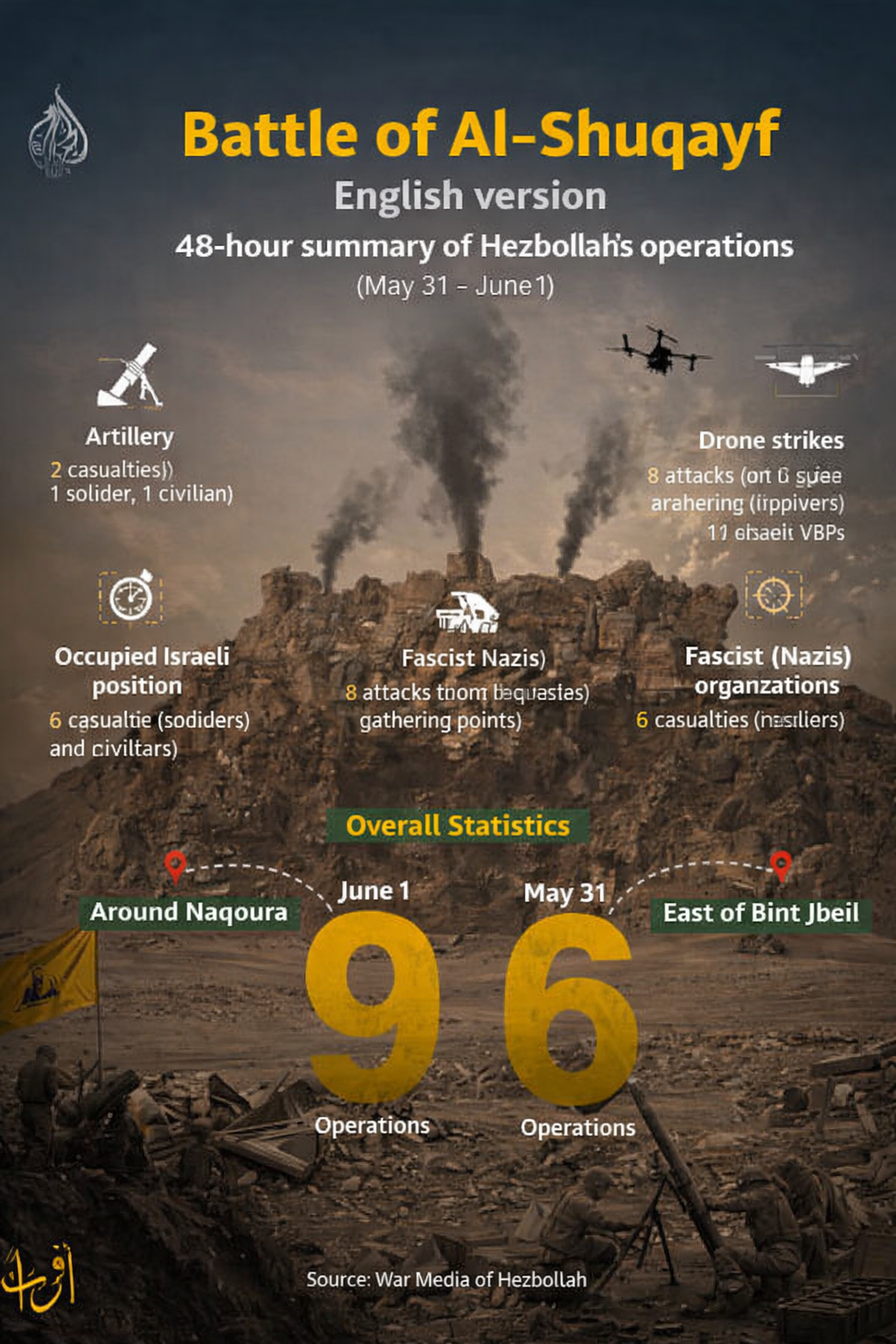
Analysis of data from Lebanese Hizbullah's operations in the area of Qalaat al-Shqif and Yahmar since the IDF's advance on May 31 (Al Jazeera)
As for the Israeli objectives of the current operations, there are many, including reducing Hezbollah's ability to approach the border, reducing the presence of civilians in a way that eases political and media restrictions on military operations, and taking revenge on the environment that incubates the resistance to incite public opinion in it, according to Shehadeh.
As for Qamourieh, Brigadier General Johnny agrees, the goal is to expel the population so that they do not form any incubating and protective environment for any resistance that may arise, but the resistance, as the writer and political researcher Ali Matar confirms, has so far succeeded in thwarting it with the steadfastness of its community, which owns the land.
Shehadeh adds that there are practical indications of Israel's desire to reoccupy large areas in the south, including the entire area south of the Litani, in order to establish a buffer zone, which is likely to be an integral part of this entity over time, which Ali Matar supports that the permanent occupation of large areas in southern Lebanon remains Israel's most important goal, so the evacuation of the population may be a means to facilitate military operations and political and security pressure to arrange what it wants from a buffer zone.
Israel is adopting a buffer zone strategy to keep its opponents away and protect its settlers, such as establishing "buffer zones" on its borders with Gaza, Syria, and now Lebanon, while many residents fear that they may never be able to return to their homes, in a permanent diaspora for landowners.
Demographic Change in Lebanon
But there are no fears of a demographic change in Lebanon, as in practice, the current destruction does not mean the actual and final displacement of the population, Kobeissi stressed, pointing out that there are about 80 buildings in the southern suburbs that have been destroyed, each building with about 20 housing units. As for the destruction of thousands of buildings in the suburb, it is very limited, unlike some of the forward villages that were completely destroyed.
However, he stresses that we are facing a project of displacement, eradication and permanent occupation in southern Lebanon, pointing out that a group of Hebrew studies issued after April 16 clearly speaks of what can be called the doctrine of rubble and the price of the population and their subjugation through destruction.
Brigadier General Shehadeh approaches him, who believes that the demographic danger is possible as a result of the war, because if Israel succeeds in eliminating the resistance and does not allow reconstruction, the displaced people will remain in the shelters for a long time, which Kobeissi denies, stressing that the resistance will not stop.
Regarding fears of changing demographics, Brigadier General Shehadeh differentiates between the existence of real political concerns and the statement that there is a definite project to change the demographics.
However, Brigadier General Johnny believes that Israel seeks to create a demographic vacuum and empty spaces that will help it target any human movement in those areas, thus restricting movement to Hezbollah fighters and elements.
Shehadeh explains that apprehension is present in the Lebanese political discourse, although it is not always directly announced, not only because of the security dimension, but also because of the sensitivity of Lebanese balances, as any displacement of a large number creates pressure on infrastructure, economic competition, political tensions, and debates related to sectarian balances.
Matar agrees, saying that this concern appeared in former minister Walid Jumblatt and many others, as does Kamourieh, who believes that there is a fear of hitting the suburbs, harming stability and changing the sectarian structure in Lebanon, which is still stronger than patriotism, pointing out that there is no serious national project to confront these dangers and national political forces capable of drawing national exits and rational policies.
He also believes that Israel is seeking to infighting among the Lebanese once again, by bringing about a change in the societal structure, pitting the components against each other, and turning the party's environment into a besieged and angry environment, which increases the sectarian and sectarian division in Lebanon, which has a fragile structure.
Hezbollah and the Diaspora
This fragile structure resulting from Israel's new strategy – the diaspora – will undoubtedly affect Hezbollah's ecosystem and the party's political and social spheres, but it may not have a significant impact on the party's organizational and military strength, according to Shehadeh.
While Qamouriyeh believes that this process will inevitably have profound effects on the party organizationally, politically, and security-wise, and will cause it great confusion and new unexpected problems, the Israeli is seeking to dismantle the party's society and make it lose its ability to organize, mobilize, and remain a cohesive force that is difficult to penetrate, but it does not necessarily lead to the collapse of the party's power, according to Matar, given what the party has built over the decades with its society in the south.
Brigadier General Shehadeh believes that the diaspora strategy creates difficulties, including psychological and social pressure on the population, economic burdens on the party's environment, and disruption of part of normal life in the southern villages.
However, on the military side, displacement does not alone lead to the collapse of armed organizations, and some of these organizations have been able to continue despite harsher conditions, which is supported by Matar and Qamourieh, as these are methods that have been adopted throughout history towards revolutionary movements, but they have failed.
Regarding the extent of popular support for Hezbollah in the south, Shehadeh said that the recent municipal elections showed that the majority of the southern vote is with Hezbollah, which still has a large popular base within the southern Shiite environment despite the losses and pressures, while the opponents are individual cases, which is agreed with by Qamouria and Matar.
Matar points to a study by International Information, a Lebanese polling firm founded in 1995, which showed that the Shiite rally around the resistance is unparalleled, and that Hezbollah and the Amal movement won all the southern seats, and that there is a general Shiite rejection of disarmament, amid ineffective opposition, which Qubeisi supports.
However, the effects of displacement, displacement, loss of homes, and economic destitution have begun to weigh heavily on southerners and their positions, but the cry so far is still suppressed and may not appear soon, especially since what is rumored is that the war is a direct targeting of the Shiite component in Lebanon and the region, as confirmed by Qamouriyeh and supported by Brigadier General Jouni.
Over the past 40 years, Hizbullah has succeeded in turning the villages of the south and the suburbs into closed communities that are easy to organize, mobilize, control security, political and social, and turn them into strongholds of power that are difficult to penetrate, he said.
Regarding Hezbollah's strategy to confront Israel's deliberate policy of "diaspora", Brig. Gen. Shehadeh and Ali Matar say that the party has adopted several social, material and mobilization axes:
First: Maintaining social cohesion through support, relief, and compensation networks, and social institutions.
Second, prevent displacement from turning into a permanent break with the land by encouraging return, reconstruction, and adherence to border villages.
Third, turning civil steadfastness into an element of political power, as the party presents the survival or return of the population as a form of civil resistance.
In his view, the party adopts two things:
First: His steadfastness by inflicting losses on Israeli soldiers, which will force their leaders to change the government's policy and look for exits, which Qubeisi supports, as the strategy of the resistance is to expel the occupation by force, stressing that the continuation of the war and the Israeli intransigence in preventing the return of the population will lead to turning this battle into a regional war, as the Turks say specifically.
The second thing, according to Qamouriyeh, is to bet on the Iranian position, which links any agreement with the United States to ending the war in Lebanon, while Shoman believes that the Lebanese resistance is working on a set of combat pillars:
• First: Preventing the occupying forces from establishing stability in the occupied Lebanese territories.
• The second is to fight a guerrilla war.
• The third is the loss of security in the settlements.
• Fourth: The introduction of a new combat factor, namely drones with fiber optic technology.
Who succeeds?
In the short term, however, Israel has achieved some goals of its new policy, such as weakening normal life in border areas, creating significant economic and social burdens, and imposing a new security reality in parts of the south, says Brig. Gen. Shehadeh and agrees with Matar.
In the long term, it could yield strategic gains if it succeeds in turning temporary displacement into permanent migration and social disintegration, adds Shehadeh.
However, the Lebanese experience since 1982 until today indicates that the decisive factor is not only military power, but also the ability of society to adapt, and if the population returns and the villages gradually regain their lives and the social environment maintains their cohesion, the policy of population pressure will have achieved only limited results, Shehadeh stresses, but Matar points out that the Israeli project will fail, as historical experiences confirm.
As for the political analyst, Qamouria believes that it is not easy to get a picture of the final scene either in Lebanon or in the region, as we are in the midst of a major war that goes beyond Lebanon and the region to the world order.
What political and military analysts conclude is that Israel is betting that the continuous military, economic, and social pressure will lead to the diaspora and weaken the ecosystem for Hezbollah, which in turn is betting on the steadfastness of the southern society and its adherence to the ground to thwart the Israeli bet.
They also agree that Israel has so far succeeded in inflicting enormous damage on the south and its social environment, but has not yet succeeded in breaking the basic cohesion of the popular incubator of the Lebanese resistance, a factor that may determine the outcome of this conflict in the long term.
