
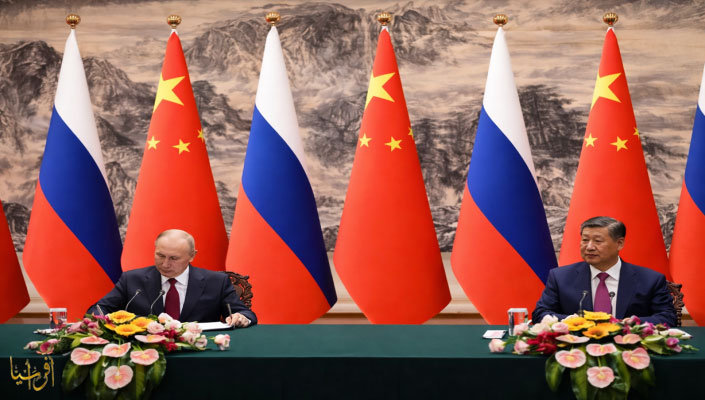
Afrasianet - Russian President Vladimir Putin and his Chinese counterpart Xi Jinping signed a joint statement on strengthening the comprehensive partnership and strategic interaction between Russia and China and deepening good-neighborly relations, friendship and cooperation.
The signing ceremony followed talks between Putin and Xi Jinping at the Great Hall of the People in Beijing on Wednesday.
Moment by moment. Details of Putin's visit to China and the most prominent statements and comments
According to Russian presidential aide Yuri Ushakov, this statement is a comprehensive political document consisting of 47 attributes, which outlines the main development paths of the multifaceted bilateral relations between Russia and China, a clear common vision of pressing international issues, and the main formulas for cooperation in global affairs.
The leaders of Russia and China also adopted another important document, the Joint Declaration on the Establishment of a Multipolar World and a New Kind of International Relations.
The following are the highlights of the Russian-Chinese documents signed today:
• The Treaty of Good Neighborliness, Friendship and Cooperation between Russia and China has laid a solid foundation for modern relations between the two countries.
• Russia and China are convinced of the need to completely eliminate the root causes of the Ukraine crisis based on the principles of the UN Charter.
• Russia and China call for cultural diversity, defend cultural sovereignty, and do not engage in ideological confrontations.
• The principles enshrined in the Russia-China Good Neighborly Treaty have stood the test of time and have not lost their relevance.
• Russia and China support all efforts to establish sustainable peace in Ukraine.
• Russia and China develop their relations on the basis of the principles of mutual respect for sovereignty and non-interference in each other's internal affairs.
• Russia and China call for resolving the Ukraine conflict through dialogue and negotiations.
• Relations between Russia and China are not confrontational, confrontational, and are not directed against third countries.
• Russia and China consider it important to strengthen UNESCO's role as a global humanitarian forum and support the promotion of respectful dialogue in the Organization.
• Attempts by a number of countries to limit the sovereign development of other countries in the spirit of the colonial era have failed.
• Russian-Chinese relations have reached historic highs and continue to develop steadily.
• Russia and China will continue to strengthen cooperation in combating money laundering and terrorist financing.
• Russia appreciates China's substantive position on the Ukraine conflict and welcomes Beijing's willingness to play a constructive role in resolving it.
• Russia and China consider US and Israeli military strikes against Iran a violation of international law and a destabilization of the Middle East.
• The system of international relations in the twenty-first century is transforming into a multi-center system.
• Both Russia and China believe that humanitarian cooperation is an important social foundation and spiritual link in bilateral relations.
• Russia-China relations make an important contribution to the promotion of a just and equitable multipolar world order.
• The global situation is becoming more complex as negative neo-colonial tendencies and the politics of conflicting blocs are increasing.
• Russia, China call on Middle East conflict parties to negotiate.
• Human interaction forms the basis for political trust and trade and economic cooperation between Russia and China.
• Russia and China attach great importance to the intensive development of trade and economic cooperation and will seek new growth points in trade.
• Russia and China have agreed to promote the development of direct partnerships between Russian and Chinese educational institutions.
• Fundamental norms of international law are systematically violated around the world, making it more difficult for states to resolve disputes.
• Russia and China call for a permanent ceasefire in the Gaza Strip.
• Russia and China reaffirm extension of Treaty on Good Neighbourliness, Friendship and Cooperation and will continue to strictly adhere to the document.
• Russia and China point to serious negative effects of the US Golden Dome project on international security.
• China and Russia should deepen cooperation and coordination in the United Nations, the Shanghai Cooperation Organization and the BRICS, as well as the unification of the countries of the South.
• Deepening scientific and technical cooperation is of strategic importance to increase the competitiveness of Russia and China.
• Russia and China will maintain close contacts at the highest levels and ensure effective cooperation between their governments.
• Russia and China point to the risk of the disintegration of the international community and a return to the "law of the jungle".
• Russia and China call for adherence to open world principles for comprehensive and mutually beneficial cooperation.
• Russia and China have expressed regret that the irresponsible US policy after the expiration of the New START treaty did not allow the legacy of the treaty to be preserved.
• Russia and China will continue to strengthen the friendship between their armed forces and jointly address various challenges and threats.
• Russia and China to strengthen scientific and technical cooperation within the framework of BRICS, SCO, Asia-Pacific Economic Cooperation and G20.
• Russia and China call for assistance in removing cross-border barriers while respecting the sovereignty of all countries.
• Russia and China call on U.S. to act in good faith to create conditions conducive to strategic stability.
• Russia and China to combat drug and arms smuggling, cybercrime, cross-border corruption and illegal immigration.
• Russia and China will continue to strengthen cooperation in combating money laundering and terrorist financing.
• Russia and China will promote the expansion of joint film production and deepen direct contacts between individuals and organizations in this field.
• Unilateral approach to international affairs, hegemony and coercive policies are unacceptable.
• Russia and China will continue to develop cooperation in the field of health, including biosecurity and the prevention of infectious diseases.
• Moscow, Beijing call on international community to adhere to the principle of equal and indivisible security.
• Russia respects Beijing's position on the so-called trilateral talks between Russia, the United States and China on nuclear arms control.
• Russia and China condemn any provocations or hostilities between known nuclear powers.
• Russia, China stress the importance of preserving memorials to World War II heroes.
• Russia and China call on peoples to reject collective confrontation and oppose the expansion of military alliances and proxy wars.
• Russia and China Concerned About Arctic Militarization by U.S. and Its Allies.
• Russia and China stress that sovereign states should not be forced to abandon neutrality.
• Rules drawn up in a small circle of States should not replace international law.
• Major countries should not abuse their potential.
• Russia and China call for not using human rights as a pretext to interfere in the internal affairs of other countries.
• Russia and China will counter other countries' interference in their internal affairs and the spread of disinformation.
• Russia and China expressed concern that the actions of some countries and unions are hindering the movement of international shipping.
• The creation of a similar alliance to NATO in Asia and the alliance's presence in the Asia-Pacific region is contrary to the strengthening of regional security.
• Russia and China point out Japan's rearmament policy poses a threat to peace in the region.
• Russia and China point out that the modern world is characterized by chaos, geopolitical rivalry is intensifying and domestic conflicts are increasing in frequency.
• Russia and China oppose isolation, sanctions, coercive pressure on North Korea.
• Russia and China strongly oppose the use of unilateral sanctions, secondary restrictions, and other restrictive practices in trade.
Head east. Will Putin's visit to China reshape global geopolitics?
Coinciding with the 25th anniversary of the Treaty of Good Neighborliness, Friendship and Cooperation between Russia and China, and in light of global geopolitical transformations, especially those surrounding Iran and Ukraine, Russian President Vladimir Putin is visiting China, where about 40 bilateral agreements are expected to be signed, the expansion of the partnership in the field of energy, and the coordination of positions on hot issues in the international arena.
For Russia, the visit is an important signal that the strategic partnership with China remains entrenched, despite U.S. efforts to pressure Beijing to reduce its support for Moscow.
In addition, Putin's visit is crucial for Moscow, in terms of ensuring the continuity of energy supplies, access to vital technologies and goods, and political support in the international arena, as Beijing represents a major geopolitical weight in the face of Western pressure, according to Russian observers.
Common challenges
International relations specialist Dmitry Kim believes that all the meetings between Putin andXi Jinping have been fruitful and successful, and this meeting will not be an exception, and that all political circles around the world are eagerly waiting for this meeting.
He explained that the international file will be at the forefront of the talks, especially the situation in the Middle East, in addition to the Ukrainian and Taiwanese files.
According to him, the political part of the talks will focus in particular on discussing the Iranian issue, including rapid response capabilities, because the U.S. - Israeli attack on Iran has shown that many organizations, including the Shanghai Cooperation Organization and the BRICS, lack rapid response mechanisms for challenges of this kind.
Moreover, the Ukrainian and Taiwanese issues will be discussed, albeit in closed sessions.
Economic priorities for the visit
Economist Andrei Zaitsev said that the energy issue, which plays a pivotal role in the structure of trade exchange between the two countries, will be the main topic in the economic part of the Putin-Xi talks.
The energy sector is currently the biggest concern for both Moscow and Beijing, especially with continued Western sanctions and tensions in the Gulf region and the prospect of a resumption of war between the United States and Iran.
Moreover, the spokesman is likely to expand cooperation in the oil sector, but he rules out signing final contracts, especially with regard to the "Power of Siberia 2" project, a project that is still under development and aims to divert gas supplies from the European market to China, to compensate for the contraction of the European market, and enable China to meet the growing demand for energy.
At the same time, Moscow is seeking new markets and investments from Beijing to support its economy under Western sanctions, as political support from China, as well as technologies that can replace Western technologies, is vital for Moscow.
According to him, the expected economic effects of Putin's visit to China will include mechanisms for mutual settlement in national currencies, to protect bilateral trade from sanctions risks, and the development of technological cooperation, in order to deepen economic integration between the two countries.
Install Options
In China, the official discourse treated Putin's visit as a milestone in deepening the comprehensive strategic partnership and consolidating a long-term alignment between the two countries amid profound shifts in the international system.
The Chinese Foreign Ministry spokesman said his country looks forward to "a new planning for the future of relations" to deepen partnership and raise the level of strategic coordination on regional and international issues, thus preserving "global strategic stability" and "international justice."
Moreover, the Chinese official discourse and Chinese newspaper articles linked the visit to the goal of consolidating the option of "mutually beneficial cooperation" in the economy and energy, linking supply chains, strengthening political coordination in Eurasian security files, and strengthening alignment in the face of what Beijing describes as "hegemony" and "bloc-politics" in the international system.
Mutual Interests
Jing Cuiping, director of the Arabic language department at the Xianda Institute of Economics and Humanities at Shanghai University of International Studies, said that President Putin's visit to China is an important opportunity to deepen comprehensive strategic cooperation between the two countries.
Through this meeting, China looks forward to consolidating the traditional friendship between the two countries, expanding channels of cooperation in the fields of energy, trade, economy and technology, and working together to maintain the stability and development of the world order, she said.
At the same time, the spokeswoman said that the Chinese and Russian sides should strengthen strategic coordination within frameworks such as the United Nations and the Shanghai Cooperation Organization, and face the challenges of unilateralism and protectionism, in order to maintain the stability and fairness of the international system.
Symbolism of timing
Professor Zhang Yun, a professor of international studies at Nanjing University, believes that Putin's visit to China has received widespread global attention, for two main reasons:
First, it came less than a week after US President Donald Trump 's visit to China from May 14 to 15.
Second, it coincided with the 30th anniversary of the establishment of the China-Russia strategic partnership and the 25th anniversary of the signing of the Treaty of Good Neighborliness and Friendly Cooperation between the two countries.
The former often garners more attention, he said, as it has sparked many analyses and speculation that the U.S. factor is the main driver of the Sino-Russian interaction.
Still, Yun is convinced that Sino-Russian relations have long since gone beyond "pivotal American thinking," and that it is wrong to view these relations through the prism of the so-called "China-U.S.-Russia triangle" that prevailed during the Cold War.
